

PREDICTIONS FOR THE GLOBAL ECONOMY IN 2023
The global economy is constantly in a state of change, and 2023 promises to be no exception. Are you ready for the newest forecasts and trends that will affect the global economy in the next year?
KEY TAKEAWAYS
- The global economy is predicted to develop steadily in 2023, but inflation and trade tensions challenge expansion.
- Technology, healthcare, and energy are among the industries that are predicted to have substantial development and innovation in the next year.
- New technologies such as artificial intelligence and blockchain will continue influencing these industries, generating new opportunities for businesses and investors.
- Significant geopolitical developments such as Brexit and US-China tensions might have far-reaching consequences on these countries’ economies and economies.
- Businesses and investors need to be adaptive and agile in the face of these challenges and opportunities and should consider diversifying their portfolios and implementing innovative techniques to stay competitive.
- Despite the possible risks and challenges, there are still many opportunities for businesses and investors in 2023, especially in developing markets and innovative areas.
- To thrive in the global economy in 2023 and beyond, staying educated and up-to-date on the latest economic trends and projections and establishing a comprehensive plan that considers both opportunities and risks is necessary.
INTRODUCTION
From the impact of the COVID-19 pandemic to geopolitical tensions and continuing trade disputes, the global economy has been confronting various challenges in recent years. Therefore, understanding the present status of the global economy and the trends and forecasts expected to shape it is important as we look forward to 2023.
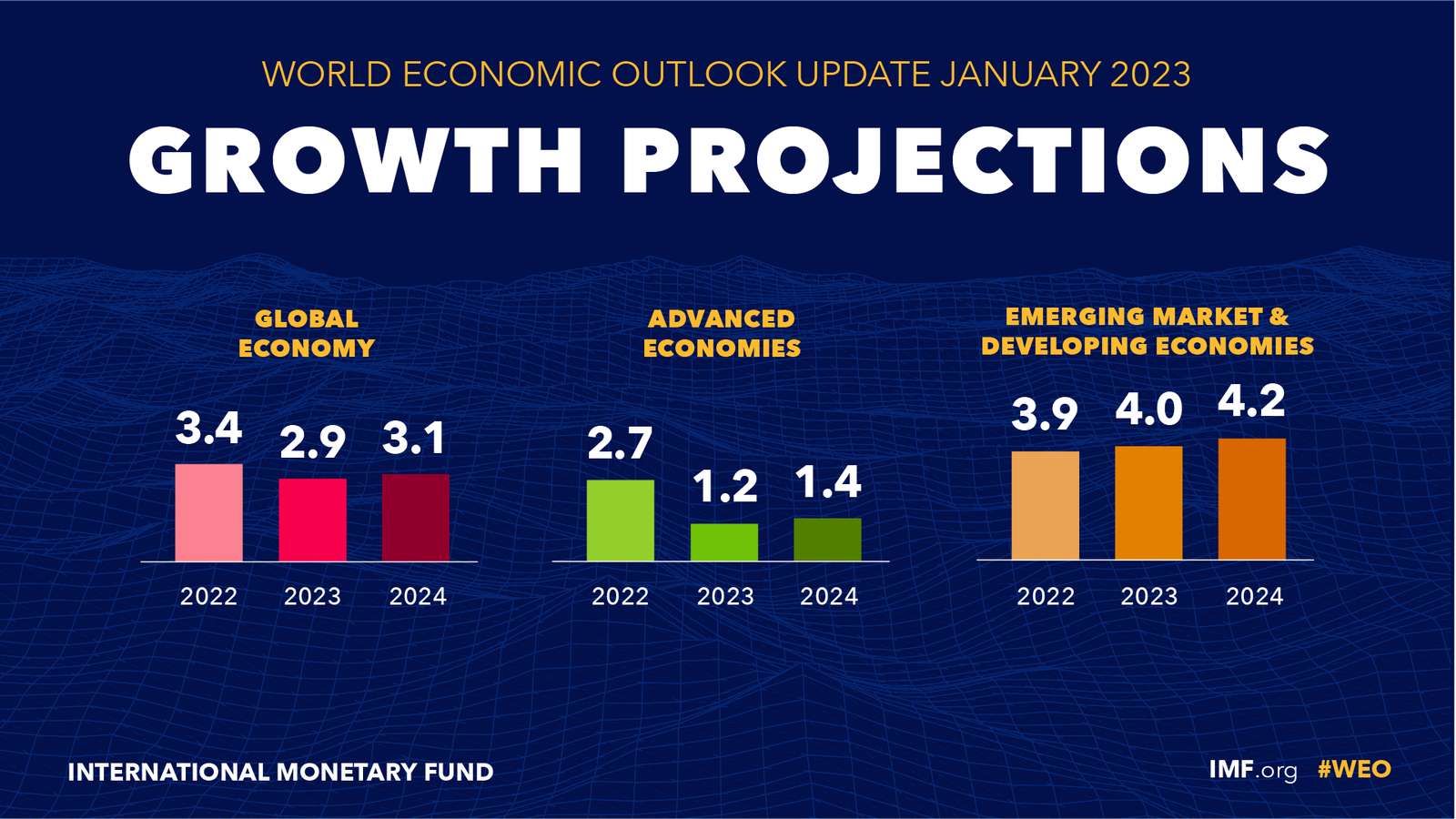
Now, the global economy is exhibiting indications of recovery from the pandemic-induced depression. As a result, the world economy is anticipated to expand by 4.9% in 2022 and 4.4% in 2023, compared to a decline of 3.3% in 2020, according to the International Monetary Fund (IMF). Although these estimates offer a reason for cautious optimism, it’s important to realize that they are vulnerable to various factors that might impact growth.
Inflation is one such factor that has caused alarm in many world regions in recent months—increases in the cost of goods and services harm consumer demand, hurting economic growth. Central banks worldwide are constantly watching inflation and trying to reduce it, but it remains a critical risk factor for the global economy in 2023.
Another possible impediment to economic growth in 2023 is persistent trade tensions and disputes. The COVID-19 pandemic has highlighted weaknesses in global supply chains and trade networks, and several governments are reevaluating their approach to international trade. These disputes may impact global growth.
Despite these challenges, some factors might still help economic growth in 2023. One such factor is technology innovation, fueling growth in various sectors, from healthcare to finance. In addition, developing and implementing emerging technologies like artificial intelligence, blockchain, and the Internet of Things provide new opportunities for businesses and investors worldwide.
To succeed in the global economy in 2023, education about the newest economic trends and forecasts is important. This includes staying up-to-date with news and analysis from credible sources and dealing with knowledgeable individuals who can assist you in navigating the tough global economy.

The global economy will face challenges and opportunities in 2023. Therefore, knowing the current status of the global economy and the trends and forecasts expected to shape it is vital for businesses and investors hoping to succeed in the future year.
GLOBAL ECONOMIC FORECAST FOR 2023
A significant year for the global economy is expected to be 2023. However, countries all over the globe are rapidly changing their economic situations as we enter the digital era owing to a variety of factors. This article will examine the global economic growth prediction for 2023, including the International Monetary Fund’s (IMF) projections and the important factors driving growth or hindering it.
The International Monetary Fund (IMF) is one of the leading international institutions providing projections for the global economy. According to the IMF’s Global Economic Outlook report, the global economy is predicted to increase by 4.9. Compared to the 3.3% growth rate, this is a significant rise.
The IMF’s Global Growth Projections for 2023 have many factors, including a rise in consumer spending, government expenditures in infrastructure, and a rebound in trade spending. Nevertheless, these projections can alter due to factors drastically affecting the global economy.
Inflation: Inflation is one of the primary factors that affect economic growth. High inflation rates may limit consumer spending, raise business borrowing costs, and lead to a drop in investments. In contrast, low inflation rates may boost economic growth, leading to higher consumer spending and business investment.
Global Trade Tensions: Global trade conflicts have been a significant barrier to economic growth in recent years. Tariffs and trade barriers may lead to lower international trade, severely affecting the global economy. Concerns have been raised that the continued trade tensions between the United States and China might slow global economic growth in 2023.
Technological Advancements: Technology developments have been a significant driving factor behind economic growth in recent years. With the rising usage of artificial intelligence (AI) and automation, businesses may enhance productivity and efficiency, leading to improved economic growth. Nevertheless, technological developments may also lead to employment losses and increased inequality.
Government Policies: Government policies may have a significant influence on economic growth. Policies such as tax cuts and greater government spending on infrastructure may encourage economic growth, whereas policies such as additional regulations and higher taxes can lead to diminished economic growth.
INDUSTRY-SPECIFIC TRENDS AND PREDICTIONS
The global economy is continually developing, and so are the numerous industries that make up its backbone. This part will examine some industry-specific trends and predictions for 2023.
Study of trends and predictions for several industries:
- Technology: The technology industry has been expanding for years, and 2023 is expected to be no different. With the increased demand for digital goods and services, technology businesses are set to see exponential growth. The industry is also expected to adopt emerging technologies such as artificial intelligence, blockchain, and IoT. These technologies will transform our lives and work, creating new opportunities for businesses to innovate and prosper.
- Healthcare: In 2023, the healthcare industry is also expected to rise significantly. The COVID-19 pandemic has underlined the need for improved healthcare systems and technologies, and worldwide is spending extensively in this field. The industry is also expected to witness the adoption of new t, technologies such as telemedicine, which will enable patients to get medical treatment remotely. Also, the industry is set to undergo growth in personalized medicine, which will deliver individualized treatment programs to patients based on their genetic composition.
- Energy: The energy industry is likewise experiencing considerable upheaval. Governments and businesses are both embracing sustainable practices as the transition to renewable energy gains speed. The growth of electric cars and renewable energy sources such as solar and wind power is expected to diminish the dependency on fossil fuels. Geopolitical tensions and supply chain disruptions are only two of the issues the industry is expected to confront.
In 2023, new technologies and innovations are set to be significant in several industries. For instance, AI is expected to completely alter how humans work, making businesses more effective and efficient. As a result, new employment opportunities and economic expansion will be brought about by technology.
In the healthcare industry, emerging technologies such as wearables, virtual reality, and telemedicine are set to improve patient outcomes, cut costs, and enhance access to medical treatment. These technologies will also enable healthcare practitioners to collect and evaluate patient data, resulting in more individualized treatment strategies.
Emerging technologies, such as renewable energy sources, energy storage, and smart grids, are also set to boost the energy industry. The generation and delivery of energy will be more sustainable and efficient thanks to these technologies.
In conclusion, diverse industries will be affected differently by the substantial changes that are set to occur in the global economy in 2023. The technology industry is set to undergo exponential expansion, while the healthcare industry is expected to witness the adoption of new technologies. As it transitions to sustainable energy sources, the energy industry is likewise experiencing tremendous changes. Adopting emerging technologies and innovations is set to transform numerous industries, creating new opportunities for businesses to innovate and develop.
GEOPOLITICAL FACTORS AND THEIR IMPACTS ON THE GLOBAL ECONOMY
In recent years, geopolitical events have affected the global economy in addition to economic reasons. As we look ahead to 2023, some significant geopolitical variables are expected to impact the global economy majorly.
- Brexit and Its Impact on Europe
One of the most significant geopolitical decent years has been Brexit, the United Kingdom’s decision to quit the European Union. Despite the UK’s official exit from the EU in 2020, talks between the two parties continue. When we look ahead to 2023, the continuing Brexit discussions will impact the global economy significantly.
One possible impact of Brexit is on the European Union’s economy. The United Kingdom was a major contributor to the EU’s budget, and its withdrawal might lead to significant changes in the EU’s finances. In addition, changes to trade agreements might significantly impact the economy of many EU member states since the UK is a major trading partner for many of them.
- Tensions Between the United States of America and China
The persistent tensions between the United States and China are another geopolitics that is expected to have a major impact on the global economy in 2023. The two countries have been involved in a trade war over the last several years, with each side slapping taxes on the other’s products.
The impact of these tensions is anticipated to continue to be seen in China; the tensions might lead to greater expenses for businesses operating in the US and China uncertainty. Moreover, the tensions might lead to changes in global supply chains as companies attempt to diversify their joint orders to decrease their exposure to the risks of the US-China trade war.
Two major geopolitical issues that are anticipated to have an impact on the global economy in 2023 are Brexit and US-China tensions. Other things to keep an eye on:
- The continued violence in the Middle East might lead to interruptions in the global oil supply and increased consumer costs.
- The continuous growth of populism in marriages might lead to changes in economic policy and increasing uncertainty for businesses.
- The prospect for further government oversight of the digital sector as nations seek to address concerns about data security and privacy.
Although geopolitical events may be a source of risk and uncertainty for businesses and investors, they can also bring opportunities. For example, businesses that can handle the complications of Brexit might gain from new trade possibilities. In addition, companies that can successfully adjust to shifting global supply networks may also benefit from a competitive edge.
In 2023, the global economy may provide possibilities for investors as well. For instance, the continued tensions between the United States and China may lead to a rise in demand for safer havens like gold and other commodities.
OPPORTUNITIES AND CHALLENGES FOR BUSINESSES AND INVESTORS
Businesses and investors are looking forward in anticipation of the potential challenges and applications that the global economy may provide. This post will examine the most important considerations for businesses and investors navigating the always-shifting economic environment.
Keeping up with global economic trends and projections is crucial for businesses and investors. By being up-to-date on the latest changes in the world economy, they may be better prepared to recognize potential opportunities and avoid dangers.
One of the key challenges that businesses and investors may encounter in 2023 is greater volatility in financiaThere is expected to be more market volatility as the world economy develops, which might make it difficult for investors to make sound judgments. However, businesses and investors may be better positioned to weather the storm if they can keep their sights on the long term and maintain a diverse portfolio.
Another potential risk for businesses and investors is the persistent effect of global trade disputes. During the last several years, we have witnessed increased protectionist measures and conflicts between key trade partners, which may cause uncertainty and volatility in global markets. However, businesses and investments can navigate these challenges and adapt to changing conditions, and may be able to identify new opportunities in rising markets and sectors.
In 2023, there are also several potential opportunities for businesses and investors. One of the largest opportunities is the continuous rise of the digital economy. As more and more people worldwide acquire access to the internet and mobile devices, we are expected to see continuous expansion in sectors such as e-commerce, digital payments, and online advertising.
The rising interest in sustainably able and socially responsible investing presents another significant potential. With consumers and investors increasingly focused on environmental, social, and governance (ESG) considerations, businesses can show a commitment to sustainability and social responsibility. As a result, they may be better positioned to attract money and customers.
Overall, there are potential opportunities and challenges for businesses in the year 2023. By remaining educated, having a long-term perspective, and adjusting to changing conditions, businesses and investors may position themselves for success in a continuously developing global economy.
CONCLUSION
As we go into 2023, the global economy is expected to continue on its road of recovery from the pandemic-induced recession of 2020. However, there are conflicting predictions for 2023, with some analysts projecting a speedy rebound and others predicting a slower growth path. In this article, we have studied some important trends and predictions for the global economy in 2023, emphasizing industry-specific trends, geopolitical factors, and opportunities and challenges for businesses and investors.
The continuous growth of developing economies, especially in Asia, is expected to affect the global economy in 2023. This is because of economic growth in driven factors like growing middle-class earnings and expanding spending. Another trend is the rising significance of sustainability and green technology. As a result, businesses and investors emphasize environmentally-friendly practices and strive to benefit from the growing demand for sustainable goods and services.
Geopolitical factors such as Brexit and US-China tensions also greatly influence the global economy in 2023. The continued trade disputes between the two economic heavyweights, in particular, might lead to a slowdown in global commerce and economic growth. In addition, the conclusion of Brexit discussions will also have enormous ramifications for the global economy, notably for the UK and the EU.
In terms of challenges, inflation and increasing interest rates are expected to offer substantial challenges for businesses and investors in 2023. Particularly in industries like real estate and banking, these factors may lead to business expenses businesses and poorer returns for investors.
Businesses and investors must be knowledgeable and adaptable to navigate the continuously developing global economy. This entails staying current with the latest economic trends, projections, and upcoming technology and breakthroughs that potentially influence their industries. It also entails being adaptable and open to reevaluating goals and tactics in light of new information or shifting market circumstances.
In general, the global economy in 2023 is expected to be marked by both challenges and opportunities. Naturally, there are hazards to be mindful of, but there are also numerous potential benefits for businesses and investors that can navigate the complicated economic environment. Moreover, by being knowledgeable and adaptable, these people and organizations may position themselves for success in the years ahead.

