

Europe serves as a gateway to post-COVID China for investors. The unevenness of China’s financial recovery and geopolitical worries has led investors to prefer investing in European firms with a focus on China over investing directly in Chinese companies this year.
China’s economy rebounded quicker than predicted in the first quarter of 2023 after it abandoned its strict zero-COVID policy late last year.
However, the improvement has been inconsistent. The services industry has benefited from pent-up consumer demand, while manufacturing has trailed behind. In addition, regulator crackdowns have been hard on the real estate and technology industries; financially strapped municipalities have little discretionary spending money, and young unemployment is significantly higher than the national average.
“Consumption is real; people are spending money. According to BNY Mellon’s senior EMEA market strategist Geoff Yu, “but there is not much beyond that.”
Now that COVID has passed, investors in China’s economy must look for more sophisticated trading opportunities.
“Rather than just saying ‘let’s go long China stock,’ we are exploring other avenues for expressing this (China recovery) theme in our portfolio. That trade is very straightforward, and there are a lot of unknowns,” said Wang Taosha, a portfolio manager at Fidelity.
“The old playbook, where Chinese recoveries were associated with a rebound in construction and housing, is not necessarily the case this time,” the author writes. “There is the geopolitical overhang and the previous rounds of domestic regulatory reforms that were applied to the tech and education sector.”
Wang is optimistic about China, but she plans to enter the market through the luxury sector because of the affluent people’s increased funds and pent-up demand for travel due to the epidemic.
Nearly 2% of the eurozone GDP is exposed to China, compared with little over 0.5% of the U.S. economy, and many potential winners are listed in Europe, as reported by Barclays.
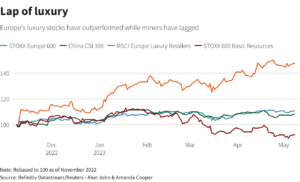
The STOXX 600 index for Europe (.STOXX) is up almost 10% this year, making it one of the best-performing major indices. A warmer winter, which reduced energy expenditures, has contributed to its highest level in 14 months.
The.CSI300 index of China’s A-shares has gained 5% this year. Moreover, since the beginning of November, roughly when China began reopening, a “Shadow China” basket compiled by Jefferies that comprises European businesses that draw over 10% of their sales from China has climbed 33%, surpassing MSCI’s index of developed European markets by 5.3%.
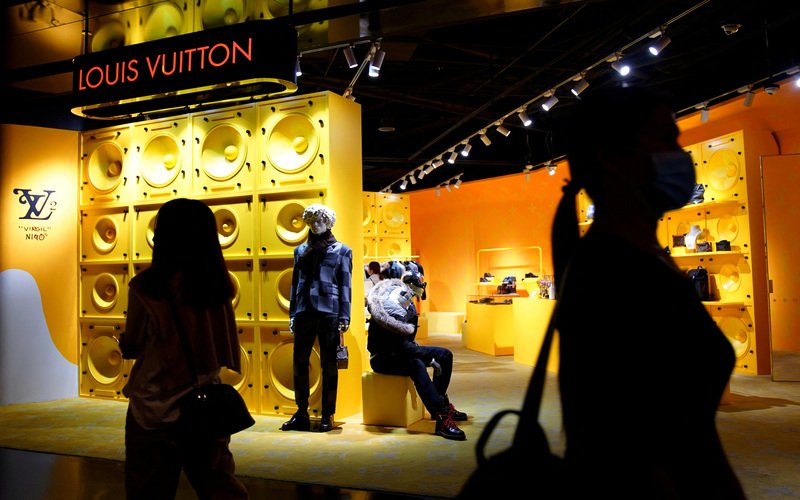
Management of LVMH (LVMH.PA), the first European firm to reach a market value of $500 billion, has cited China’s reopening as a key factor in the company’s recent success and future development plans, so it stands to gain.
“Given the higher risk premium of China stocks, the demand for’shadowing’ China will continue to be strong,” Jefferies said.
Politics and haggling over concessions
“One reason why people go for indirect exposure to China, so through the European market, is to manage the geopolitical risk,” Emmanuel Cau, head of European equities strategy at Barclays, said.
Going directly to China carries greater risk than going indirectly (via Europe), where you can access liquidity and enter and exit the market at will.
Worries have been compounded by China’s growing emphasis on data security, which has resulted in raids on consulting and due diligence companies’ offices and limited foreign clients’ ability to access corporate data.
The fact that European equities were inexpensive at the beginning of this year has also played a role.
Despite the company’s impressive performance, LVMH is selling at a steep 33 times earnings. James Cook, head of investment experts at Federated Hermes, has commented on the high valuations of mainland Chinese retailers that do not own the brands, noting that their stocks are trading at a multiple of 70.
We own Swatch, the Swiss watch manufacturer. That’s not just a novel approach to capitalize on China’s rising middle-class appetite for luxury goods; it’s also cheap.
According to Refinitiv statistics, Chinese blue chips have a price-to-earnings ratio of roughly 30, while the STOXX 600 has a ratio of only 13.5.
While “buy Europe” may seem like the obvious solution, it is not the case. Instead, luxury stocks, less affected by sanctions, have done well. At the same time, technology companies have been hit hard by geopolitical concerns, and commodities stocks have been hit hard by production issues.
Some companies that make consumer items have even struggled. For example, despite management’s assertions that the Chinese market is improving, Adidas’ first-quarter statistics, released last week, revealed the business was having trouble maintaining market share.
“You had to buy the right China exposure,” Cau of Barclays said. For example: “What is doing extremely well this year is luxury; if you’d bought European miners hoping that China would stimulate, you’d have gotten it wrong.”

