

Asia shares and bonds rally as Powell fuels optimism about ending rate hikes. As a noncommittal Federal Reserve chairman caused markets to double down on expectations that U.S. interest rates have peaked and cuts are imminent, Asian equities and Treasuries continued their worldwide rise on Thursday.
With FTSE futures up 0.5% and EURO STOXX 50 futures up 0.7%, Europe was also expected to start positively. The markets believe the Bank of England’s tightening cycle is finished, as it will meet later in the day.
Nasdaq futures increased by 0.4% and S&P 500 futures by 0.3%. Investors anticipate Apple’s (AAPL.O) earnings, a leading indicator of consumer demand and the tech industry. Later in the day, the Cupertino, California-based corporation is anticipated to disclose a 1% decline in quarterly sales.
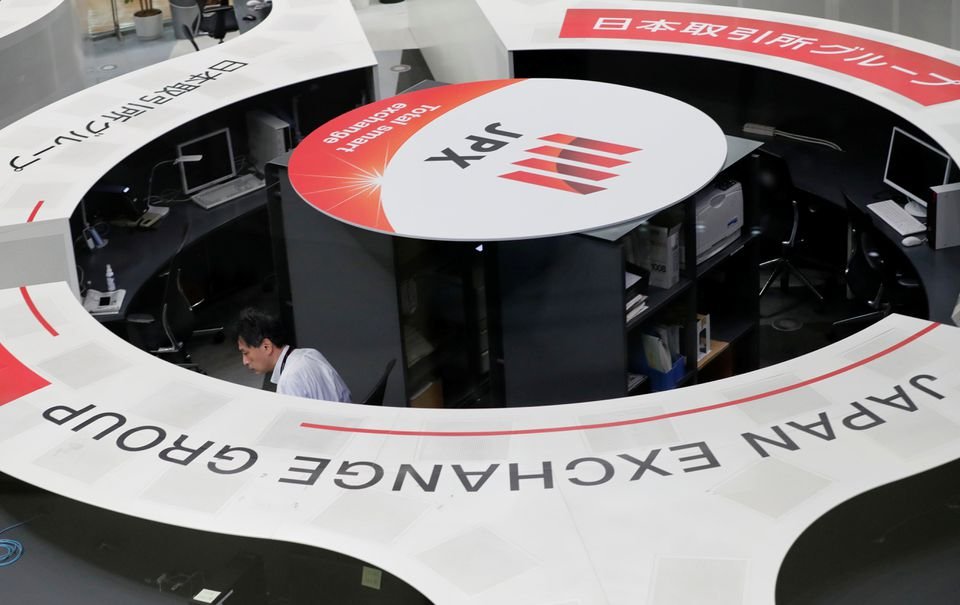
The most significant daily increase since late July occurred on MSCI’s broadest index of Asia-Pacific equities outside of Japan (.MIAPJ0000PUS), which increased 1.6%. Nikkei (.N225) in Tokyo increased by 1.1%.
Hong Kong’s Hang Seng index (.HSI) increased 0.9%, while China’s blue chips (.CSI300) fell 0.2%. The policy rate was left in its current range of 5.25% to 5.50% by the Fed overnight. Markets concluded that Chair Jerome Powell was not as aggressive as he could have been, even if he did not rule out another raise.
As markets reduced the likelihood of a December rise to about 20% and a January move to 25%, Fed funds futures increased in value. The markets have factored in a 70% probability that the tightening will end and that rate reductions of up to 85 basis points might occur as early as June of next year.
Treasury and Wall Street both surged. The Nasdaq Composite (.IXIC) increased 1.6%, while the S&P 500 (.SPX) gained 1%. The benchmark 10-year Treasury yield dropped to 4.7196%, the lowest level in almost two weeks, by another basis point. The Treasury’s statement that the government will restrict growth in the size of its longer-dated auctions contributed to the overnight decline of 14 basis points, the worst daily decline since March.
David Chao, global market strategist for Invesco’s Asia Pacific (pre-Japan) region, wrote in a note to clients, “We conclude that the Fed is probably done with rate hikes, even though Fed Chair Powell has clearly reserved the right to do so.”
“This gives Asian central banks—like the Philippines and Indonesia—more leeway to maintain interest rates rather than hike them,” stated Chao, who also expressed his expectation that foreign assets—particularly those in developing markets—would do better than U.S. assets.
The market’s next major focus will be on Friday’s non-farm payrolls report, which experts predict will show that employment growth in October was 180,000, down from 336,000 in September. It will follow conflicting figures indicating robust job vacancies and slower-than-anticipated growth in private payrolls.
Regarding currencies, the U.S. dollar was somewhat weaker due to the decline in Treasury rates, but the weaker Australian and New Zealand dollars saw a boost from the recovery in risk sentiment, rising by 0.5% and 0.7%, respectively, to multi-week highs.
Seema Shah, chief global strategist at Principal Asset Management, said that in a few months, the topic would be “When will they cut?” rather than “Will they hike again?” even if the FOMC may not be discussing it today.
The yen gained on Thursday, rising 0.3% to 150.42 per dollar. After the Bank of Japan decided to loosen its control over the 1% restriction on 10-year rates, it fell to a one-year low. However, many felt that this adjustment was insufficient to bridge the significant interest rate differences between Japan and other nations.
The price of oil increased. While U.S. West Texas Intermediate futures increased 1.1% to $81.32 a barrel, Brent crude futures increased 1.0% to $85.50. Gold was trading 0.2% higher at $1,985.99 an ounce.

