

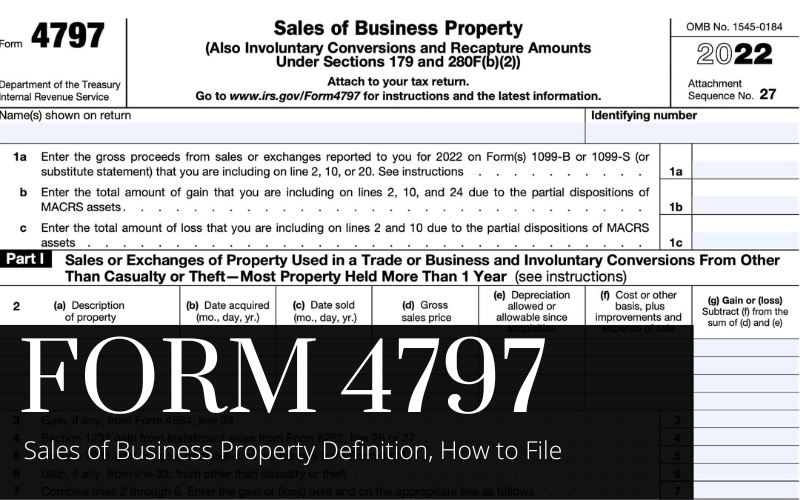
What is Form 4797: Business Property Sales?
IRS Form 4797 (Sales of Business Property) is a tax form. It reports gains from selling or exchanging business property, including rental property and industrial, agricultural, and extractive property.
Entities must provide the following on Form 4797:
- Property Description
- Purchase date
- Date of sale or transfer
- Purchase cost
- Selling price gross
- Add depreciation to the sales price.
Form 4797: Who Can File?
Business property purchased for rental revenue may be recorded on Form 4797. Form 4797 allows taxpayers to report a house utilized as a business—form 4797 reports oil, gas, geothermal, and mineral property sales gains.
The sale gains may be tax-exempt if a property was utilized for business or income while also being a principal residence. This is common for self-employed individuals and independent contractors who work from home.
The net profit or loss from selling business property is calculated by subtracting the purchase price from the sales price minus depreciation charges.
Filing Form 4797
Four components make up Form 4797.
The first part, Sales or Exchanges of Property Used in a Trade or Business and Involuntary Conversions From Other Than Casualty or Theft, recognizes the most depreciable property held for over a year.
The second part, Ordinary Gains and Losses, records property sold for a loss within a year.
The third Part, Gain from Disposition of Property under Sections 1245, 1250, 1252, 1254, and 1255, covers capital assets disposed of for a profit after more than a year.
Schedule C’s gross income line must include a corporation or partnership’s Line 17, Part II total. Titled Part IV: Recapture Amounts Under Sections 179 and 280F(b)(2): When business use drops below 50%.
When a flowing-through company, like a partnership or S corporation, sells a property, partners, and shareholders may face tax events (gain or loss) upon filing Form 4797.
To disclose capital asset dispositions not reported on Schedule D, use Form 4797, available for download here.
What is the difference between Schedule D and Form 4797?
Schedule D reports personal investment gains, while Form 4797 reports real estate gains, primarily company transactions.
What Should You Use—8949 or 4797?
Form 4797 is typically sufficient for reporting gains from real estate sales. When investing in an eligible fund to defer capital gains, use Form 8949.
How to Avoid Business Sale Capital Gains Tax
You can defer, but not avoid, capital gains tax. Reinvesting capital gains in an opportunity zone might delay capital gains tax on a business sale.
Bottom Line
IRS Form 4797 (Sales of Business Property) reports financial gains from business property sales or exchanges. The form requests a property description, purchase date, depreciation, and cost.
Conclusion
- IRS Form 4797 is a tax form.
- Form 4797 reports gains from selling or exchanging business property, including rental property and industrial, agricultural, or extractive property.
- Entities must disclose a property description, purchase date, sale or transfer date, cost of purchase, gross sales price, and depreciation amount on Form 4797.

