

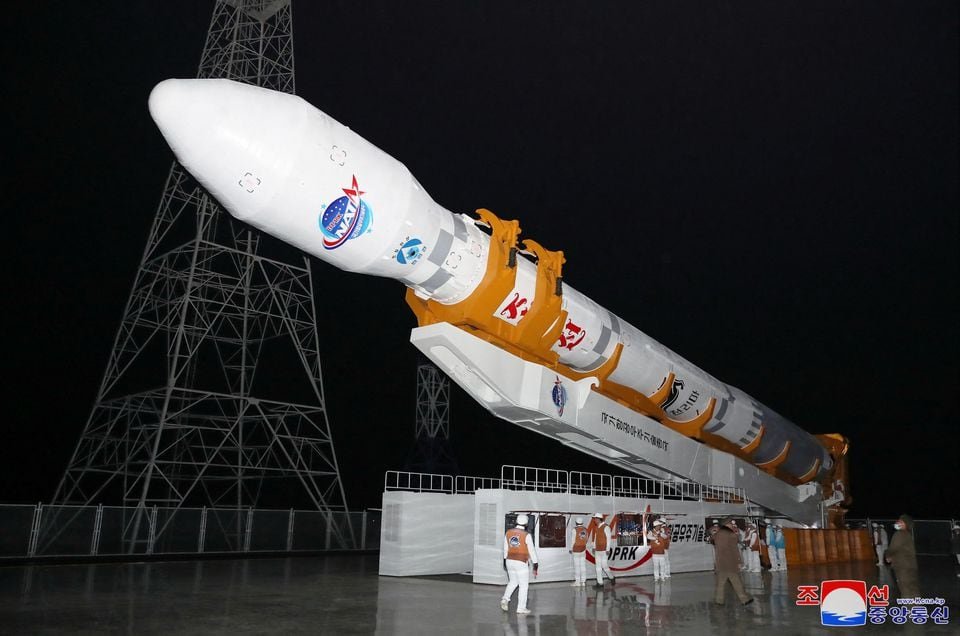
Following North Korea’s defiant launch of a spy satellite, which it declared a success, and in defiance of warnings from the United States and its allies, South Korea moved on Wednesday to suspend a portion of the military pact it struck with Pyongyang in 2018.
South Korea will increase military surveillance along the border in response to the agreement’s clause being suspended.
On Tuesday, North Korea reported that it launched its first spy satellite into orbit. Images released by the official North Korean news agency, KCNA, purportedly showed leader Kim Jong Un witnessing the dramatic missile launch from a base.
Kim later received an update on the satellite’s first activities at the space agency’s control center in Pyongyang and saw photos of critical American military installations captured above Guam, such as the Andersen Air Force Base, according to KCNA.
To provide his military forces with “abundant valuable real-time information about the enemy and further promote their responsive posture,” Kim emphasized the necessity to launch more reconnaissance satellites on various orbits.
After modifications, the satellite would officially launch its surveillance mission on December 1, according to KCNA. When South Korea and Japan initially reported the launch, they could not confirm whether a satellite had entered orbit. According to the Pentagon, the U.S. military determines if the launch was successful.
While on a state visit to Britain, South Korean President Yoon Suk Yeol approved the decision to halt a portion of the inter-Korean agreement. Earlier, via video link, Yoon presided over a National Security Council meeting that included ministers and the head of intelligence.
Known as the Comprehensive Military Agreement, it was agreed upon during a 2018 meeting between Kim Jong Un and former South Korean President Moon Jae-in to defuse tensions between the two rivals.
Opponents claim that while Pyongyang has blatantly broken the agreement, Seoul’s capacity to keep an eye on North Korea’s activities along the border has been undermined. On Wednesday, South Korea said it was lifting a provision in the agreement and starting aerial monitoring close to the border.
PRESENTATION OF POWER
A day after the aircraft carrier Carl Vinson arrived, the USS Santa Fe, a nuclear-powered submarine, docked at a port in South Korea as a show of force against North Korea’s nuclear and missile programs.
Joint maritime exercises between the United States and Japan are scheduled, according to South Korea’s Defense Minister Shin Won-sik, who visited the carrier to demonstrate their “strong will” to counter any provocation by the North.
Adrienne Watson, a U.S. National Security Council spokesman, described the satellite launch as “a brazen violation of multiple U.N. Security Council resolutions.”
According to a spokesperson, U.N. Secretary-General Antonio Guterres encouraged North Korea to strictly abide by resolutions passed by the U.N. that prohibit it from using technology related to ballistic missile programs. The closest ally of Pyongyang, China, appealed to all sides to maintain peace and stability on the Korean Peninsula through its foreign ministry.
According to KCNA, the Malligyong-1 satellite entered orbit at 10:54 p.m. (1354 GMT) on Tuesday after being launched on a Chollima-1 rocket from the Sohae satellite launch complex at 10:42 p.m. (1342 GMT). After two unsuccessful efforts to launch what it claimed to be spy satellites this year, North Korea informed Japan that it intended to launch a satellite between Wednesday and December 1.
The military of South Korea stated that it thought the most recent rocket included a reconnaissance satellite. Destroyers from the U.S., Japan, and South Korea outfitted with Aegis systems were positioned to track the launch vehicle and exchange data.
RUSSIAN LINKAGE
The launch on Tuesday is the first since September, when Kim Jong Un and Vladimir Putin met at Russia’s state-of-the-art space complex, during which the Russian president pledged to assist Pyongyang in developing satellites.
According to South Korean officials, Moscow most certainly provided technical assistance for the most recent launch as part of an expanding alliance that has seen North Korea transport millions of artillery shells to Russia.
However, several missile specialists claimed that Moscow would not have provided compassionate and proprietary knowledge and that it was too soon for Russian technical support to integrate into the rocket or the satellite fully.
According to Hong Min, a Korea Institute for National Unification weapons analyst, “this consultation may not have been an in-depth involvement in the design, but likely targeted specific challenging aspects within North Korea’s planned design.” Although they have openly promised further collaboration, North Korea and Russia have denied ever having conducted military sales.
The launch occurred slightly over a week before South Korea intended to launch its first spy satellite into orbit on a Space X rocket.

