

What’s Heuristics?
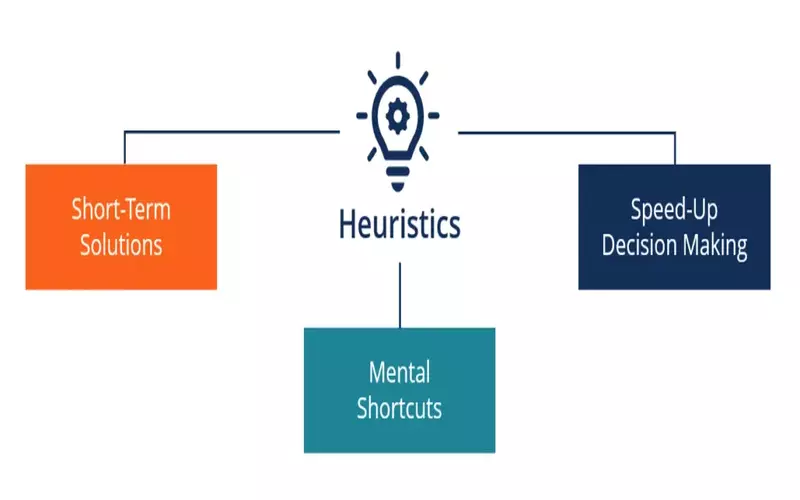
Heuristics are mental shortcuts often employed to simplify difficulties and prevent cognitive overload. The human brain developed and programmed with heuristics, helping people swiftly reach acceptable judgments or solve complicated situations. Given limited time and calculative capacity, these solutions may not be ideal but are typically sufficient.
These cognitive shortcuts are common in behavioral economics.
Understanding Heuristics
Human brain evolution makes heuristics natural. Due to limited processing capacity, the brain uses shortcuts or practical rules of thumb. We would fail if we had to consider every detail, gather all available data, and analyze it.
Heuristics enable quick, suitable judgments that may not be the best. People continually use educated guesses, trial and error, the process of elimination, and prior experience to solve issues or plan actions. Heuristic approaches simplify and accelerate decision-making in a complicated environment with abundant data using shortcuts and proper computations.
Heuristics, first recognized by Herbert Simon in his work on limited rationality, are now a cornerstone of behavioral economics. Simon believed decision-making was about achieving “good enough” outcomes for the individual based on their limited information and balancing the interests of others, not rational financial behavior (“optimizing”). Simon dubbed this “satisficing,” a play on “satisfy” and “suffice.”
The Benefits of Heuristics
Heuristics let us make intelligent judgments without all the facts or sophisticated calculations.
Humans utilize the information they have to make intelligent judgments since they cannot get or comprehend all the information they require. Heuristics expand our cognitive abilities.
Heuristics are helpful when speed or timeliness concerns arise, such as when entering a transaction or making a rapid choice. Therefore, heuristics are helpful when there is no time to evaluate all choices properly.
The Drawbacks of Heuristics
Heuristics have downsides. While quick and dirty, they may not make the best judgment or be wrong. Quick decisions without all the facts might cause judgment errors and miscalculations.
Heuristics also exacerbate biases that cause illogical economic conduct and shape our worldview—behavioral economics catalogs such heuristics.
Pros and Cons of Heuristics
Pros
- Quick and simple
- It lets us make decisions beyond our cognitive abilities
- Allows rapid judgments in a short time
Cons
- Often wrong
- Can cause systemic biases or judgment mistakes
- Example of Behavioral Economics Heuristic
Representativeness
Representativeness heuristics are behavioral economic shortcuts for problem-solving. Using brain shortcuts, representativeness makes judgments based on prior experiences or qualities comparable to the current circumstance.
Suppose Fast Food ABC expanded to India and its stock price rose. An expert stated that all fast-food chains profit in India. The analyst quickly recommended a “buy” rating for Fast Food XYZ after its announcement to explore the Indian market the following year.
He skipped data review for both firms, although that may have been a bad idea. Research may have shown that Indian customers dislike Fast Food XYZ’s food.
Adjusting and anchoring
Anchoring and adjustment are common heuristics. Anchoring and adjustment include starting with a goal number or value, called the anchor, and adjusting it until it’s acceptable. This method’s main drawback is that if the initial anchor value is not genuine, all future modifications will push toward the anchor and away from the actual value.
An example of anchoring and adjustment is a vehicle salesman starting discussions with a high price, which may be over the fair value. The high price is an anchor, so the ultimate price will be greater than if the auto dealer started low.
Recency (Availability) Heuristic
People often overestimate the likelihood of a recent occurrence repeating due to the availability (or recency) heuristic. Even though shark attacks are infrequent, news stories can make them conspicuous and cause individuals to avoid the ocean.
Another example is the “hot hand,” or the belief that a streak of success will continue. Hot hands are useless in casinos, markets, and basketball. A recent streak of luck does not change the event odds.
Confirmation bias
Research has shown that confirmation bias occurs when people prioritize information that aligns with their preconceived notions. While rejecting contradictory information.
Recognizing confirmation bias may help investors avoid bad decision-making, missed opportunities, and bubbles. To prevent confirmation bias, seek out opposing ideas and avoid positive questions.
Retrospect Bias
All hindsight is 20/20. However, hindsight bias might cause us to forget inaccurate forecasts or estimations before events. Instead, we believe we forecast an occurrence correctly when we didn’t. This might lead to overconfidence in future projections or regret for missed possibilities.
Psychology and Heuristics
In the mid-20th century, Herbert Simon defined and studied heuristics, which explain why individuals and organizations may not behave rationally in the real world despite market incentives penalizing erroneous behavior. Simon observed that business managers rarely optimize but instead use heuristics or shortcuts to “satisfy.”
In the 1970s and 1980s, psychologists Amos Tversky and Daniel Kahneman of Hebrew University in Jerusalem created Prospect Theory, building on Herbert Simon’s work. Prospect Theory, a cornerstone of behavioral economics, lists various subconscious financial appraisal heuristics. Research indicates that people are more averse to losses than gains, with the pain of losing $50 being more significant than the joy of getting $50. People may take unnecessary risks to avert losses, leading to higher losses.
In recent years, behavioral economists have sought to build “nudges” to correct people’s illogical use of heuristics to help them achieve better results, such as enrolling them in a retirement savings plan by default.
Stereotypes
Stereotypes help us judge strangers. Stereotyping applies group-level characteristics about specific social groups—often racist, sexist, or otherwise discriminatory—to all group members, regardless of their personalities, beliefs, skills, or behaviors. Oversimplified ideas allow us to appraise people’s relationships and consequences swiftly. However, these assessments are often inaccurate, insulting, and perpetuate social marginalization.
Types of heuristics
Behavioral economics has uncovered various heuristics to help humans make complicated decisions. Representativeness, anchoring and adjustment, and availability (recency) are most commonly referenced in behavioral economics. Examples of heuristics include cognitive vs. emotional biases and judgment vs. calculation mistakes.
Heuristic Thinking?
Heuristic thinking employs subconsciously created mental shortcuts to make difficult decisions and draw fast conclusions. These can be a “rule of thumb” (e.g., save 5% of your salary for a pleasant retirement) or unconscious cognitive processes like the availability bias.
Another word for heuristic?
Heuristics include rules of thumb, mental shortcuts, informed guesses, or satisfaction.
How Are Heuristics and Algorithms Different?
An algorithm is a step-by-step plan for achieving a goal, frequently optimizing it. Structured like a formula or “recipe.” They are repeatable because an algorithm produces the same outcome with the same input. Heuristics are informed guesses or gut feelings. Heuristics are mental shortcuts instead of rules. It also creates suboptimal and nonsensical results that may vary even with the same input.
Computer heuristics?
Heuristics in computer science are faster or more efficient ways to solve problems. This may require estimates or methods that avoid computationally demanding processes.
The Verdict
Heuristics are pragmatic mental shortcuts for judgment and decision-making. Given the universe’s complexity, the amount of input to absorb, and the calculative skills needed to make an ideal decision, our brains would not work without heuristics. Heuristics let us make speedy, good-enough decisions. Behavioral economics may identify flaws and systematic biases in these choices.
Conclusion
- Given time restrictions, heuristics are mental shortcuts for solving issues quickly with a meaningful result.
- Heuristics help investors and financial professionals analyze and invest faster.
- Heuristics can cause poor decision-making based on a few facts, although speed can compensate.
- Behavioral economics has focused on heuristics as a restriction on rational behavior.
- Economic heuristics include availability, anchoring, confirmation bias, and the hot hand fallacy.

