

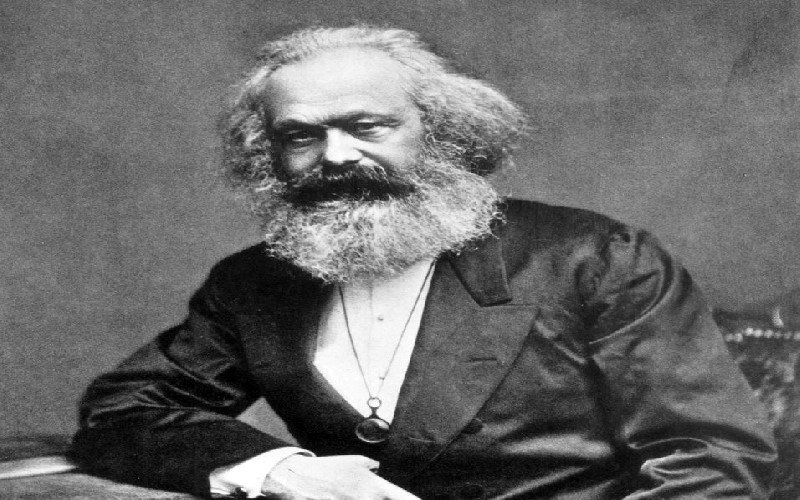
Karl Marx was an economist, writer, social theorist, and philosopher who lived from 1818 to 1883. His views on capitalism, socialism, and communism have made him well-known.
Marx and Friedrich Engels published the Communist Manifesto in 1848; later in life, he wrote Das Kapital, which covered the labor theory of value. The first volume was published in Berlin in 1867, and the second and third volumes were published posthumously in 1885 and 1894, respectively.
Childhood and Schooling
Marx was born May 5, 1818, in Trier, Prussia (now Germany). His father was a prosperous Jewish lawyer who had converted to Lutheranism before Marx’s birth. While studying law in Bonn and Berlin, Marx became acquainted with G.W.F. Hegel’s philosophy.
The Young Hegelians, a group of students who opposed their day’s political and theological establishments, introduced him to radicalism at an early age. In 1841, Marx graduated with a doctorate from the University of Jena. Since his radical views kept him from being hired as a teacher, he became a writer and eventually the editor of the liberal Rheinische Zeitung in Cologne.
After his time in Prussia, Marx briefly resided in France, where he eventually met Friedrich Engels, who would become his lifelong friend. After being banished from France, he briefly resided in Belgium before relocating to London, where he lived with his spouse for the remainder of his days.
Marx was interred in London’s Highgate Cemetery on March 14, 1883, suffering from pleurisy and bronchitis. The Communist Party of Great Britain unveiled a grand tombstone featuring a bust of Marx and the Anglicized phrase “Workers of all Lands Unite,” which is an allusion to the well-known line from The Communist Manifesto that reads, “Proletarians of all countries, unite!” His original grave was of little note.
Marx’s Concepts
Even though most modern thought does not support Marx’s field of study, Marxian economics, he drew inspiration from classical political economists like David Ricardo and Adam Smith. Marx’s theories have still significantly impacted society, most notably in communist initiatives like those in the USSR, China, and Cuba. Marx remains a significant figure among contemporary economists in political economy, sociology, and heterodox economics.
Marx generally argued that the two primary defects in capitalism that cause businesses to abuse employees are the unpredictability of free market competition and the extraction of excess labor. Marx ultimately believed that capitalism would collapse as more people were forced into working-class positions, inequality increased, and competition would drive corporate profits to zero. He speculated that this would trigger a revolution in which the working class would take over production.
Surplus Value and Exploitation
Karl Marx’s work on understanding capitalism as a social and economic structure is still relevant today, even though many associate him with socialism. Marx makes the case that there are two major classes in society in Das Kapital (also known as Capital in English). Capitalists are the owners of businesses that control the means of production, including factories, equipment, and raw materials, and they are also entitled to all profits. They also organize the manufacturing process.
Laborers make up the other, much larger class, which Marx referred to as the “proletariat.”. Laborers do not own or have any claims to the production equipment, the finished goods they work on, or any proceeds from their sales. Instead, labor performs tasks in exchange for payment. Marx maintained that capitalists exploit workers as a result of this unequal structure.
Marx argues that employers can make money because of this exploitation, which involves taking from employees a full day’s worth of labor and output but only paying them a smaller portion of this value in wages. Marx referred to this as excess value and claimed it was evil.
Value Theory of Labor
Karl Marx accepted the labor theory of value (LTV), along with other classical economists, to explain relative variations in market prices. This theory states that you can calculate an economic good’s value objectively by adding up the typical labor hours required to make it. Put differently, a table should be valued twice as much if it requires twice as much labor as a chair.
In Das Kapital, Marx posed a devastating intellectual challenge to laissez-faire economists by demonstrating his superior understanding of labor theory compared to his contemporaries and predecessors, including Adam Smith: if goods and services are typically sold at their actual objective labor values as measured in labor hours, then how do capitalists enjoy profits? Marx deduced that this had to imply that capitalists were either underpaying or overworking workers, taking advantage of them to lower the cost of production.
Even though Marx’s response was ultimately shown to be false and subsequent economists embraced the subjective theory of value, his straightforward claim was sufficient to expose the fallacies of the logic and premises of the labor theory, thereby contributing to a revolution in economic thought.
Materialism in the Past
Marx also established the influential idea of historical materialism. According to this idea, the technology utilized in manufacturing determines the social hierarchy of a specific period. Industrial capitalists organize labor in factories or offices where workers are paid wages, resulting in a highly structured society.
Marx proposed that feudalism was a particular form of social connection between the lord and peasant classes that existed before capitalism and had to do with the hand-powered or animal-powered methods of production that were common at the time.
Works Written by Marx
In addition to countless pamphlets, articles, and essays, Karl Marx wrote and published no fewer than fifteen comprehensive multi-volume volumes during his lifetime. He would frequently be spotted writing in the British Museum’s reading rooms in London.
Marx and Engels’ beliefs about the nature of politics and society are summarized in The Communist Manifesto, arguably his most well-known work and an attempt to explain the objectives of Marxism and, subsequently, socialism. Marx and Engels outlined their beliefs in drafting the Communist Manifesto: capitalism was unsustainable, and a socialist society would eventually replace the capitalist system.
Das Kapital was a thorough three-volume criticism of capitalism, or Capital: A Criticism of Political Economy in English. It presents Marx’s theories on the production of commodities, labor markets, the social division of labor, and a fundamental comprehension of the rate of return to capital owners. It is by far the more scholarly work. Before the third volume could be completed, Marx passed away. Engels published it posthumously, mainly using notes from Marx. Many concepts and criticisms of capitalism prevalent in the past are still relevant, including the rise of monopolistic mega-corporations, the unemployment rate, and the ongoing conflict between employers and employees.
Today’s Influence
Marx’s writings laid the groundwork for later communist leaders like Vladimir Lenin and Josef Stalin. His theories served as the theoretical foundation for communism and constituted the cornerstone of Marxism, which operated on the tenet that capitalism held the seeds of its demise.
Marx wrote almost entirely from the perspective of the average worker. Marx is the author of the theory that the value that is “stolen” from employees and given to employers makes capitalist profits possible.
The pure version of Marxist ideas has very few direct disciples in modern times; after economist Eugen von Böhm-Bawerk’s Karl Marx and the Close of His System was first published in English in 1898, very few Western thinkers adopted Marxism. In Böhm-Bawerk’s scathing critique, Marx’s failure to include capital markets or subjective values in his research invalidates most of his more emphatic conclusions. Nonetheless, Marx offers some insights that even contemporary economists might apply.
Marx recognized that capitalism was significantly more productive than earlier or alternative economic systems, despite being its sharpest critic. The “capitalist production” he described in Das Kapital involved the “togetherness of various processes into a social whole,” including creating new technology. According to him, all nations should adopt capitalism and increase their production capacity. After that, workers would inevitably rebel and establish communism, taking control of the means of production as a group and establishing themselves as the dominant social class. However, Marx, like Adam Smith and David Ricardo before him, anticipated that an economy’s profit rate would always decline over time due to capitalism’s unrelenting pursuit of profit through competition and technological advancement to lower production costs.
Transition from Economic to Social Transformation
Marx’s “primary contribution” to economic science, according to Dr. James Bradford “Brad” DeLong, UC Berkeley professor of economics, actually came in a 10-paragraph section of The Communist Manifesto where he explains how economic growth causes shifts among social classes, often leading to a struggle for political power. This is the foundation for an often overlooked facet of economics: the actors’ political actions and feelings. A French economist, Thomas Piketty, later offered a corollary to this theory, arguing that although income disparity had no adverse economic effects, it would incite widespread backlash against capitalism. Any economic system, then, has to consider anthropological and moral factors. Historical materialism is the theory that society’s structure and shifts from one order to another can be caused by technological changes in how goods are produced in an economy.
What is Karl Marx’s leading theory?
Marxism was founded on Karl Marx’s ideas on capitalism and communism. One of his primary theories was a critique of capitalism and its flaws. Marx believed that capitalism would eventually come to an end. A classless society would be ushered in when the repressed workers grew estranged from the owners and eventually overthrew them to seize control of the means of production.
For What Purpose Is Karl Marx Most Known?
The theories of Karl Marx are primarily responsible for the growth of Marxism. Communism was also founded on his principles. Marxism was founded on his writings, Das Kapital and The Communist Manifesto.
Marxism versus Communism: What Is It?
Marxism is a socioeconomic analytical system; communism is a type of economic production that includes political activities and the government. Karl Marx created the expansive philosophy known as Marxism in the latter part of the 1800s, bringing together economic, political, and social theory. It primarily focuses on the conflict between the ownership and working classes and prefers socialism and communism to capitalism.
The Final Word
Although Karl Marx’s ideas are still debatable, they are still applicable today. Marx had much to say about the capitalistic production system and harshly criticized it for creating social and wealth inequities, negative externalities, and class conflict, even if mainstream economics denigrated Marxism as an eccentric school of thought. Marx was ultimately proven to be wrong in his forecasts of the impending downfall of capitalism and the subsequent communist revolutions. Many have discounted Marx and Marxian ideas as a result of this. Marx’s observations are nevertheless relevant and motivating to others.
Conclusion
- Karl Marx was a famous philosopher who wrote about sociology, politics, and economics.
- Marx was born in Germany but lived most of his life in London. There, he wrote many of his famous works, such as The Communist Manifesto and Capital (Das Kapital).
- Marx worked closely with Friedrich Engels, a social thinker and longtime friend.
- Marx is famous for the revolutionary things he wrote about communism and socialism.
- Most people today don’t agree with Marxism or Marxian economics, but many of Marx’s criticisms of capitalism are still valid.

