

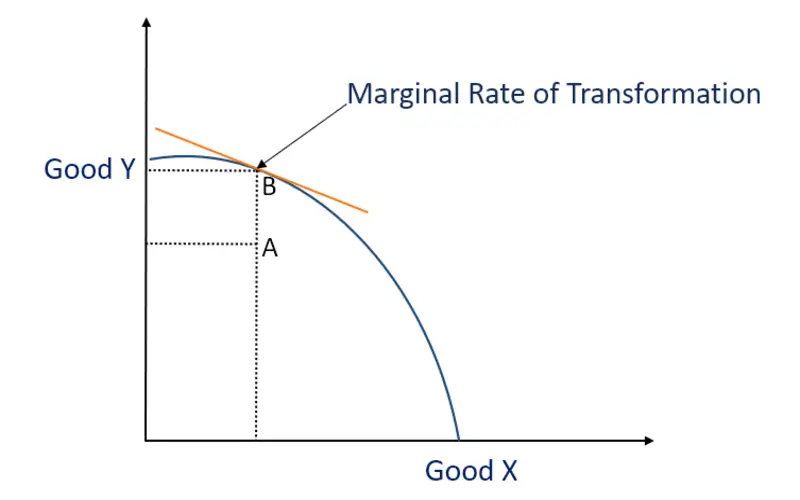
What is the marginal rate of transformation (MRT)?
The marginal rate of transformation (MRT) denotes the quantity of one good that must be sacrificed to produce or acquire one unit of another good. It is the quantity of suitable Y units sacrificed to produce an additional unit of good X, with all other factors of production and technology remaining constant.
How to Determine and Compute the Marginal Rate of Transformation (MRT)
MRT = MCx / MCy,
where
MCx represents the cost of producing an additional unit of X and
MCy represents the rate of growth achieved by reducing the production of Y.
Therefore, the ratio indicates the quantity of Y that must be sacrificed to generate an additional X. To determine the marginal rate of transformation (MRT), divide the marginal cost of producing an additional unit of a commodity by the resources made available by ceasing production of that unit. The above formula calculates the MRT by dividing the marginal cost of production for good X by the marginal cost of production for good Y.
The Significance of the Marginal Rate of Transformation (MRT)
Economists can utilize the marginal transformation rate (MRT) to assess the opportunity costs of producing an additional unit of a given good or service. In this instance, the opportunity cost is represented by the production of another commodity that was not produced. The production possibility frontier (PPF), associated with the marginal transformation rate, represents the output potential for two products using the same resources.
MRT represents the incline of the production possibility frontier in its absolute value. An individual point along the curved line representing the frontier experiences a distinct marginal transformation rate. The economics of producing the two products inform this rate.
As a result of efficient resource allocation at points along the production possibility frontier, increasing the production of one commodity reduces the output of the other. Put differently, when resources are allocated towards the production of one good rather than another, the quantity of those products produced will be reduced. This tradeoff exists as measured by the marginal rate of transformation (MRT). In general, as one descends the PPF, the opportunity cost and the absolute value of the MRT both increase. The alternative commodity’s opportunity cost (measured in units) escalates as one good’s production increases. This phenomenon is similar to the law of diminishing returns.
An Illustration of Implementing the Marginal Rate of Transformation (MRT)
The MRT is the rate at which a negligible quantity of X can be exchanged for a minute quantity of Y. The opportunity cost of one unit of one product over another constitutes the rate. The rate at which a transformation occurs may also vary in proportion to the number of units of X and Y. The MRT for perfect substitute products is one and remains constant.
For instance, in the scenario where three additional loaves of bread can be baked with the resources freed up by baking one less cake, the transformation rate at the margin is 3 to 1. Consider the fact that baking a cake requires $3. In the interim, one dollar can be conserved by forgoing the preparation of a loaf of bread. The MRT is, therefore, 3, calculated by dividing $3 by $1.
Consider an additional instance wherein a student is confronted with a tradeoff: sacrificing some leisure time to improve their grades in a specific course through increased study. As quantified by the absolute value of the slope of the production possibility frontier curve, the MRT represents the rate of grade improvement for a pupil in exchange for time spent studying.
There is a distinction in the space between the MRT and the MRS (marginal rate of substitution).
Although the marginal rate of transformation (MRT) and marginal rate of substitution (MRS) share some similarities, they are distinct concepts. In contrast to the marginal rate of substitution, which emphasizes demand, MRT emphasizes supply.
The marginal rate of substitution indicates the number of units of Y that a specific consumer group would accept in exchange for one fewer unit of X. To illustrate, a customer with a preference for apples over oranges might be deemed equally content with three apples rather than one orange.
Constraints of Marginal Rate of Transformation (MRT) Implementation
The marginal transformation rate (MRT) generally fluctuates and may require frequent recalculation. Furthermore, if MRT does not equal MRS, products will not be distributed efficiently.
Conclusion
- The opportunity cost to make one more unit of something is MRT, which is the number of units that must be given up to make or get a unit of another good.
- People also think of MRT as the absolute value of the slope of the frontier of output options.
- MRT looks at supply, while the marginal replacement rate looks at demand.

