

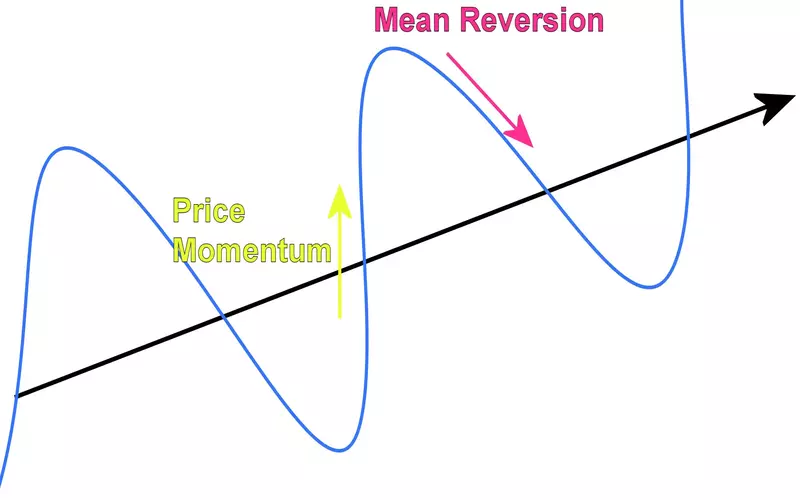
What does the term “reversion” mean?
Financial time series data like price, earnings, and book value use mean reversion. An asset is attractive when its market price is lower than its average past price. The price should fall if it’s above average. Mean reversion helps traders and investors time their strategies.
Understanding Mean Reversion
The financial theory of mean reversion states that asset prices will return to their long-term average. This idea assumes asset prices and historical returns will average out over time. The stronger the deviation from this mean, the more likely the asset’s price will move closer to it.
Traders use
Investors capitalize on asset prices that have deviated significantly from their historical mean using mean reversion strategies.
- Statistics: Investors use Z-scores to measure asset price deviation from the mean. Z-scores above 1.5 or below -1.5 may indicate trading opportunities.
- Investors and traders find correlated assets in pair trading. They buy the undervalued asset and short the overvalued one when their price ratio deviates from its mean.
- Volatility: Some traders and investors buy highly volatile options, expecting them to revert to the mean.
- Stop-loss orders and take-profit points can be set around managing risk and securing gains.
- Quantitative analysts use mean reversion and complex mathematical models to predict price movements in algorithmic trading strategies.
Time horizon and market conditions affect mean reversion. The time horizon affects the mean reversion strategy’s effectiveness. Trades may use intraday data, while investors may use yearly data.
Mean reversion works better in range-bound markets than in trending markets.
Calculating Mean Reversion
Calculating mean reversion uses statistical and quantitative methods to measure an asset’s price deviation from its historical mean.
First, asset price history is collected. The time frame depends on the investor’s or trader’s horizon. Then, the selected time frame’s average price is calculated.
Mean=SumofpricesofPrices/NumberofObservations
Each price point’s deviation is calculated from there.
Deviation=Price−Mean
Next, the price series standard deviation is calculated to assess volatility.
StandardDeviation=SquareRoot(SumofSquaredDeviations/(NumberofObservations−1)
Z-scores are calculated from these figures. An element’s Z-score indicates its standard deviation from the mean.
Z−Score=Deviation/StandardDeviation
The asset may be overvalued if its Z-score is above 1.5 or 2 and undervalued below 1.5 or -2.
Technical Analysis and Mean Reversion
Mean reversion underpins many technical analysis indicators and trading strategies. It helps traders identify overbought or oversold conditions, providing potential entry and exit points. Technical indicator tools using mean reversion:
- Traders and investors use moving averages to find the mean price over a period. Overbought occurs when the price is above the moving average and a threshold. It may be oversold when the price is below the moving average and a threshold.
- Bollinger Bands: The technical analysis indicator has a middle band (simple moving average) and two standard deviation-calculated outer bands. Prices should return to the middle band.
- Relative Strength Index (RSI): The RSI measures overbought and oversold conditions from 0 to 100. RSIs above 70 indicate overbought conditions, while those below 30 indicate oversold conditions, implying mean reversion.
- Stochastic Oscillator: This indicator compares a security’s closing price to its 14-day price range. Stochastic oscillator values above 80 are overbought, and values below 20 are oversold.
- MACD: The MACD measures trend strength, direction, momentum, and duration. The asset may deviate from its mean when the MACD crosses above or below its signal.
Day Trading and Mean Reversion
Day traders buy and sell financial instruments in one day, often holding positions for minutes or hours. Day trading strategies depend on mean reversion to capitalize on short-term price fluctuations.
Essential strategies include intraday moving averages. Day traders use short-term moving averages to find intraday mean prices. When the asset’s price deviates significantly, reversion is expected.
Trading Strategy Guides. “Mean Reversion Trading Strategy With a Sneaky Secret.”
Day traders use RSI and stochastic oscillators to identify intraday overbought or oversold conditions. Day traders often follow technical analysis signals to enter or exit positions. Day traders also look for “squeezes” in Bollinger bands, indicating low volatility and a significant price move. Reversion should be to the mean or middle band.
Some day traders use mean-reversion algorithms to execute high-frequency trades.
Swing Trading, Mean Reversion
Swing trading involves holding positions for days or weeks to profit from short-term prices. Mean reversion helps swing traders spot price trend reversals. The assumption is that prices will return to their long-term average. Investors usually use mean reversion:
This theory has inspired many investing strategies that involve buying or selling stocks or other securities with recent performance that differs significantly from their historical averages. However, a return change may indicate that a company no longer has the same prospects, making mean reversion less likely.
Mean reverting can affect interest rates, company P/E ratios, and percentage returns.
A crossover or crossover of the price and moving average, followed by a significant deviation, may indicate a reversal. The RSI and MACD indicate overbought or oversold conditions, suggesting a mean reversion.
Fibonacci retracements also indicate price reversion levels. Retracements typically occur at 38.2%, 50%, and 61.8%.
Finally, swing traders can use candlestick patterns like the doji, hammer, bullish, and bearish engulfing to spot reversals, including mean reversions.
Trading Forex with Mean Reversion
Mean reversion forex trading strategies capitalize on currency pairs reverting to their historical mean or average price. Technical analysis indicators can help find short-term opportunities using mean reversion.
Moving averages help forex traders find the average exchange rate over time. A reversion is likely when a currency pair deviates significantly from this average. RSI and stochastic oscillators identify currency pairs with overbought or oversold conditions, indicating mean reversion.
Forex traders and investors use pivot points. These identify support and resistance levels where the price may revert to the mean. They use the previous trading session’s high, low, and closing prices.
Finally, currency correlations are used. Some traders and investors use mean reversion for currency correlations. While historically correlated currency pairs diverge, traders may buy the underperforming pair and short the outperforming one.
Hypothetical Mean Reversion Example
Consider Company XYZ stock mean reversion.
Company XYZ stock has averaged 50 over the past 200 days. A positive earnings report boosts the stock price to $70. Over 200 days, the stock’s standard deviation is $5.
Calculate the Z-score using (70-50)/5 = 4.
A 4 Z-score means the stock is significantly overvalued relative to its historical mean. Since the stock should return to its mean, this may indicate a short position. In the following weeks, the initial excitement fades, and the stock price falls to $52, closer to its historical mean.
Mean Reversion Benefits and Drawbacks
Mean reversion trading is structured and flexible but is sensitive to market conditions and has higher transaction costs. Therefore, traders and investors must know these factors and use effective risk management.
Benefits of Mean Reversion
Many benefits come from mean reversion. This includes:
- Mean reversion simplifies trading entry and exit points with a systematic approach.
- Versatility: for intraday to long-term asset classes and time frames.
- Amundi. “Looking for Value Across Assets: Is Mean-Reversion Dead?”
- Risk Management: Set stop-loss and take-profit levels around the mean to control risk.
- Profit Potential: Trend-following may not work in range-bound markets, but the strategy can.
- Confirmation: Multiple indicators like the ones above can confirm mean-reverting signals, improving strategy reliability.
Limitations of Mean Reversion
Challenges and limitations come with any approach. Some mean reversion limitations:
- Mean reversion is less effective in strongly trending markets, where prices may take time to return to the mean.
- Transaction Costs: Frequent trading increases transaction costs.
- Shorter time frames are more susceptible to market noise, which can cause false mean-reverting signals.
- Economic shocks or sudden news can disrupt mean-reverting patterns and cause losses.
- Non-directional: Unlike trend-following strategies, mean reversion may not suit all trading styles.
A Mean Reversion Strategy?
Mean reversion trading exploits financial assets’ tendency to revert to their historical mean or average price. The strategy seeks to identify significant overvalued or undervalued assets and take positions in hopes of a reversion to the mean.
What is the best mean reversion timeframe?
Mean reversion times depend on the trader or investor’s goals, risk tolerance, and asset.
Which Asset Is Best for Mean Reversion Trading?
Mean reversion asset selection depends on market conditions, trading and investing expertise, and risk tolerance. Mean reversion strategies work well with stocks, forex, commodities, ETFs, and fixed-income instruments.
What Is the Difference Between Trend-Following and Mean Reversion?
The principles of trend-following and mean reversion differ. The goal of trend-following is to profit from solid asset movements. Mean reversion exploits price deviations from an average.
Conclusion
Mean reversion is a financial theory that says asset prices will eventually return to their historical average. It underpins stock, forex, and commodity trading strategies. Investors use moving averages, RSIs, and Bollinger bands to find mean-reverting opportunities. These indicators indicate asset overvaluation or undervaluation, providing entry and exit points.
It works well in range-bound or sideways markets and can be used intraday or long-term. Since mean reversion strategies are frequently traded, traders and investors must use risk management and consider transaction costs.

