

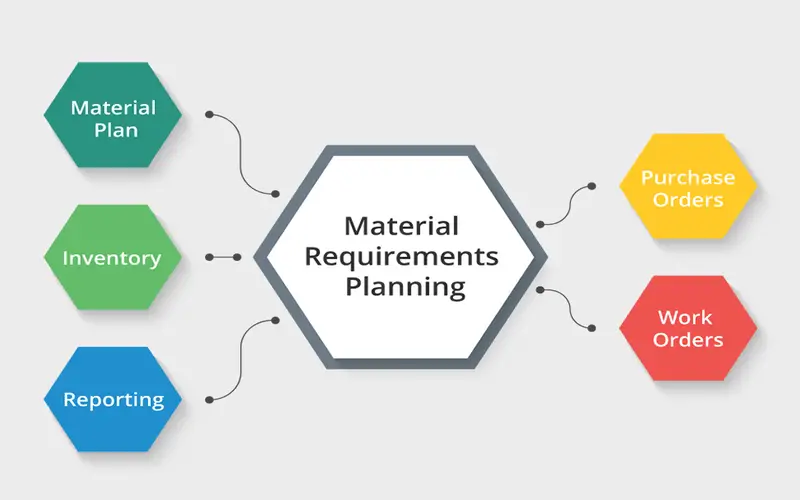
What is MRP (Material Requirements Planning)?
Material requirements planning (MRP) is a business-oriented software-based integrated inventory and supply management system. Businesses use MRP to schedule production and deliveries, maintain inventory levels, and estimate the amount of raw materials needed.
What is Material Requirements Planning (MRP)?
MRP assists businesses and manufacturers in defining what materials are required, how much is required, and when materials are required and working backward from a production plan for final goods.
MRP translates a plan into a list of requirements for the subassemblies, parts, and raw materials required to complete a final product on time. MRP assists manufacturers in understanding inventory requirements while balancing supply and demand.
Managers can use MRP to assess their labor and supply needs and increase production efficiency by entering data into the MRP scheme, such as:
- Name of the Item: The title of the finished good, which is sometimes called Level “0” on the bill of materials.
- Master Production Schedule (MPS): How much must we make to meet demand? When do you need it?
- Storage life of things.
- Inventory Status File (ISF): This file lists the items in stock and those on order from sources.
- Bills of materials (BOM) list the parts and ingredients needed to make a product.
- Planning information includes limitations and instructions such as routes, standards for workers and machines, standards for quality and testing, and methods for sizing lots.
Manufacturing and MRP
Manufacturers strategically and cost-effectively control the types and quantities of materials they purchase to guarantee they can meet current and future consumer demand. MRP assists businesses in maintaining proper amounts of inventory, allowing manufacturers to better align their production with rising and falling demand.
The MRP procedure:
- Estimates demand and material requirements. MRP breaks down demand into specific raw materials and components after evaluating client needs and utilizing the bill of materials.
- Allocates material inventory. MRP allocates inventory to the precise regions that are required.
- Produces a production schedule. Manufacturing time and workforce requirements are assessed, and a timeline is developed.
- Keep an eye on the procedure. MRP immediately notifies management of delays and proposes backup solutions to meet build deadlines.
The Evolution of MRP
Material requirements planning was one of the first integrated information technology (IT) systems that attempted to improve business productivity by utilizing computers and software technology.
In the 1940s and 1950s, the first MRP inventory management systems emerged, utilizing mainframe computers to extrapolate information from a bill of materials for a specific final product into a production and purchase plan. MRP systems were enhanced with information feedback loops, allowing production managers to adjust and update system inputs as needed.
Manufacturing resources planning (MRP II), the next iteration of MRP, incorporates marketing, finance, accounting, engineering, and human resources into the planning process. Enterprise resource planning (ERP), introduced in the 1990s, is a concept that improves on MRP by using computer technology to connect multiple functional areas throughout a whole company enterprise.
The Benefits and Drawbacks of MRP
Pros
- Materials and components are readily available as required.
- Inventory levels and associated costs were reduced.
- Customer lead times have been reduced.
- Enhanced manufacturing productivity
- Enhanced labor productivity
Cons
- The accuracy of input data is heavily relied upon.
- Implementation is costly.
- Lack of manufacturing schedule flexibility
- Possession of more inventory than is required
- Less capable than a complete ERP system
ERP versus MRP
Enterprise resource planning (ERP) extends MRP systems. While MRP is a resource planning and control system, ERP is a solution for the entire firm, and an ERP system incorporates enhanced capability in financials, customer relationships, and sales order administration.
MRP can be a standalone applicant,ion, or a component of an ERP, a unified system that serves all company needs, not just resource scheduling. It reduces information redundancy and adds components such as user-level security.
Increased efficiency, integrated information, tailored reporting, and higher-quality customer service are all advantages of an ERP system.
What Are the Three Primary MRP Inputs?
An MRP system’s three primary inputs are the Master Production Schedule (MPS), Inventory Status File (ISF), and Bill of Materials (BOM).
How can MRP help a business?
MRP guarantees that supplies and components are available when needed, that inventory levels are optimized, that manufacturing efficiency is enhanced, and that customer satisfaction rises.
What Are the MRP System’s Outputs?
Using required inputs, the MRP calculates what materials are required, how much is required to finish a structure, and when materials are required along the construction process.
This enables organizations to adopt just-in-time (JIT) production, which allows them to schedule production based on material availability. This reduces inventory levels and allows enterprises to move resources through the manufacturing process efficiently.
conclusion
Material needs planning (MRP) is a software-based inventory and supply management system businesses use to estimate raw material amounts and schedule output. MRP determines the materials needed, how much is needed, and when they are needed in the manufacturing process by inputting information such as the Master Production Schedule, Inventory Status File, and Bill of Materials (BOM).

