

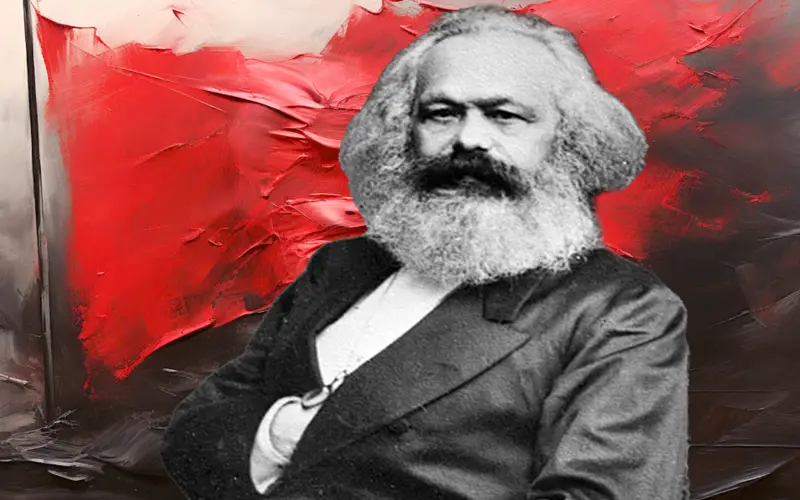
What exactly is Marxism?
Marxism is a social, political, and economic theory named after the German philosopher and economist Karl Marx, who lived in the nineteenth century. His research looks at the historical consequences of capitalism on labor, productivity, and economic development, and he contends that a worker revolution is required to replace capitalism with a communist economy. According to Marxism, the fight between social classes—precisely, the bourgeoisie, capitalists, and the proletariat, or workers—defines economic relations in a capitalist economy and eventually leads to a communist revolution.
Understanding Marxism
Marxism is a social and political ideology that includes Marxist class conflict theory and Marxian economics. Karl Marx and Friedrich Engels published the essay The Communist Manifesto in 1848, which lays forth the notion of class struggle and revolution.
Marxian economics focuses on Marx’s critique of capitalism, which he described in his 1867 book Das Kapital.
In general, Marxism contends that capitalism, as a form of economic and social reproduction, is defective and will eventually fail.
Capitalism is a method of production in which business owners (capitalists) own all the means of production (factory, tools and machinery, raw materials, finished product, and profits earned from its sale). Workers (labor) are hired for compensation and have no ownership stake or profit share.
Furthermore, workers’ wages are lower than the economic value that their work generates for the capitalist. This is the wellspring of capitalist profits and the source of the fundamental class conflict between labor and capital.
Economics, according to Marx
Like other classical economists, Karl Marx believed in a labor theory of value (LTV) to explain price discrepancies in the market. According to this theory, the typical number of hours of labor required to create a thing can serve as an objective measure of its value. In other words, if a table takes twice as long to manufacture as a chair, it should be valued twice as much. Marx added to this theory by concluding that this labor value signified worker exploitation. Marx maintained that capitalism has two major defects that lead to employer exploitation of workers: the chaotic character of free market competition and the extraction of surplus labor.
Marx prophesied that capitalism would eventually kill itself as more people were demoted to the working class, inequality increased, and competition drove corporate profits to zero. This, he predicted, would culminate in a revolution in which production would be transferred to the working class as a whole.
Class Struggle and the End of Capitalism
Marx’s class theory depicts capitalism as one phase in a historical continuum of economic systems that naturally follow one another. They are propelled, he argued, by massive, impersonal forces of history that manifest themselves through social class behavior and conflict. According to Marx, every society is split into social classes, with members having more in common than members of other social classes.
Some significant parts of Marx’s theories of how class conflict will play out under a capitalist system are as follows:
- Capitalist society is divided into two classes: the bourgeoisie, or company owners, who control the means of production, and the proletariat, or workers, whose labor converts raw commodities into marketable goods.
- Ordinary laborers have minimal authority in the capitalist economic system since they do not own the means of production, such as factories, buildings, and materials. Workers are also easily replaceable during periods of high unemployment, which reduces their perceived worth even further.
- To maximize earnings, business owners must get the most work out of their employees while paying them the lowest rates possible. As a result, there is an imbalance between owners and workers, whose labor the owners exploit for financial gain.
- Because workers have little personal investment in the production process, Marx predicted that they would become alienated from their work and even their humanity and become angry with business owners.
- The bourgeoisie can use social institutions such as government, media, universities, organized religion, and the banking and financial systems as tools and weapons against the proletariat to maintain their power and privilege.
- The inherent disparities and exploitative economic relationships between these two groups will eventually lead to a revolution in which the working class rebels against the bourgeoisie, seizes control of the means of production, and abolishes capitalism.
As a result, Marx believed that the capitalist system held the seeds of its demise. The underlying capitalist relations of alienation and exploitation of the proletariat would ultimately push the working class to rebel against the capitalists and seize control of the means of production.
The “vanguard of the proletariat,” a group of educated leaders who would lead this revolution and unite the working class by raising awareness and consciousness, would be aware of society’s class structure.
Marx predicted that, first under socialism and then under communism, collective ownership of the means of production would replace private ownership after the revolution.
Social stratification and class conflict would no longer exist in the last stage of human development.
Communism, Socialism, and Capitalism
Marx and Engels’ ideas set the framework for communism’s theory and practice, which advocates for a classless society in which all property and wealth are owned communally rather than privately.
Today, the only countries with communist systems are China, Cuba, Laos, North Korea, and Vietnam.
Notably, in the name of economic growth and global trade, most of these countries have loosened some of their most stringent policies.
The Soviet Union was a communist experiment that began in 1921 and ended in 1991, leaving 15 former Soviet Socialist Republics to rebuild their economies from the ground up. None of them selected communism as a model.
Socialism
Socialism is several decades older than communism. Its early supporters advocated for more egalitarian economic distribution, worker solidarity, improved working conditions, and community ownership of land and manufacturing equipment.
Individuals may still hold property under socialism, based on the principle of public ownership and regulation of the means of production. Rather than emerging from a class revolution, socialist change has occurred inside existing social and political structures, whether democratic, technocratic, oligarchic, or dictatorial.
Capitalism
Both communism and socialism oppose capitalism, defined by private ownership and a legal framework that protects the right to acquire or transfer private property.
Private persons or the corporations they form own the means of production and the right to profit from them in a capitalist system.
Communism and socialism seek to correct the flaws of capitalism’s free-market system. These include worker exploitation, class disparities, and an outright lack.
Marxist criticism
Marx inspired many followers, although many of his forecasts did not come true. Marx predicted that increased competition would result in bankruptcies and the establishment of monopolies, with control of production falling into fewer and fewer hands. He predicted that bankrupt former capitalists would join the proletariat, eventually forming an army of the unemployed. Furthermore, the market economy, by definition unplanned, would face crippling supply-and-demand issues, resulting in severe economic depressions.
Capitalism has not been destroyed but has evolved since Marx’s time. Governments in many capitalist countries, including the United States, can prohibit monopolies and commercial activities. Governments set minimum wages, and regulatory bodies set worker protection standards.
It is far from the romantic ideal. In many capitalist cultures, economic disparity has risen. Recessions have occurred regularly, as did the Great Depression, but they are not regarded as an essential element of free markets.
Indeed, a society without rivalry, money, or private property has not emerged in the contemporary world, and recent history indicates that it is unlikely to emerge.
Marxism: What Kind of Philosophy?
Karl Marx founded the social, political, and economic theories that make up Marxism in the second half of the nineteenth century. It is primarily concerned with the repercussions of a society divided into an owning class and a working class, and it offers a new system of shared ownership of the means of production as a remedy to capitalism’s inevitability of inequality.
What Did Marx Have to Say About the Future?
Marx believed that capitalism would inevitably self-destruct. Most enterprises would fold and be absorbed into unmanageable monopolies as competition intensified. Workers would reject an exploitative regime. The oppressed workers would eventually topple the owners to seize control of the means of production, ushering in a classless society based on shared ownership.
Was Karl Marx correct?
Not at all. Since the Soviet Union’s demise in 1991, the most successful of the few remaining communist countries, most notably China and Vietnam, have changed some of their most rigorous customs. No one has been able to completely eradicate personal property, money, and class hierarchies as Karl Marx envisioned.
In its various manifestations, capitalism will remain the dominant economic system in 2021. However, it has evolved since Marx’s time, with some of the worst excesses addressed. Examples include worker safety regulations, child labor laws, minimum wage laws, and anti-poverty programs.
Is Marxism and Communism the same thing?
Marxism is a philosophy, whereas communism is a political system based on Marxist ideals. Marx envisioned a future in which the workers owned the means of production. Governments own the means of production in real-world communism.
Conclusion
Karl Marx established the social and economic theory of Marxism in the nineteenth century. According to Marxian economics, the capitalist production system is intrinsically unjust to workers, who constitute the majority of the population.
Marx’s social theories linked capitalism’s defects to a developing class conflict between labor and business owners, eventually leading to a revolution that empowered the working class and established common ownership of the means of production.
His views have been validated in practice. The Soviet Union’s communist experiment came to an end in 1991. It is still being tried in China, establishing a hybrid social and economic structure that Marx may not recognize.

