

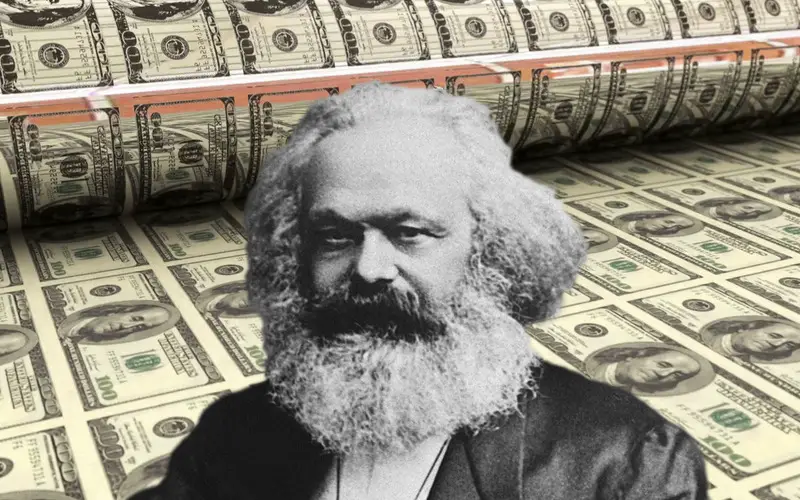
What exactly is Marxian economics?
Marxian economics is a school of thought based on the ideas of Karl Marx, a 19th-century economist and philosopher. Marxian economics, often known as Marxist economics, focuses on the role of labor in the growth of an economy and is critical of Adam Smith’s classical approach to wages and productivity. Marx maintained that labor specialization, combined with an increasing population, drives down wages and that the value placed on commodities and services does not fully account for the actual cost of labor.
Learning Marxian Economics
Much of Marxian economics is based on Karl Marx’s fundamental essay “Das Kapital,” released in 1867. In the book, Arx articulates his theory of the capitalist system, its dynamism, and its tendency toward self-destruction. Uch of Das Kapital explains Marx’s concept of the “surplus value” of labor andications for capital. According to Marx, a big army of unemployed, which he blamed on capitalists, drove wages to the subsistence level rather than the labor pool pressure. He claimed that labor was merely a commodity with subsistence pay in the capitalist system.
On the other hand, capitalists might force workers to work longer hours than necessary to make a living and then seize the excess product, or surplus value, created by the workers. In other words, Marx contended that workers create value through their labor but are underpaid. He asserts that the ruling classes take advantage of their labor by paying their employees less than the value of their labor rather than by selling their products at a higher price.
Classical Economics vs. Marxian Economics
Marxian economics rejects economists’ classical conceptions of economics, such as Adam Smith’s. Smith and his contemporaries believed that the free market, an economic system based on supply and demand with little or no government intervention and a focus on profit maximization, inherently benefited society.
Marx disagreed, claiming that capitalism continually serves only a few people. According to this economic paradigm, the ruling class accumulates wealth by extracting value from the working class’s cheap labor.
Unlike classical approaches to economic theory, Marx advocated for government action. He thinks the state should make economic decisions rather than producers and consumers to ensure that everyone wins. He anticipated that capitalism would eventually kill itself as more people were demoted to worker status, resulting in a revolution and the state taking over production.
Particular Considerations
Even though the two theories are closely related, Marxian economics is regarded as distinct from Marxism. It differs because it is less concerned with social and political issues. Marxian economic concepts generally contrast with the qualities of capitalist activities. With the Bolshevik revolution in Russia and the expansion of communism throughout Eastern Europe in the first half of the twentieth century, it appeared that the Marxist dream had finally and firmly taken root.
However, that ideal was dashed before the end of the century. People in Poland, Hungary, Czechoslovakia, East Germany, Romania, Yugoslavia, Bulgaria, Albania, and the Soviet Union rejected Marxist theory. They embarked on a dramatic transformation toward private property rights and a market-exchange-based society.
Conclusion
- Marxian economics is a way of thinking about money based on the writings of Karl Marx, an economist and philosopher who lived in the 1800s.
- Marx said that capitalism has two main problems that make it easy to take advantage of people: the free market is unstable, and there is too much labor.
- He said wages are decreasing because people are becoming more specialized and the population is growing. He also said that the prices of goods and services don’t reflect the actual labor costs.
- He said that capitalism would eventually force more people to become workers, leading to a revolt and the state taking over production.

