

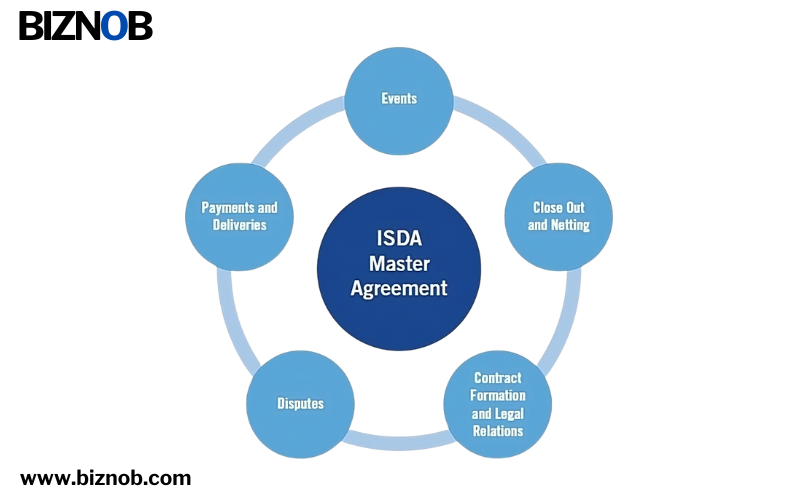
How do you explain an ISDA Master Agreement?
A standard document often used to govern over-the-counter derivatives trades is an ISDA Master Agreement. The International Swaps and Derivatives Association (ISDA) puts out the agreement, which spells out the rules for a derivatives deal between two people, usually a derivatives trader and a counterparty. There is a standard ISDA Master Agreement, but it comes with a customized schedule and sometimes a credit support annex. Both of these are signed by both parties in a deal.
A Look at How an ISDA Master Agreement Works
When two people sell over-the-counter (OTC) derivatives, they do not go through an exchange or middleman. Because the over-the-counter market is so big, risk managers must closely monitor traders and ensure approved transactions are correctly handled. When two people agree to do business together, they both get a confirmation message that lists the terms of the deal and links to the signed agreement. This is when the ISDA Master Agreement rules come into play.
Over the last few decades, the foreign exchange and interest rate swap markets have increased. They now handle deals worth trillions of dollars every day. In 1985, the ISDA MA was made to make these deals more uniform. The last changes and updates were made in 1992 and 2002; both versions can be used now. These agreements are used by banks and other businesses all over the world. The ISDA MA (Master Agreement) also makes it easy to close out and net transactions because it combines the different standards used in different countries.
Companies all over the world use this Model.
Most big banks worldwide have agreements with each other called Master Agreements. These deals usually cover all branches that trade options, foreign exchange, or interest rates. To do swaps, banks need business counterparties to sign an agreement. Some people also want agreements for trades involving foreign exchange.
The ISDA Master Agreement is a standard document, but the schedule that comes with it changes and clarifies some of its terms and conditions. The plan is worked out to fit either (a) the needs of a specific hedging deal or (b) a long-term trading relationship.
There is sometimes a Credit Support Annex (CSA) that goes with the Master as well. There is less credit risk for both parties because the CSA spells out the terms and conditions under which they must post security to each other.
What an ISDA Master Agreement Can Do for You
Better openness and more liquidity are the two most significant benefits of a Master Agreement. Each side can review the ISDA MA (Master Agreement) to understand how it works since it is a standard agreement. That makes things more straightforward because it makes it less likely to be unclear language or exit clauses. An ISDA Master Agreement makes things more consistent and more accessible for parties to do business with each other repeatedly, increasing liquidity. This kind of agreement saves everyone time and money on legal fees because it clarifies the rules.
What an ISDA Master Agreement Needs
The master agreement and schedule spell out the situations in which one party can end covered deals early because the other party has done something that ends the deal. Some common reasons for removal are not paying or going bankrupt. A credit downgrade below a certain level is another event that can be added to the plan and lead to termination.
It is written in the ISDA MA whether the UK or New York state rules will apply. In the event of a termination event, it also spells out how to value, close, and net all covered activities.
Conclusion
- An ISDA MA is a standard document often used to govern over-the-counter derivatives trades.
- When two people sell over-the-counter (OTC) derivatives, they do not go through an exchange or middleman.
- The main benefits of a Master Agreement are that it makes things more transparent and increases liquidity.

