

Bear Market Guide: Definition, Phrases, Examples, and How to invest during one
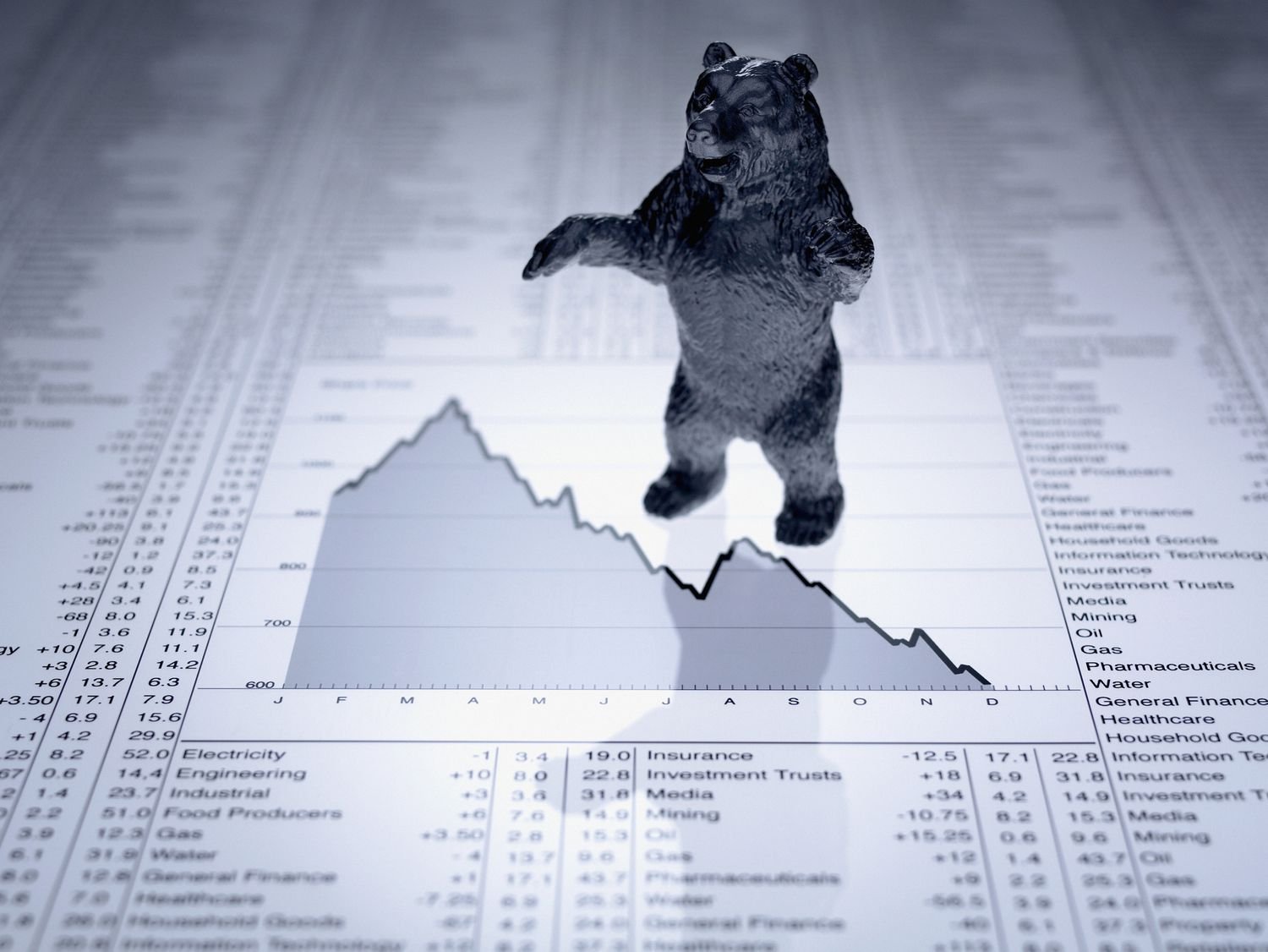
A bear market is when a market experiences prolonged price declines. It typically describes a condition where securities prices fall 20% or more from recent highs amid widespread pessimism and negative investor sentiment.
Bear markets are often associated with overall market or index declines, like the S&P 500. Still, individual securities or commodities can also be considered in a bear market if they experience a decline of 20% or more over a sustained period—typically two months or more. Bear markets may also accompany general economic downturns, such as a recession. Bear markets may be contrasted with upward-trending bull markets.
Understanding Bear Markets
Stock prices generally reflect future expectations of cash flows and profits from companies. As growth prospects wane and expectations are dashed, stock prices can decline. Herd behavior, fear, and a rush to protect downside losses can lead to prolonged periods of depressed asset prices.
One definition of a bear market says markets are in bear territory when stocks, on average, fall at least 20% off their highs. But 20% is an arbitrary number, just as a 10% decline is an arbitrary benchmark for a correction. Another definition of a bear market is when investors are more risk-averse than risk-seeking. This bear market can last months or years as investors shun speculation in favor of dull, sure bets.
The causes of a bear market often vary. Still, in general, a weak, slowing, or sluggish economy, bursting market bubbles, pandemics, wars, geopolitical crises, and drastic paradigm shifts in the economy, such as shifting to an online economy, are all factors that might cause a bear market. The signs of a weak or slowing economy are typically low employment, low disposable income, weak productivity, and a drop in business profits. In addition, any government intervention in the economy can also trigger a bear market.
For example, tax or federal funds rate changes can lead to a bear market. Similarly, a drop in investor confidence may also signal the onset of a bear market. When investors believe something is about to happen, they will take action—in this case, selling off shares to avoid losses.
Bear markets can last for multiple years or just several weeks. A secular bear market can last anywhere from 10 to 20 years and is characterized by below-average returns on a sustained basis. There may be rallies within secular bear markets where stocks or indexes rally for a period, but the gains are not sustained, and prices revert to lower levels. A cyclical bear market, on the other hand, can last anywhere from a few weeks to several months.
The U.S. major market indexes were close to bear market territory on December 24, 2018, falling just shy of a 20% drawdown.2 More recently, significant indexes, including the S&P 500 and Dow Jones Industrial Average (DJIA), fell sharply into bear market territory between March 11 and March 12, 2020.3 Before that, the last prolonged bear market in the United States occurred between 2007 and 2009 during the Financial Crisis and lasted for roughly 17 months. The S&P 500 lost 50% of its value during that time.4
In February 2020, global stocks entered a sudden bear market in the wake of the global coronavirus pandemic, sending the DJIA down 38% from its all-time high on February 12 (29,568.77) to a low on March 23 (18,213.65) in just over one month.5 However, both the S&P 500 and the Nasdaq 100 made new highs by August 2020
Phases of a Bear Market
Bear markets usually have four different phases.
- High prices and high investor sentiment characterize the first phase. Towards the end of this phase, investors begin to drop out of the markets and take in profits.
- In the second phase, stock prices begin to fall sharply, trading activity and corporate profits begin to drop, and economic indicators that may have once been positive start to become below average. Some investors begin to panic as sentiment starts to fall. This is referred to as capitulation.
- The third phase shows speculators start entering the market, raising some prices and trading volume.
- In the fourth and last phase, stock prices continue to drop, but slowly. As low prices and good news attract investors again, bear markets lead to bull markets.
Bear Markets vs. Corrections
A bear market should not be confused with a correction, a short-term trend with a duration of fewer than two months. While corrections offer a good time for value investors to find an entry point into stock markets, bear markets rarely provide suitable entry points. This barrier is because it is almost impossible to determine a bear market’s bottom. Trying to recoup losses can be an uphill battle unless investors are short sellers or use other strategies to make gains in falling markets.
Between 1900 and 2018, the Dow Jones Industrial Average (DJIA) had approximately 33 bear markets, averaging one every three years.7 One of the most notable bear markets in recent history coincided with the global financial crisis between October 2007 and March 2009. The Dow Jones Industrial Average (DJIA) declined 54% during that time.4 The global COVID-19 pandemic caused the 2020 bear market for the S&P 500 and DJIA. The Nasdaq Composite most recently entered a bear market in March 2022 on fears surrounding the war in Ukraine, economic sanctions against Russia, and high inflation.
Short Selling in Bear Markets
Investors can make gains in a bear market by short selling. This technique involves selling borrowed shares and repurchasing them at lower prices. It is a hazardous trade and can cause heavy losses if it does not work out. A short seller must borrow the shares from a broker before a short sale order is placed. The short seller’s profit and loss amount is the difference between the price where the shares were sold and the price where they were repurchased, referred to as “covered.”
For example, an investor shorts 100 shares of a stock at $94. The price falls, and the shares are covered at $84. The investor pockets a profit of $10 x 100 = $1,000. If the stock trades higher unexpectedly, the investor is forced to buy back the shares at a premium, causing heavy losses.
Puts and Inverse ETFs in Bear Markets
A put option gives the owner the freedom, but not the responsibility, to sell a stock at a specific price on or before a certain date. Put options can be used to speculate on falling stock prices and hedge against falling prices to protect long-only portfolios. Investors must have options privileges in their accounts to make such trades. Buying puts is generally safer than short selling outside of a bear market.
Inverse ETFs are designed to change values in the opposite direction of the index they track. For example, the inverse ETF for the S&P 500 would increase by 1% if the S&P 500 index decreased by 1%. Many leveraged inverse ETFs magnify the returns of the index they track by two or three times. Like options, inverse ETFs can be used to speculate on or protect portfolios.
Real-World Examples of Bear Markets
The ballooning housing mortgage default crisis caught up with the stock market in October 2007. The S&P 500 touched a high of 1,565.15 on October 9, 2007. By March 5, 2009, it had crashed to 682.55, as the extent and ramifications of housing mortgage defaults on the overall economy became apparent.10 The U.S. major market indexes were again close to bear market territory on December 24, 2018, falling just shy of a 20% drawdown.
Most recently, the Dow Jones Industrial Average went into a bear market on March 11, 2020, and the S&P 500 entered a bear market on March 12, 2020.11 This followed the longest bull market on record for the index, which started in March 2009. The COVID-19 pandemic’s onset, which resulted in widespread lockdowns and concerns about weak consumer demand, drove down stocks. During this period, the Dow Jones fell sharply from all-time highs close to 30,000 to lows below 19,000 in a few weeks. From February 19 to March 23, the S&P 500 declined by 34%.1213
Other examples include the aftermath of the bursting of the dot-com bubble in March 2000, which wiped out approximately 49% of the S&P 500’s value and lasted until October 2002, and the Great Depression, which began with the stock market collapse of October 28–29, 1929.
Conclusion
- When prices drop by over 20%, bear markets occur, frequently coinciding with gloomy investor sentiment and dimming economic prospects. 1
- Bear markets can be cyclical or longer-term. The former lasts for several weeks or a couple of months, and the latter can last for several years or even decades.
- Short selling, put options, and inverse ETFs are some ways investors can make money during a bear market as prices fall.

