

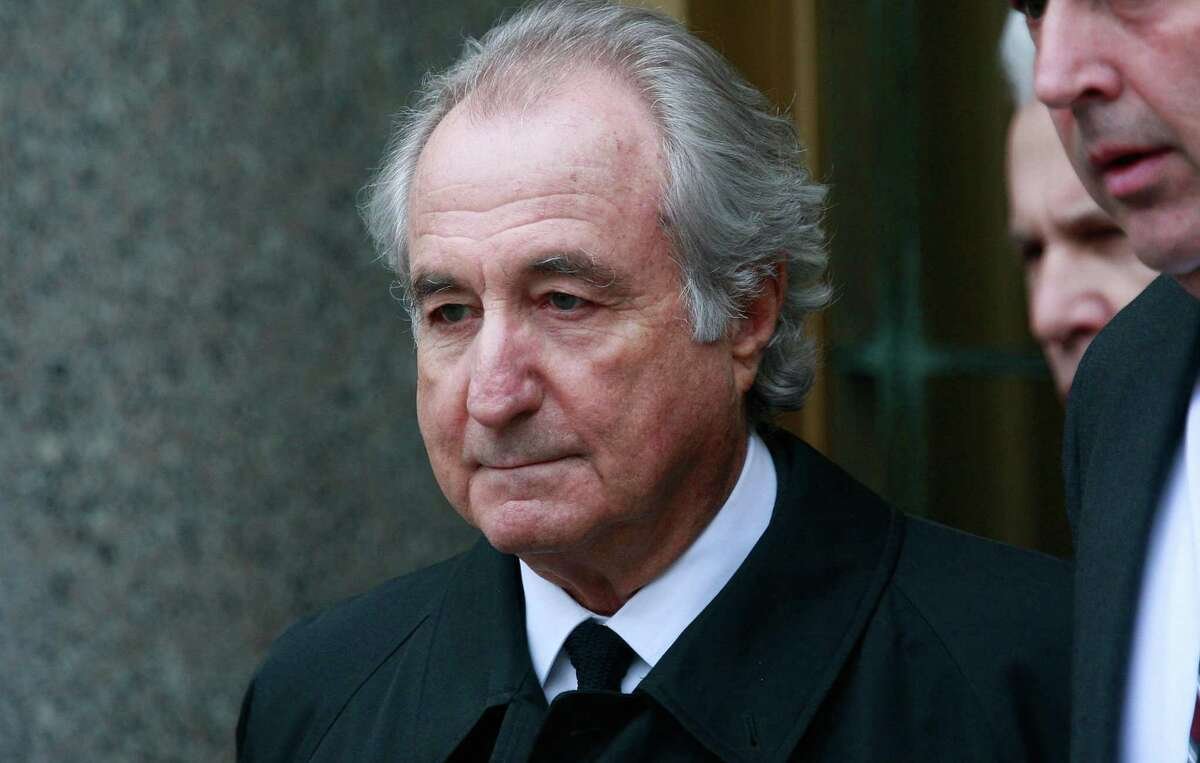
Bernie Madoff: Who He Was, How His Ponzi Scheme Worked
Bernard Lawrence “Bernie” Madoff was an American financier who executed the largest Ponzi scheme in history, defrauding thousands of investors out of tens of billions of dollars over at least 17 years, possibly longer.
He was also a pioneer in electronic trading and chair of the Nasdaq in the early 1990s. He died in prison at age 82 on April 14, 2021, while serving a 150-year sentence for money laundering, securities fraud, and several other felonies.
Early Life and Education
Bernie Madoff was born in Brooklyn, New York, on April 29, 1938, to Ralph and Sylvia Madoff. His father worked as a plumber before entering the financial industry with his wife.34 They founded Gibraltar Securities, which was ultimately forced to close by the SEC.5
Bernie earned a bachelor’s degree in political science from Hofstra University in 1960 and briefly attended law school at Brooklyn Law School. While in college, Bernie married his high school sweetheart, Ruth (née Alpern), with whom he later founded Bernard L. Madoff Investment Securities LLC in 1960.
At first, he traded penny stocks with the $5,000 he earned from installing sprinklers and working as a lifeguard.8 He soon persuaded family, friends, and others to invest with him. When the “Kennedy Slide” flash crash lopped 20% off the market in 1962, Madoff’s bets soured, and his father-in-law had to bail him out.
Notable Accomplishments
Madoff had a chip on his shoulder and felt he was not part of the Wall Street crowd. In an interview with journalist Steve Fishman, Madoff advised, “We were a small firm; we weren’t a member of the New York Stock Exchange. It was pronounced.”
According to Madoff, he began to make a name for himself as a scrappy market maker. “I was thrilled to take the crumbs,” he told Fishman, giving the example of a client who wanted to sell eight bonds; a giant firm would disdain that kind of order, but Madoff’s would complete it.
Success finally came when he and his brother Peter began to build electronic trading capabilities—”artificial intelligence,” in Madoff’s words—that attracted massive order flow and boosted the business by providing insights into market activity. “I had all these major banks coming down, entertaining me,” Madoff told Fishman. “It was a head trip.”
He and four other Wall Street mainstays processed half of the New York Stock Exchange’s order flow—controversially, he paid for much of it—and by the late 1980s, Madoff was making in the vicinity of $100 million a year. Madoff would become chair of the Nasdaq in 1990 and served in 1991 and 1993.
Scandal, Scheme, and Crime
At some point, Madoff attracted investors by claiming to generate significant, steady returns through an investing strategy called split-strike conversion, a legitimate trading strategy. However, Madoff deposited client funds into a single bank account to pay existing clients who wanted to cash out.
He funded redemptions by attracting new investors and their capital but could not maintain the fraud when the market turned sharply lower in late 2008.
On December 10, 2008, he confessed his wrongdoing to his sons, who worked at his firm. The following day, they turned him over to the authorities.12 Bernie remained adamant that his sons were not aware of his scheme. The fund’s last statements indicated it had $64.8 billion in client assets.
The Players
It is not sure when Madoff’s Ponzi scheme began. He testified in court that it started in the early 1990s, but his account manager, Frank DiPascali, who had worked at the firm since 1975, said the fraud had been occurring “for as long as I remember.”
Even less clear is why Madoff carried out the scheme at all. “I had more than enough money to support my lifestyle and my family’s. I didn’t need to do this for that,” he told Fishman, adding, “I don’t know why.” The legitimate wings of the business were highly lucrative, and Madoff could have earned the Wall Street elites’ respect solely as a market maker and electronic trading pioneer.
Madoff repeatedly suggested to Fishman that he was not entirely to blame for the fraud. “I just allowed myself to be talked into something, and that’s my fault,” he said, without making it clear who talked him into it. “I thought I could extricate myself after some time. I thought it would be a very short period, but I just couldn’t.”
The so-called Big Four—Carl Shapiro, Jeffry Picower, Stanley Chais, and Norm Levy—have attracted attention for their long and profitable involvement with Bernard L. Madoff Investment Securities LLC. Madoff’s relationships with these men go back to the 1960s and 1970s, and his scheme netted them hundreds of millions of dollars each.
“Everybody was greedy; everybody wanted to go on and I just went along with it,” Madoff told Fishman. He indicated that the Big Four and others (several feeder funds pumped client funds to him, some all but outsourcing their management of clients’ assets) must have suspected the returns he produced or should have. “How can you be making 15 or 18% when everyone is making less money?” Madoff said.
The Scheme
Madoff’s ultra-high returns persuaded clients to look the other way. He deposited their funds in an account at Chase Manhattan Bank—which merged to become JPMorgan Chase & Co. in 2000—and let them sit. According to one estimate, the bank may have made as much as $435 million in after-tax profit from those deposits.20
When clients wished to redeem their investments, Madoff funded the payouts with new capital, which he attracted through a reputation for unbelievable returns and grooming his victims by earning their trust. Madoff also cultivated an image of exclusivity, often initially turning clients away. This model allowed roughly half of Madoff’s investors to cash out at a profit. These investors must pay into a victims’ fund to compensate defrauded investors who lost money.
Madoff created a reputation for respectability and generosity, wooing investors through his charitable work. He also defrauded several nonprofits; some had their funds nearly wiped out, including the Elie Wiesel Foundation for Peace and the global women’s charity Hadassah.2122: He used his friendship with J. Ezra Merkin, an officer at Manhattan’s Fifth Avenue Synagogue, to approach congregants. By various accounts, Madoff swindled $2.4 billion from its members.
Madoff’s plausibility to investors was based on several factors:
- His principal public portfolio appeared to stick to safe investments in blue-chip stocks.
- He claimed to be using a collar strategy—a split-strike conversion. A collar minimizes risk, whereby purchasing an out-of-the-money put option protects the underlying shares.
- His returns were high (10 to 20% per annum), consistent, and not outlandish. As the Wall Street Journal reported in a now-famous interview with Madoff from 1992:
“[Madoff] insists the returns were really nothing special, given that the Standard & Poor’s 500-stock index generated an average annual return of 16.3% between November 1982 and November 1992. ‘I would be surprised if anybody thought that matching the S&P over 10 years was anything outstanding,’ he says.”
The Investigation
The SEC had been investigating Madoff and his securities firm since 1992—a fact that frustrated many after he was finally prosecuted since it was felt that the most significant damage could have been prevented if the initial investigations had been rigorous enough.
Financial analyst Harry Markopolos was one of the earliest whistleblowers. In 1999, he calculated in an afternoon that Madoff had to lie. He filed his first SEC complaint against Madoff in May 2000, but the regulator ignored him.
Markopolos wrote in a scathing 2005 letter to the Securities and Exchange Commission (SEC), “Madoff Securities is the world’s largest Ponzi scheme. In this case, there is no SEC reward payment due to the whistleblower, so I’m turning this case in because it’s the right thing to do.
Using what he called “Mosaic Theory,” Markopolos noted several irregularities.29 Madoff’s firm claimed to be making money even when the S&P was falling, which made no mathematical sense based on what Madoff claimed he was investing in.30 The biggest red flag of all, in Markopolos’s words, was that Madoff Securities was earning “undisclosed commissions” instead of the standard hedge fund fee (1% of the total plus 20% of the profits).
The bottom line, concluded by Markopolos, was that “the investors that pony up the money don’t know that BM [Bernie Madoff] is managing their money.”31 Markopolos also learned Madoff was applying for huge loans from European banks (seemingly unnecessary if Madoff’s returns were as high as he said).
It was not until 2005—shortly after Madoff nearly went belly-up due to a wave of redemptions—that the regulator asked Madoff for documentation on his trading accounts. He made up a six-page list; the SEC drafted letters to two of the firms listed but didn’t send them, and that was that. “The lie was simply too large to fit into the agency’s limited imagination,” writes Diana Henriques, author of the book “The Wizard of Lies: Bernie Madoff and the Death of Trust,” which documents the episode. The SEC was criticized in 2008 following the revelation of Madoff’s fraud and their slow response to act on it.
The Punishment
In November 2008, Bernard L. Madoff Investment Securities LLC reported year-to-date returns of 5.6% during the same period when the S&P 500 dropped 39%.34 As the selling continued, Madoff became unable to keep up with a cascade of client redemption requests
So, on December 10, according to the account he gave Fishman, Madoff confessed to his sons Mark and Andy, who worked at their father’s firm. “The afternoon I told them all, they immediately left, they went to a lawyer, the lawyer said, ‘You gotta turn your father in,’ they went, did that, and then I never saw them again.” Bernie Madoff was arrested on December 11, 2008.35
Madoff insisted he acted alone, though several of his colleagues were sent to prison. His elder son, Mark Madoff, committed suicide precisely two years after his father’s fraud was exposed.36. Several of Madoff’s investors also killed themselves. Andy Madoff died of cancer at age 48 in 2014.
Madoff was sentenced to 150 years and forced to forfeit $170 billion in 2009. The U.S. Marshals auctioned off his three homes and four boats. On February 5, 2020, Madoff’s lawyers requested that he be released early from prison, claiming that he was suffering from a terminal kidney disease that may kill him within 18 months.39
However, Madoff, prisoner No. 61727-054, remained at the Butner Federal Correctional Institution in North Carolina until he died on April 14, 2021.
The Aftermath
The paper trail of victims’ claims displays the complexity and sheer size of Madoff’s betrayal of investors. According to documents, Madoff’s scam ran for over five decades, beginning in the 1960s. His final account statements, which include millions of pages of fake trades and shady accounting, show that the firm had $47 billion in “profit.”
While Madoff pleaded guilty in 2009 and was sentenced to spend the rest of his life in prison, thousands of investors lost their life savings, and multiple tales detail the harrowing sense of loss victims endured.
Investors victimized by Madoff have been helped by Irving Picard, a New York lawyer overseeing the liquidation of Madoff’s firm in bankruptcy court. Picard has sued those who profited from the Ponzi scheme; by April 2021, he had recovered nearly $14 billion.
In addition, a Madoff Victim Fund (MVF) was created in 2013 to help compensate those Madoff defrauded. Still, the Department of Justice didn’t start paying roughly $4 billion in the fund until late 2017. Richard Breeden, a former SEC chair overseeing the fund, noted that thousands of the claims were from “indirect investors”—people who put money into funds Madoff had invested in during his scheme. Since they were not direct victims, Breeden and his team had to sift through thousands and thousands of claims, only to reject many of them. Breeden said he based most of his decisions on a straightforward rule: Did the person in question put more money into Madoff’s funds than they took out?45 Breeden estimated that the number of “feeder” investors was north of 11,000 individuals.
In a September 2021 update for the Madoff Victim Fund, Breeden wrote, “MVF is thrilled to announce a new distribution totaling $568,648,065 to 30,539 victims of the crimes committed at Madoff Securities. This is our largest distribution yet when compared to the number of victims paid. With the completion of the seventh distribution of funds in September 2021, approximately $3.762 billion has been distributed to 39,494 Madoff victims in the U.S. and worldwide. Breeden also noted that they have recovered 81.35% of the victims.
Depictions of Bernie Madoff in Popular Culture
As a financial antagonist, Bernie Madoff has been depicted as a villain in the media and pop culture. For instance, in a 2009 episode of HBO’s Curb Your Enthusiasm, Jason Alexander (who played George on Seinfeld) falls victim to Madoff’s con and loses all of the money he earned from a made-up app. Madoff (or similar knock-offs) have also had other fictional characters, such as a couple in Woody Allen’s film Blue Jasmine and the protagonist of Elinor Lipman’s novel The View from Penthouse B.
Madoff himself has also been depicted in several incarnations, from a 2010 theatrical production called Investing with Madoff to an ABC miniseries starting with Richard Dreyfuss. In 2017, Robert DeNiro played Madoff in the HBO film The Wizard of Lies. Several documentaries, books, and journalistic accounts have also described Bernie Madoff’s fraud and subsequent demise.
Who was Bernie Madoff?
Bernie Madoff was an American financier and former Nasdaq chair who orchestrated the largest Ponzi scheme in history. Bernie promised investors high returns in exchange for their investments. However, rather than investing, he deposited their money into a bank account and paid, upon request, from existing and new investors’ funds. During the 2008 recession, he could no longer accommodate redemption requests. His scheme ended after his sons turned him over to the authorities. Bernie was convicted of fraud, money laundering, and other related crimes, for which he was sentenced to 150 years in federal prison. Bernie Madoff died in prison on April 14, 2021, at 82.
How much money did Bernie Madoff return?
In addition to being sentenced to prison, Bernie Madoff was ordered to pay back $170 billion of investors’ money. The Feds seized and sold Madoff’s assets, which included real estate, yachts, and jewelry. As of September 2021, the Richard Breeden-led Bernie Madoff Victims Fund had recovered and paid out more than $3.7 billion to nearly 40,000 victims.
How did Madoff get caught?
Although several people alerted the SEC and other authorities to Bernie Madoff’s scheme, it wasn’t until he confessed to his sons that he was caught. In 2008, when Bernie could no longer accommodate investors’ redemption requests, he admitted his wrongdoings to his sons, Mark and Andrew, who then turned their father over to authorities.
In 2009, at age 71, Madoff pleaded guilty to 11 federal felony counts, including securities fraud, wire fraud, mail fraud, perjury, and money laundering. The Ponzi scheme became a potent symbol of the culture of greed and dishonesty that, according to critics, pervaded Wall Street in the run-up to the financial crisis. Madoff, the subject of numerous articles, books, movies, and biopic miniseries, was sentenced to 150 years in prison and ordered to forfeit $170 billion in assets. Still, no other prominent Wall Street figures faced legal ramifications after the crisis. In April 2021, Madoff died in a federal correctional facility at age 82.
Conclusion
- Bernie Madoff was a money manager responsible for one of the largest financial frauds in modern-day history.
- Bernie Madoff’s Ponzi scheme, which likely ran for decades, defrauded thousands of investors out of tens of billions of dollars.
- Investors put their trust in Madoff because he created a reputation for respectability, his returns were high but not outlandish, and he claimed to use a legitimate strategy.
- In 2009, Madoff was sentenced to 150 years and forced to forfeit $170 billion as restitution.
- As of September 2021, the Madoff Victims Fund had distributed its seventh distribution of more than $568 million.

