

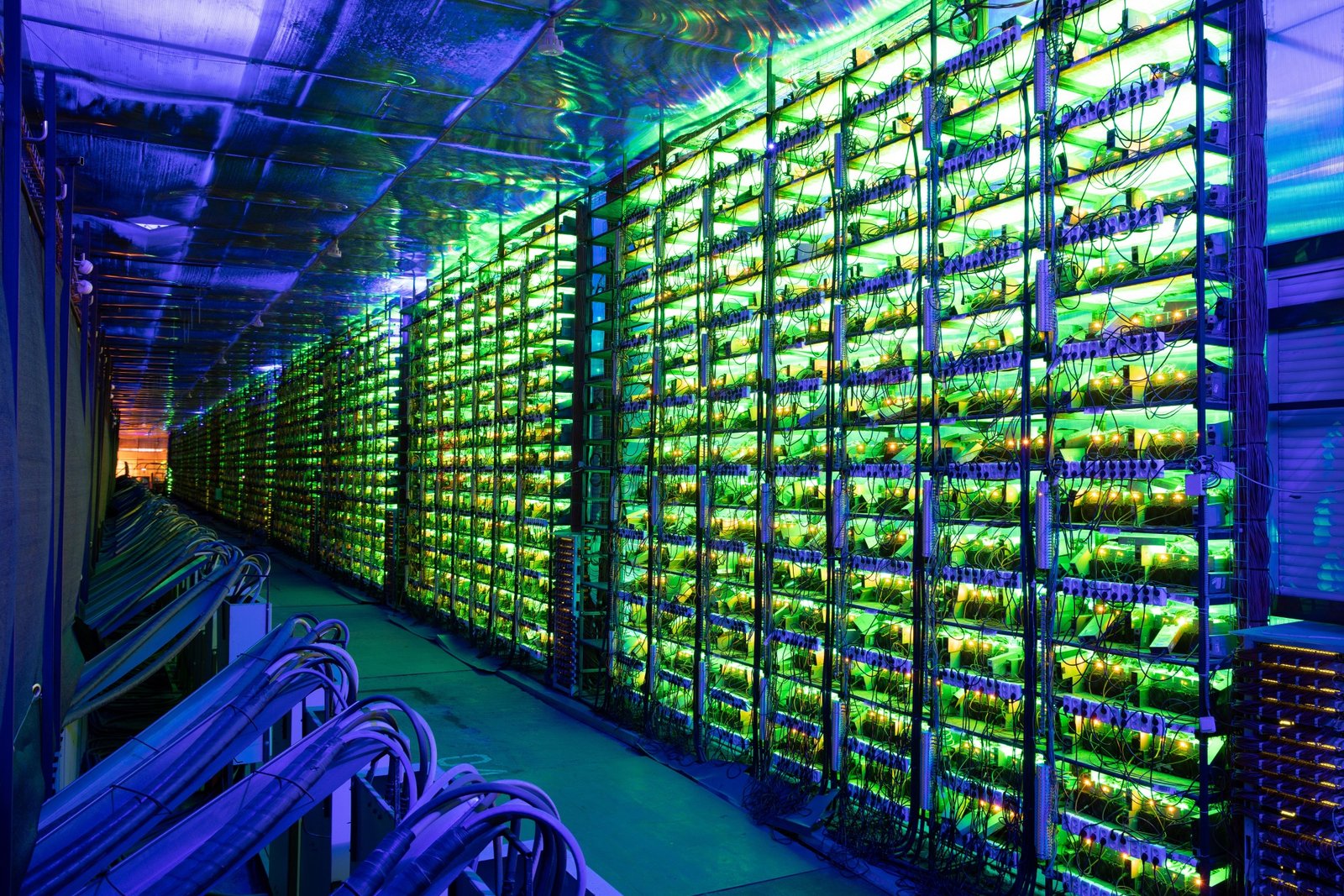
What is Bitcoin mining?
The process of mining Bitcoin involves generating a cryptographic solution that satisfies specific requirements to authenticate the information inside a blockchain block. The miners or miners who were the first to arrive at the proper answer, are rewarded with bitcoin and fees for the work that they have done. This payment is granted when the correct solution is achieved.
There is a gradual decrease in the payoff for mining Bitcoin over time. This process of awarding rewards will continue until there are 21 million bitcoins in circulation. As soon as that threshold is met, it is anticipated that the Bitcoin incentive will be discontinued, and miners will be compensated for their efforts by receiving fees for the task they have completed.
How does Bitcoin mining work?
Here’s a simplified example to explain the process: Say you ask friends to guess a number between 1 and 100. Your friends don’t have to guess the exact number; they have to be the first to guess a number less than or equal to your number. If you think of the number 19, and a friend comes up with 21, another 55, and another 83, they lose because they all guessed more than 19. But if you have three friends left and the next one guesses 16, they win, and the others don’t get a chance to guess. The one who guessed 16 was the first to guess a number less than or equal to 19.
In this case, the number you chose, 19, represents the target hash the Bitcoin network creates for a block, and the random guesses from your friends are the guesses from the miners.
How does bitcoin mining work?
Here’s a simplified example to explain the process:. Say you ask friends to guess a number between 1 and 100. Your friends don’t have to guess the exact number; they have to be the first to guess a number less than or equal to your number. If you think of the number 19, and a friend comes up with 21, another 55, and another 83, they lose because they all guessed more than 19. But if you have three friends left and the next one guesses 16, they win, and the others don’t get a chance to guess. The one who guessed 16 was the first to guess a number less than or equal to 19.
In this case, the number you chose, 19, represents the target hash the Bitcoin network creates for a block, and the random guesses from your friends are the guesses from the miners.
Proof-of-Work
The mining process is what you hear called proof-of-work (PoW)—it takes a lot of energy and computational power to reach the goal of less than or equal to a target hash. The work done is considered the validation proof needed—Calit’s proof-of-work.
Confirmation
Each block contains the previous block’s hash, so when the next block is generated, the previous block is included. Remember that if even one character changes, the hash changes, so the hash of each following block will change. This secures the blockchain.
However, the block you closed and received a reward for hasn’t yet been firmed up. The block isn’t checked until five blocks after it has gone through that many validations. That said, altering information in a block is possible before reaching six validations. Still, it is doubtful because the network must be controlled by someone attempting to change information for it to work.
Rewards
The reward for successfully validating a block is bitcoin. In 2009, you’d receive 50 bitcoins for mining a block. But the block reward is halved every 210,000 blocks (or roughly every four years), so in 2013, the reward amount declined to 25, then 12.5, then 6.25. In the Bitcoin’slving event, the reward will change to 3.125.7
Another incentive for Bitcoin miners to participate in the process is transaction fees. In addition to rewards, miners also receive fees from any transactions in that block. When Bitcoin reaches its planned limit of 21 million (expected around 2140), miners will be rewarded with fees for processing transactions that network users will pay. These fees ensure miners are still incentivized to mine and keep the network going. The idea is that competition for these fees will cause them to remain low after halving events are finished.
Difficulty
Mining difficulty is how much work it takes to generate a number less than the target hash. Mining difficulty changes every 2,016 blocks or approximately every two weeks. The next difficulty level depends on how efficient miners were in the preceding cycle.
It is also affected by the number of new miners joining Bitcoin because it increases the hash rate or the amount of computing power deployed to mine the cryptocurrency. The more miners compete for a solution, the more complex the problem will become. If computational power is taken off the network, the difficulty adjusts downward to make mining easier.
The difficulty level for mining in October 2023 was $57.3 trillion. The chances of a computer producing a hash below the target are 1 in 57.3 trillion. To put that in perspective, you are about 170,000 times more likely to win the Powerball jackpot with a single lottery ticket than you are to pick the correct hash on a single try.
What Are the Economics of Mining Bitcoin?
Bitcoin mining is a business venture. Profits generated from its bitcoin output depend on the investment made in its inputs.
There are three main costs of Bitcoin mining:
- Electricity: This is the power that runs your mining systems 24/7. Mining can run up a substantial bill. Considering that the process (network-wide) consumes as much electricity as certain countries, the costs can be high.10. It’s important to consider the costs of cooling the area your mining system is in. They produce a lot of heat while mining—the more you have, the more heat they produce. These rigs need to be cooled, so the air conditioning you need can become very expensive.
- Mining systems: Contrary to the popular narrative, desktop computers and regular gaming systems can be used to mine by joining a mining pool. However, the returns are limited because most pools split the rewards based on the amount of work each miner contributes. These systems cannot compete with the ASIC mining machines, but it is possible to come out a few hundred dollars ahead after accounting for the energy used. If you want to be competitive, you’ll buy several ASIC miners and join a pool, which can set you back between $4,000 and $12,000 per rig. The faster they can mine, the more you’ll build infrastructure. Network speeds do not significantly affect the Bitcoin mining process, but latency does. Latency is the time it takes to communicate with the rest of the network. Also, mining farms require multiple internal connections to connect each mining rig to a primary router or server with a connection to the internet. However, if you’re using our gaming rig to mine and join a pool, you shouldn’t need extra bandwidth—just low latency to the pool you joined.
The total costs for these three inputs should be less than the output—in this case, bitcoin’s—or your ability to generate profits from your venture. Considering the fluctuating—and often rising—price of Bitcoin, minting your cryptocurrency might sound like an attractive proposition.
But given the economic difficulties of Bitcoin mining, you may have to resign yourself to accepting lower profits and a longer time to break even after purchasing equipment to participate in the lottery that Bitcoin has become.
History of Bitcoin Mining
Two developments have contributed to the evolution and composition of Bitcoin mining today. First, custom manufacturing of mining Bitcoin machines acted to centralize the network. Because Bitcoin mining is essentially guesswork, arriving at the correct answer before another miner has almost everything to do with how fast your computer can produce hashes.
In the early days of Bitcoin, desktop computers with ordinary CPUs dominated Bitcoin mining. However, it began taking a long time to discover transactions on the cryptocurrency’s level as the algorithm’s level increased with time. According to some estimates, it would have taken “several hundred thousand years on average” using “PUs to find a valid block at the early 2015 difficulty level.11
GPU Mining
Over time, miners realized that graphics processing units (GPUs), or graphics cards, were more effective and faster at mining. But they consumed a lot of power and weren’t for heavy mining. Eventually, manufacturers began limiting their mining abilities because the increase in demand for GPUs made their prices skyrocket and decreased their availability.
ASIC Mining
Miners now use custom mining machines, called Application-Specific Integrated Circuit (ASIC) miners, equipped with specialized chips for faster and more efficient bitcoin mining. They cost anywhere from several hundred to tens of thousands of dollars. Today, bitcoin mining is so competitive that it can only be done profitably with the most up-to-date ASICs. But even with the newest unit at your disposal, one is rarely enough to compete with mining pools.
Issues With Bitcoin Mining
Between one in 57.6 trillion odds, scaling difficulty levels, and the massive network of users verifying transactions, one block of transactions is verified roughly every 10 minutes.12 But it’s important to remember that 10 minutes is a goal, not a rule.
Speed
The Bitcoin network can currently process between three and six transactions per second, with transactions logged in the blockchain every 10 minutes.13 By comparison, Visa can process somewhere around 65,000 transactions per second.14 Second-layer solutions and upgrades to the Bitcoin blockchain have attempted to address speed issues. However, modern banking networks and other blockchains still dwarf the number of transactions the Bitcoin network can handle.
Scalability
This issue at the heart of the Bitcoin protocol is known as scaling. Though Bitcoin miners generally agree that something must be done to address scaling, there is less consensus about how to do it.
Bitcoin has been adjusted by introducing upgrades and accepting input from layers that do much of the work off-chain, but it still has issues with scalability.
Energy Use
For most of Bitcoin’s history, its mining process has remained energy-intensive. In the decade after it was launched, Bitcoin mining was concentrated in China, which relies on fossil fuels like coal to produce most of its electricity. Not surprisingly, Bitcoin mining’s high energy costs have drawn the attention of climate change activists. According to some estimates, the cryptocurrency’s process consumes as much electricity as entire countries.
What is Bitcoin mining?
Bitcoin mining is the process that validates Bitcoin transactions. It consists of mining systems competing with each other to solve a cryptographic problem and award Bitcoin.
What Purpose Does Bitcoin Mining Serve?
Bitcoin mining serves two purposes: It confirms and secures cryptocurrency transactions.
What Are the Main Costs Associated With Bitcoin Mining?
The three most significant costs for Bitcoin mining are electricity, network infrastructure, and mining infrastructure.
Bitcoin mining is a costly hobby without guaranteed results. To be competitive, you must invest in several expensive machines, run them 24/7, and pay high electricity bills. Even then, there is no guarantee that you will earn any bitcoin.
Is Bitcoin mining green?
Climate activists have criticized Bitcoin mining’s usage as proof that the cryptocurrency is not environmentally friendly. Bitcoin mining is estimated to consume as much electricity as entire countries.10 As the world pivots toward renewable energy sources, bitcoin mining is expected to become greener.
Conclusion
- Validating transaction information and maintaining the integrity of the blockchain are mining jobs, while the Bitcoin reward is an incentive to mine.
- Bitcoin mining is necessary to maintain the ledger of transactions upon which Bitcoin is based.
- Miners have become very sophisticated over the past several years, using complex machinery and grouping to speed up mining operations.
- Bitcoin mining has generated controversy because it is not considered environmentally friendly.

