

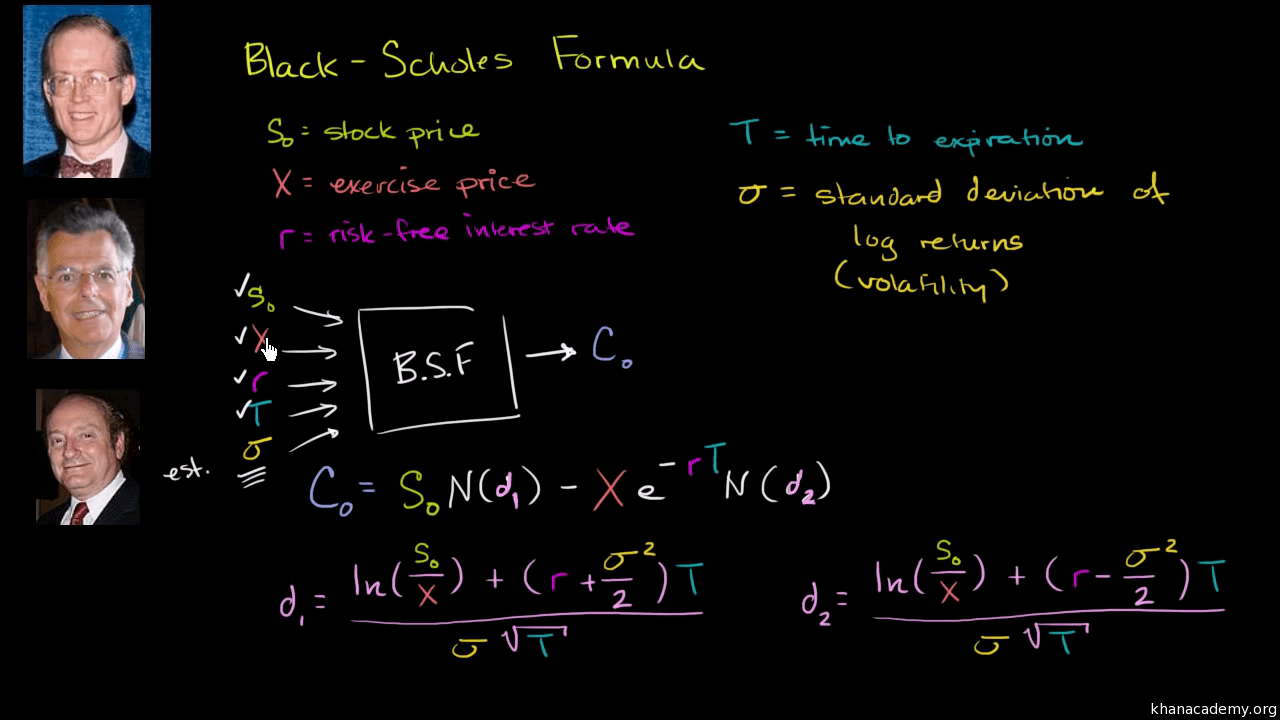
What is the Black-Scholes Model?
It is widely acknowledged that the Black-Scholes model, often called the Black-Scholes-Merton (BSM) model, is among the most fundamental ideas in contemporary financial theory. Considering the influence of time and several other risk variables, this mathematical equation provides an estimate of the theoretical value of derivatives dependent on other investment instruments. Developed in 1973, it is currently recognized as one of the finest approaches to pricing an option contract.
History of the Black-Scholes Model
Developed in 1973 by Fischer Black, Robert Merton, and Myron Scholes, the Black-Scholes model was the first widely used mathematical method to calculate the theoretical value of an option contract, using current stock prices, expected dividends, the option’s strike price, expected interest rates, time to expiration, and expected volatility.
The initial equation was introduced in Black and Scholes’ 1973 paper, “The Pricing of Options and Corporate Liabilities,” published in the Journal of Political Economy.1 Robert C. Merton helped edit that paper. Later that year, he published his article, “Theory of Rational Option Pricing,” in The Bell Journal of Economics and Management Science, expanding the mathematical understanding and applications of the model and coining the term “Black-Scholes theory of options pricing.”
In 1997, Scholes and Merton were awarded the Nobel Memorial Prize in Economic Sciences for finding “a new method to determine the value of derivatives.” Black had passed away two years earlier and so could not be a recipient, as Nobel Prizes are not given posthumously; however, the Nobel committee acknowledged his role in the Black-Scholes model.
How the Black-Scholes Model Works
Black-Scholes posits that instruments, such as stock shares or futures contracts, will have a lognormal distribution of prices following a random walk with constant drift and volatility. Using this assumption and factoring in other important variables, the equation derives the price of a European-style call option.
The Black-Scholes equation requires five variables. These inputs are volatility, the underlying asset’s price, the option’s strike price, the time until the option’s expiration, and the risk-free interest rate. With these variables, it is theoretically possible for option sellers to set rational prices for their selling options.
Furthermore, the model predicts that heavily traded asset prices follow a geometric Brownian motion with constant drift and volatility. When applied to a stock option, the model incorporates the constant price variation of the stock, the time value of money, the option’s strike price, and the time to the option’s expiry.
Black-Scholes Assumptions
The Black-Scholes model makes certain assumptions:
- No dividends are paid out during the life of the option.
- Markets are random (i.e., market movements cannot be predicted).
- There are no transaction costs associated with buying the option.
- The risk-free rate and volatility of the underlying asset are known and constant.
- The returns of the underlying asset are normally distributed.
- The option is European and can only be exercised at expiration.
While the original Black-Scholes model didn’t consider the effects of dividends paid during the option’s life, the model is frequently adapted to account for dividends by determining the ex-dividend date value of the underlying stock. Many option-selling market makers also modify the model to account for the effect of options that can be exercised before expiration.
Alternatively, firms will use a binomial or trinomial model or the Bjerksund-Stensland model for the pricing of the more commonly traded American-style options.
The Black-Scholes Model Formula
The mathematics involved in the formula are complicated and can be intimidating. Fortunately, you don’t need to know or even understand the math to use Black-Scholes modeling in your strategies. Options traders have access to various online options calculators, and many of today’s trading platforms boast robust options analysis tools, including indicators and spreadsheets that perform the calculations and output the options pricing values.
The Black-Scholes call option formula is calculated by multiplying the stock price by the cumulative standard normal probability distribution function. After that, the strike price’s net present value (NPV) multiplied by the cumulative standard normal distribution is subtracted from the resulting value of the previous calculation.
Volatility Skew
Black-Scholes assumes stock prices follow a lognormal distribution because asset prices cannot be hostile (they are bounded by zero).
Often, asset prices are observed to have significant right skewness and some degree of kurtosis (fat tails). This means high-risk downward moves happen more often in the market than a normal distribution predicts.
The assumption of lognormal underlying asset prices should show that implied volatilities are similar for each strike price according to the Black-Scholes model. However, since the market crash in 1987, implied volatility for at-the-money options has been lower than those further out of the money or far in the money. This phenomenon is because the market is pricing with a greater likelihood of a high volatility move to the downside in the markets.
This has led to the presence of a volatility skew. A smile or skewed shape can be seen when the implied volatilities for options with the same expiration date are mapped out on a graph. Thus, the Black-Scholes model is not efficient for calculating implied volatility.
The Black-Scholes model is often contrasted against the binominal or Monte Carlo simulations.
Benefits of the Black-Scholes Model
The Black-Scholes model has been successfully implemented and used by many financial professionals due to its variety of benefits. Some of these benefits are listed below.
- Provides a framework: The Black-Scholes model provides a theoretical framework for pricing options. This allows investors and traders to determine the fair price of an option using a structured, defined methodology that has been tried and tested.
- Allows for Risk Management: By knowing the theoretical value of an option, investors can use the Black-Scholes model to manage their risk exposure to different assets. The Black-Scholes model is, therefore, valuable for investors in evaluating potential returns and understanding portfolio weaknesses and deficient investment areas.
- Allows for Portfolio Optimization: The Black-Scholes model can optimize portfolios by measuring the expected returns and risks associated with different options. This allows investors to make smarter choices that are better aligned with their risk tolerance and pursuit of profit.
- Enhances Market Efficiency: The Black-Scholes model has led to greater market efficiency and transparency as traders and investors can better price and trade options. This simplifies the pricing process as there is a greater implicit understanding of how prices are derived.
- Streamlines Pricing: On a similar note, practitioners in the financial industry widely accept and use the Black-Scholes model. This allows for greater consistency and comparability across different markets and jurisdictions.
Limitations of the Black-Scholes Model
Though the Black-Scholes model is widely used, there are still some drawbacks. Some drawbacks are listed below.
- Limits Usefulness: As stated previously, the Black-Scholes model only prices European options and does not consider that U.S. options could be exercised before the expiration date.
- Lacks Cashflow Flexibility: The model assumes that dividends and risk-free rates are constant, but this may not be true. Therefore, the Black-Scholes model may lack the ability to truly reflect an investment’s accurate future cash flow due to model rigidity.
- Assumes Constant Volatility: The model also assumes volatility remains constant over the option’s life. This is often not the case because volatility fluctuates with supply and demand.
- Misleads Other Assumptions: The Black-Scholes model also leverages other assumptions. These assumptions include that there are no transaction costs or taxes, the risk-free interest rate is constant for all maturities, short selling of securities with the use of proceeds is permitted, and there are no risk-less arbitrage opportunities. These assumptions can lead to prices that deviate from the actual results.
- Acts as a stable framework that can be used using a defined method.
- Allows investors to mitigate risk by better understanding exposure
- It may be used to devise the best portfolio strategies based on an investor’s preferences.
- Streamlines and improves efficient calculating and reporting of figures
- It does not take into consideration all types of options
- May lack cashflow flexibility based on the future projections of a security
- May make inaccurate assumptions about future stable volatility
- It relies on several other assumptions that may not materialize into the actual price of the security
What Does the Black-Scholes Model Do?
The Black-Scholes model, also known as Black-Scholes-Merton (BSM), was the first widely used model for option pricing. Based on certain assumptions about the behavior of asset prices, the equation calculates the price of a European-style call option based on known variables like the current price, maturity date, and strike price. To do this, subtract the cumulative standard normal probability distribution function from the product of the stock price and the strike price’s net present value (NPV).
What Are the Inputs for the Black-Scholes Model?
The inputs for the Black-Scholes equation are volatility, the underlying asset price, the option’s strike price, the time until the option’s expiration, and the risk-free interest rate. With these variables, it is theoretically possible for option sellers to set rational prices for their selling options.
What Assumptions Does the Black-Scholes Model Make?
The original Black-Scholes model assumes that the option is a European-style option and can only be exercised at expiration. It also assumes that no dividends are paid out during the life of the option, that market movements cannot be predicted, that there are no transaction costs in buying the option, that the risk-free rate and volatility of the underlying asset are known and constant, and that the prices of the underlying asset follow a lognormal distribution.
What Are the Limitations of the Black-Scholes Model?
The Black-Scholes model only prices European options and does not consider that American options could be exercised before the expiration date. Moreover, the model assumes dividends, volatility, and risk-free rates remain constant over the option’s life.
Not considering taxes, commissions, trading costs, or taxes can also lead to valuations that deviate from real-world results.
The Black-Scholes model is a mathematical model used to calculate the fair price or theoretical value. It provides a way to calculate an option’s theoretical value by considering the underlying asset’s current price, the option’s strike price, the time remaining until expiration, the risk-free interest rate, and the volatility of the underlying asset. The Black-Scholes model has profoundly impacted finance and led to the development of a wide range of derivative products such as futures, swaps, and options.
Conclusion
- The Black-Scholes model, aka the Black-Scholes-Merton (BSM) model, is a differential equation widely used to price options contracts.
- The Black-Scholes model requires five input variables: the strike price of an option, the current stock price, the time to expiration, the risk-free rate, and the volatility.
- Though usually accurate, the Black-Scholes model makes certain assumptions that can lead to predictions that deviate from real-world results.
- The standard BSM model is only used to price European options, as it does not consider that American options could be exercised before the expiration date.

