

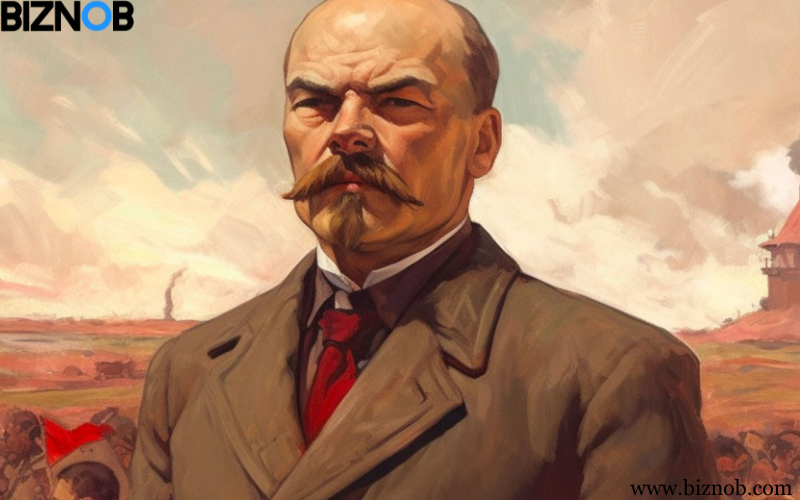
The founder of the 1917 Bolshevik revolution in Russia and the first head of the Union of Soviet Socialist Republics (USSR) was Vladimir Ilyich Ulyanov, also known as “Lenin.”
He used force to establish communism, a version of Marxist socialism, in the former Russian Empire. Its goals were to eliminate the nobility, redistribute wealth, impose community control over the means of production, and make life more equal for most people.
Throughout his adult life, Lenin actively promoted and oversaw Russian revolutionary communist activity. The October Revolution of 1917 catalyzed the ascent of Lenin’s Bolshevik party to power. Following the Revolution, the Bolshevik regime led by Lenin was characterized by widespread economic collapse and hardship, a violent civil war, widespread (and occasionally intentional) starvations among the rural working class, and the ruthless persecution, torture, and killing of anyone suspected of dissent, inadequate allegiance to the Revolution, or withholding food or other necessities.
Lenin is still held in high regard by certain communists, supporters, and people from the former USSR states, despite his crimes. According to a 2017 Levada Center survey conducted in Russia, Lenin’s standing as the nation’s father has faded but is still intact. Up from 40% in 2006, 56% of Russians now think he had an entirely or primarily favorable impact on Russian history, yet many surveyed were unable to provide specifics regarding his actions.
Childhood and Schooling
Approximately 450 miles east of Moscow, in Simbirsk, Lenin was born in 1870. Under the last name Ulyanov, his family belonged to an affluent middle-class family. His older brother Alexandr’s death for attempting to kill the Russian Tsar and his expulsion from Kazan University for instigating a student uprising in 1887 were the two events that shaped his opinions on the Revolution.
He converted to Marxism in 1889. However, he was subsequently permitted to take the bar exam and graduated from St. Petersburg University with a law degree. He joined a gang of revolutionary Marxists and became a public defender.
He was ultimately sent to Siberia for three years, from 1897 to 1900, due to his actions. He relocated to Europe and took on the alias “Lenin” to conduct his revolutionary operations there. In 1907, he left Russia again to get involved in the Revolution of 1905, which finally failed.
Acts
The Revolution in Russia
In April 1917, when the monarch had abdicated and the Soviet Revolution had begun, Lenin returned to Russia. Lenin referred to the temporary authority in the nation as “a dictatorship of the bourgeoisie.” He imagined a society where workers and peasants reigned under a “dictatorship of the proletariat.”
Because of the devastation that World War I was causing Russia and their desire for change, Lenin and his Red Guards—a clandestinely assembled army of workers, peasants, and disgruntled Russian military personnel—were able to overthrow the government in a nearly bloodless coup d’état in November 1917.
The Civil War in Russia
After Lenin came to power, he pulled Russia out of World War I. Still, not before his Red Army and the White Army—a confederation of monarchists, capitalists, and democratic socialists—started a three-year civil war. Lenin established “War Communism,” which nationalized every business and manufacturer to finance the war. Farmers’ grain was confiscated to feed the armed forces and generate revenue for the government by selling it overseas.
It is believed that socialism is a transitional stage between capitalism and communism. In socialism, people equally share economic resources given by a democratically elected government, unlike in communism, which entails total state control over financial resources.
Following a 1918 assassination attempt that left him critically injured, Lenin used the Cheka, the Bolshevik secret police, to carry out the Red Terror. According to some estimates, over 100,000 individuals were killed who were either associated with or believed to be opposed to the Revolution’s goals (also known as “counterrevolutionaries”).
In November 1920, the Red Army defeated Crimea’s last White Army forces. Lenin’s revolutionary activities are believed to have murdered 8 million people and 1.5 million soldiers between the Russian Civil War, the Red Terror, and the famines that followed because of War Communism.
Lenin’s War Communism ultimately destroyed the economy, creating the USSR. To avert a repeat of the 1921 Russian Revolution, he instituted his New Economic Policy after the hunger that claimed the lives of at least five million people. It allowed for the introduction of a wage system, some private businesses, and the open market sale of crops and other items by peasants, subject to the payment of taxes on any profits received in the form of cash or raw materials—state-owned for-profit businesses like steel.
Between 1922 and 1924, Lenin had a series of strokes that made it impossible for him to talk and rule. Less than a year after the Bolsheviks signed a treaty establishing the USSR on December 30, 1922, including Russia, Ukraine, Belarus, and the Transcaucasian Federation (later Georgia, Armenia, and Azerbaijan), he passed away on January 21, 1924. His remains were embalmed and placed on exhibit at a mausoleum in Red Square, Moscow, where they remain to this day.
History
Lenin’s legacy is a multifaceted one. He aimed to better the lot of Russia’s working class, poor, and peasants who suffered under the aristocratic practices of the Russian Empire. Millions of people died as a consequence of his cruel actions, even though he brought about a revolution and a new kind of government.
Furthermore, he established the USSR, which, under Stalin, descended into an even more ruthless state that claimed millions more lives and complicated global matters for the 20th century and even into the 21st following its collapse.
Lenin’s Revolution was only partially able to accomplish its original aim. Even though the Russian nobility was annihilated, many people’s lifestyles remained unchanged.
Lenin wrote extensively on his ideas about capitalism, the Revolution, the Russian Empire, and Marxism. The April Theses, The Development of Capitalism in Russia, Imperialism, the Highest Stage of Capitalism, and What Is to Be Done are some of his most significant writings that address these subjects. Severe Issues Facing Our Movement: The Three Foundations and Elements of Marxism.”
What was Vladimir Lenin’s fate?
A cerebral hemorrhage claimed the life of 54-year-old Vladimir Lenin in 1924. He had already had strokes. Stalin took over as the Soviet Union’s leader after his death.
What was the achievement of Vladimir Lenin?
Lenin-led revolutionary uprising helped the communist Bolshevik party gain control of Russia and the former Russian Empire. One of the most significant global historical occurrences of the 20th century, it would have a global impact on international political, strategic, and economic developments. Millions of Russians and others died as a consequence of Lenin’s Revolution and the Soviet Union’s founding, which also sparked the Cold War, a century-long series of sporadic battles and diplomatic disputes.
What did Vladimir Lenin want during World War I?
Russia was still an empire under Tsar Nicholas II at the start of World War I. Lenin thought that Russia’s defeat in the First World War would usher in the revolutionary revolution he had long been waiting for. During this period, he authored and published several works. Lenin returned to Russia after the war to fan the flames of the already-ent revolution.
The Final Word
One of the most influential figures in history, Vladimir Lenin, changed his nation in a way that affected millions of people’s lives and influenced the whole globe. His legacy will also be remembered for his cruel government and the millions of people he killed, even if his ideas on capitalism and Marxism are still read today and have influenced many people and countries.
Conclusion
- One of the main organizers of the Russian communist revolution that resulted in the creation of the USSR was Vladimir Ilyich “Lenin” Ulyanov.
- The scion of a prosperous upper-middle-class family, Lenin came to power by taking advantage of the unhappiness of rural peasants and the urban working poor.
- Over 8 million Russian Empire residents perished as a direct consequence of Lenin’s Revolution, the civil war and famines that followed, and the ruthless internal repression he oversaw against dissidents and scapegoats. Many of them perished from hunger, torture, or summary execution.

