

What Is Two-Bin Inventory Control?
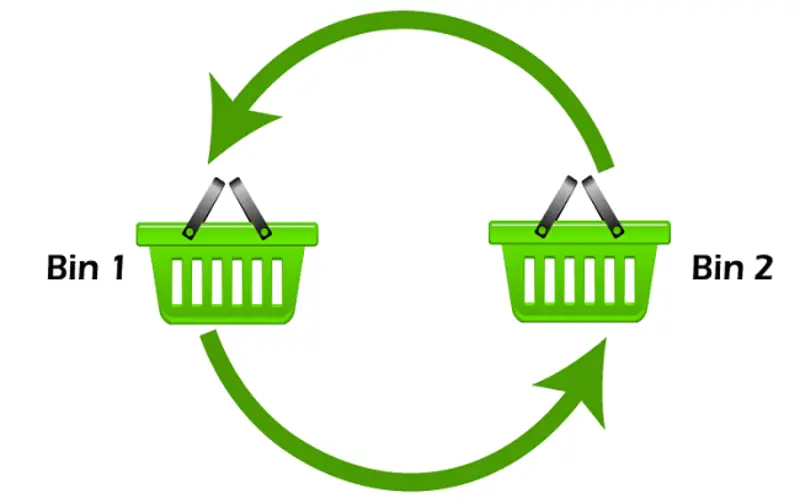
Two-bin inventory control is a method for figuring out when to refill supplies or materials utilized in manufacturing. Once the first bin’s contents are gone, a request is made to replenish or swap them. Then, the second bin should be stocked with enough goods to hold out until the first bin’s order is delivered. The second bin holds leftover material or reserve stock, whereas the first has the bare minimum operating stock. Kanban, a term closely linked to the just-in-time (JIT) technique of production, is another name for the two-bin inventory management system.
How Two-Bin Inventory Control Works
One of the main issues businesses have is effectively controlling stock levels. It would be best to have more inventory to avoid losing to rivals and missing sales chances. On the other hand, having too much inventory increases the likelihood of theft, deterioration, damage, and exposure to variations in demand. It also entails more storage expenses and longer times to recover the money from items acquired and returned to the company.
A fundamental method businesses use to lower these risks and maintain, more or less, the proper amount of stock on hand to fulfill demand without going overboard is the two-bin inventory management system.
This is how the procedure may be simplified in its most basic form:
- Put the first bin in front of the second bin or on top of it.
- Each bin has a reorder card on the bottom.
- Stock is drawn from the first bin, which is easier to reach.
- The second bin is put in place of the first one after it is empty.
- The first bin is restocked using the reorder card.
Once the requested merchandise is delivered, it is put in the empty bin, and the cycle is started again.
This technique works well for hospital inventory management and is widely used in many other businesses, including industrial processes.
Particular Points to Remember
Two-bin inventory management is nearly always used for small or low-value commodities readily stocked in large quantities. The perpetual inventory system, on the other hand, governs higher-value goods.
Furthermore, the quantity ordered for the reserve stock (bin no. 2) may be changed based on past trends of variation in the working stock (bin no. 1) depletion rate.
The procedure only functions as expected if the new order is placed after emptying the first and second bins. Since the inventory in the first bin is also the inventory that is sold first, the inventory technique used for both bins is first in, first out (FIFO).
Typically, the quantity of goods kept in the reserve stock bin is calculated using the formula below:
(Daily usage rate * lead time) + safety stock
Two-Bin Inventory Control Example
Company A is a tiny business that assembles its goods using a variety of nuts and bolts. Among the several things it purchases from outside vendors are fasteners. It utilizes around 800 of them a week, or 160 a day, with a three-day lead time, which is the time between the start and finish of a manufacturing process.
Based on the initial computation mentioned earlier, business A should have a minimum of 480 fasteners in its reserve bin. Nonetheless, the management has chosen to supplement its reserve storage bin with more fasteners as a preventative step, given that utilization levels might vary by up to 15%. If, like in the past, demand increases and production rates rise, this safety stock can be helpful.
Conclusion
- Two-bin inventory control is a method for figuring out when to refill supplies or materials utilized in manufacturing.
- Once empty, an order is made to replace the products in the first bin. Products from the second container are consumed while you wait.
- Two-bin inventory management is nearly always used for small or low-value commodities readily stocked in large quantities.
- Inventory is recorded using bin cards and store ledger cards.
- By using a two-bin inventory management system, businesses may lower inventory risks and guarantee that there is always an adequate supply of goods to fulfill demand.

