

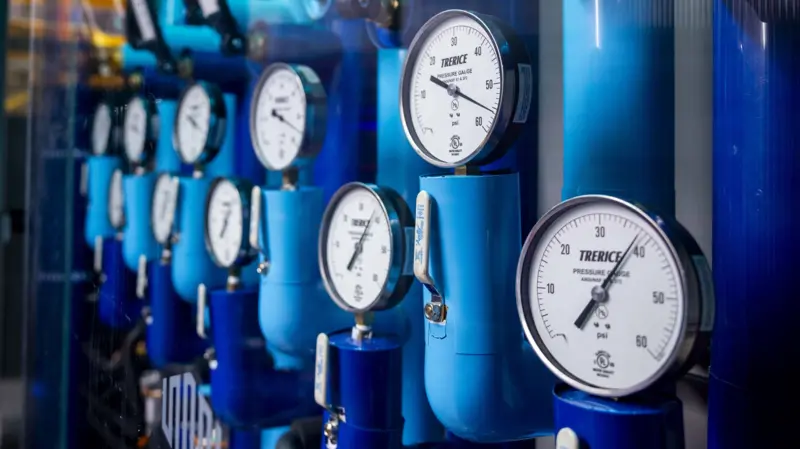
As the world’s demand for cloud services, streaming, and artificial intelligence continues to rise, data centres are under increasing pressure to manage one major challenge: heat. The powerful servers inside these facilities run nonstop and generate vast amounts of warmth, pushing traditional cooling systems to their limits. To cope, operators are turning to water-based technologies that cool equipment in ways that resemble showers, baths and even full immersion.
For many years, air cooling was the standard solution. Cold air was circulated through server rooms while hot air was pushed out using fans and air-conditioning units. While effective in the past, this method is becoming less practical. Modern servers, particularly those used for AI and advanced computing, are far more powerful and generate much more heat than earlier generations.
Liquid cooling offers a more efficient alternative. Water and other liquids absorb heat far better than air, allowing servers to stay cool even when working at high capacity. In some systems, liquid flows through sealed pipes directly attached to hot components, carrying heat away in a controlled and targeted way. This approach is often compared to a shower, where heat is constantly washed away before it can build up.
More advanced systems use liquid immersion cooling. In these setups, entire servers are placed inside tanks filled with a non-conductive liquid that is safe for electronics. As the servers operate, the liquid absorbs the heat they produce. In certain designs, the liquid boils gently on contact with hot components, then condenses and cycles back through the system, creating an efficient and continuous cooling loop.
One of the biggest advantages of liquid-based cooling is energy efficiency. Cooling can account for a significant share of a data centre’s electricity use. By relying less on large air-conditioning systems and fans, liquid cooling can reduce overall power consumption and operating costs. This also helps companies lower their carbon footprint, an important goal as the tech industry faces growing environmental scrutiny.
However, water use raises important questions. Some cooling systems consume large amounts of water, which can be controversial in areas affected by drought or water scarcity. To address this, many data centres are moving toward closed-loop systems that recycle water rather than constantly drawing fresh supplies. Others use specially engineered fluids instead of water, reducing reliance on local water resources.
Liquid cooling is especially attractive for facilities running artificial intelligence workloads. AI chips produce intense heat in concentrated areas, making them difficult to cool with air alone. Liquid systems allow these chips to operate more efficiently and at higher performance levels, supporting the rapid growth of AI services without requiring massive new data centre construction.
There are also practical design benefits. Liquid-cooled data centres can be smaller and more densely packed because they do not need wide aisles for airflow. This makes them well suited to urban environments where space is limited and expensive.
Despite these advantages, liquid cooling is not yet standard across the industry. Installation costs can be high, and maintaining these systems requires specialised knowledge. There are also concerns about leaks, although operators say modern designs include extensive monitoring and safety measures to minimise risk.
As data demands continue to grow, many experts believe liquid cooling will play an increasingly central role in data centre design. What once seemed unusual servers effectively taking a bath is quickly becoming a practical solution to one of modern computing’s biggest challenges.

