

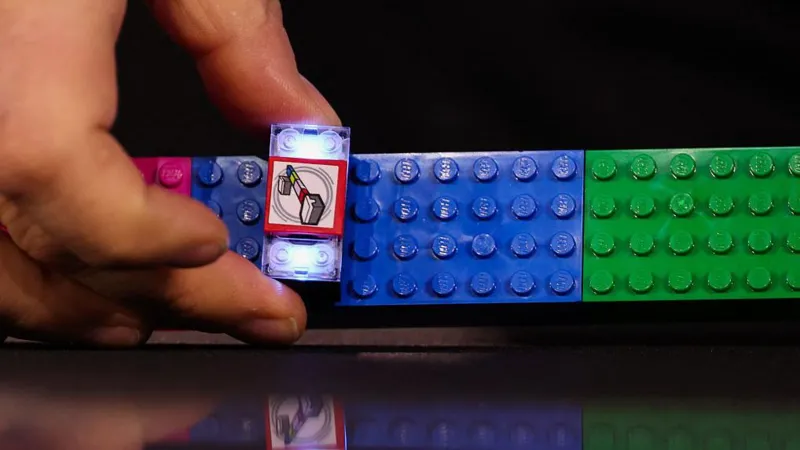
Lego has revealed a new range of technology-enhanced building blocks designed to bring its sets to life with sound, light and motion-sensitive reactions. While the company describes the innovation as groundbreaking, some child development experts warn it could change the nature of imaginative play.
The new Smart Bricks were unveiled at the Consumer Electronics Show (CES) 2026 in Las Vegas. Lego says the Smart Play system represents its most significant innovation in nearly five decades, with the first products scheduled to launch in March alongside a new Star Wars set.
The Smart Bricks contain built-in sensors, lights, sound components, an accelerometer and a custom silicon chip. These allow the bricks to detect movement, position and proximity, triggering responses such as sound effects or lighting changes during play.
The system works alongside Smart Minifigures and Smart Tag tiles, which carry digital identifiers. When the components interact, the Smart Brick produces specific reactions. During demonstrations at CES, a Lego birthday cake responded with music and cheers when its candles were blown out, while a helicopter emitted flight sounds and flashed red when it crashed.
Lego says the technology is designed to respond naturally to children’s actions rather than replace creative play. Tom Donaldson, head of Lego’s Creative Play Lab, said the goal was to surprise and inspire children to continue building and experimenting.
However, some play specialists have expressed concern. Josh Golin, executive director of children’s advocacy group Fairplay, argued that Smart Bricks risk shifting play away from imagination and into programmed responses.
Children already bring movement and sound to traditional Lego through creativity alone, he said, warning that digital features could limit open-ended play.
Andrew Manches, professor of children and technology at the University of Edinburgh, echoed these concerns, noting that Lego’s appeal has long been its simplicity and adaptability. However, he acknowledged that blending physical and digital play can offer new possibilities when designed thoughtfully.
Lego’s chief product and marketing officer, Julia Goldin, has previously said the company views digital innovation as a way to enhance, not replace, hands-on building. She said Lego aims to integrate technology seamlessly into physical play experiences.
The company has experimented with digital elements before, including augmented reality apps, video game collaborations and interactive figures such as the Super Mario Minifigure released in 2020.
Lego chief executive Niels B. Christiansen said in the company’s 2024 annual report that investment in digital technology had accelerated as part of its long-term growth strategy.
As smart toys become more common, experts have also raised broader concerns around privacy and data security, particularly as some toys begin incorporating artificial intelligence. Professor Manches said it remains important to closely examine how such technologies affect children’s everyday lives.
Lego says the Smart Play platform is intended to evolve over many years, as it continues to explore new ways of combining traditional building with interactive technology.

