

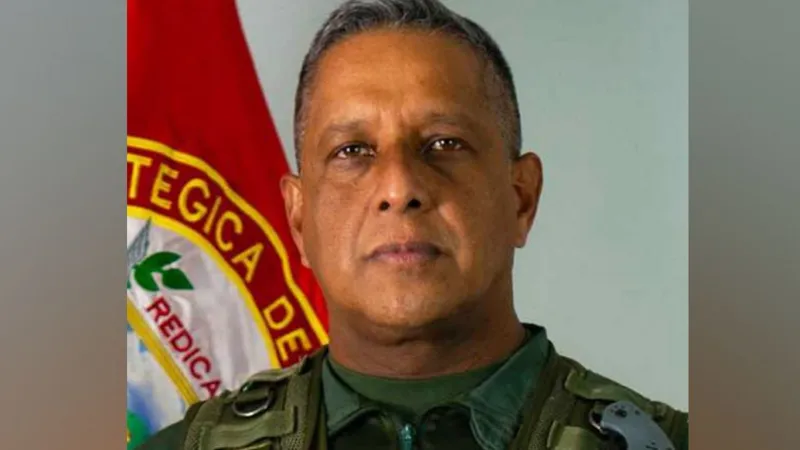
Venezuela’s interim president, Delcy Rodríguez, has dismissed the general who led the country’s presidential honour guard just days after former leader Nicolás Maduro was captured by US forces and taken to New York to face narco-terrorism charges.
General Javier Marcano Tábata had been responsible for commanding the elite military unit tasked with protecting the head of state. Members of the unit are believed to be among the dozens killed during the US raid in Caracas that led to Maduro’s seizure, although the Venezuelan government has yet to release full casualty figures.
Rodríguez, who was sworn in by the government-controlled National Assembly earlier this week, issued the order to replace Marcano Tábata. She had served as Maduro’s vice-president and is regarded as one of his closest allies.
Following Maduro’s capture, US President Donald Trump said Washington would “run” Venezuela and confirmed that talks were taking place with Rodríguez. He also warned that she would face consequences “worse than Maduro’s” if she failed to meet US demands, including agreements related to Venezuela’s oil reserves, the largest proven reserves in the world.
Although Trump later claimed Venezuela would hand over up to 50 million barrels of oil to the US, Rodríguez’s interim government has not responded publicly to those remarks.
Since assuming office, Rodríguez has adopted a mixed tone. While she has condemned Maduro’s capture as an “illegal kidnapping”, she has also said her government is open to cooperation with the United States. Observers are watching closely to see whether her leadership signals a shift in direction or reveals internal divisions.
The removal of Marcano Tábata is among the first major personnel changes under Rodríguez’s leadership. In addition to leading the presidential guard, he also headed Venezuela’s military counterintelligence agency, the DGCIM.
The DGCIM has been accused by the United Nations of serious human rights abuses, including torture, sexual violence and cruel treatment of detainees since 2013. However, analysts say the general’s dismissal is unlikely to be linked to those allegations, as his replacement, Gustavo González López, previously led the national intelligence agency Sebin, which has faced similar accusations.
Instead, analysts suggest the decision reflects frustration over the failure of the presidential guard to prevent Maduro’s capture. Cuba, a close ally of Venezuela, said 32 of its nationals were killed in the raid, many believed to have been embedded within the guard. Venezuela’s military has reported that 23 of its own personnel, including five generals, were killed.
Some government supporters have described the operation as humiliating, citing the ease with which US forces overcame Venezuela’s defences and seized Maduro, who was later shown publicly in US custody.
Replacing the head of the presidential guard may be an effort by Rodríguez to consolidate power and ensure loyalty within her inner circle, as the threat of further US military action looms. Trump has said a second wave of strikes was prepared but ultimately deemed unnecessary, while continuing to warn of severe consequences if the interim government does not comply with US demands.
Other senior figures may also be at risk. According to Reuters, US officials have urged Interior Minister Diosdado Cabello to cooperate. Washington has long accused Cabello of involvement in drug trafficking, allegations he denies, and recently increased a reward for information leading to his capture to $25m.

