

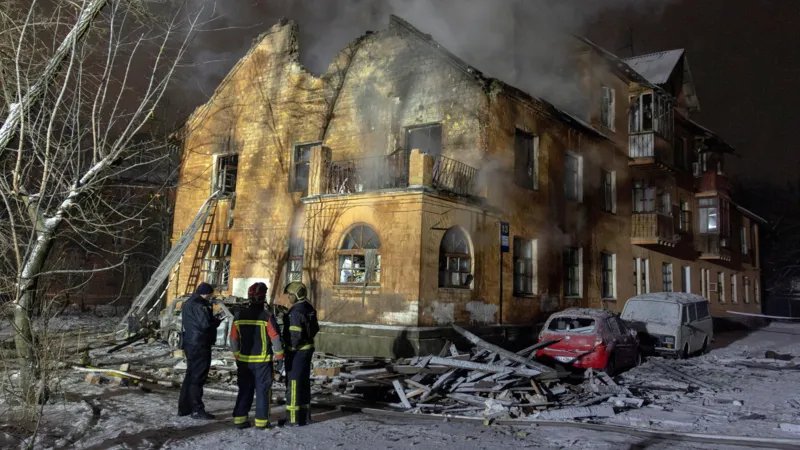
Russia has carried out a major overnight attack on Ukraine, using its rarely deployed Oreshnik ballistic missile as part of the assault.
Ukrainian authorities said four people were killed and at least 25 others wounded in Kyiv on Thursday night, after hours of explosions echoed across the capital and lit up the night sky.
This marks only the second confirmed use of the Oreshnik missile by Moscow. The weapon was first deployed in November 2024, when it struck the central Ukrainian city of Dnipro.
Russia’s defence ministry claimed the strike was retaliation for a Ukrainian drone attack that allegedly targeted President Vladimir Putin’s residence in late December — an allegation Kyiv has firmly denied.
Although Moscow did not publicly disclose the missile’s specific target, videos circulating on social media shortly before midnight (22:00 GMT) showed a series of explosions on the outskirts of the western city of Lviv.
President Volodymyr Zelensky and Ukrainian officials later confirmed that a ballistic missile had hit infrastructure in Lviv, located about 60km (40 miles) from Poland’s border.
The Oreshnik is an intermediate-range hypersonic ballistic missile, capable of travelling up to 5,500km (3,417 miles). It is believed to carry a warhead designed to fragment during its final descent, releasing several independently targeted inert projectiles. This produces a distinctive pattern of repeated explosions occurring seconds apart.
Ukrainian Foreign Minister Andrii Sybiha warned that the use of such a weapon so close to the European Union and Nato borders represented a serious escalation. “A strike of this kind near the EU and Nato frontier is a grave threat to European security and a test for the transatlantic community,” he said.
Sybiha dismissed Russia’s justification for the attack, describing it as a response to “hallucinations” about the alleged drone strike on Putin’s residence.
The European Union had already cast significant doubt on whether the drone attack ever occurred. Former US President Donald Trump also said last week that he did not believe such an incident had taken place.
On Friday, EU foreign policy chief Kaja Kallas said the use of the Oreshnik missile was intended as a signal to Europe and the United States.
“Putin does not want peace,” she wrote on X. “Russia’s answer to diplomacy is more missiles and destruction. This deadly pattern of large-scale Russian strikes will continue until we help Ukraine break it.”
Zelensky said the overnight assault involved far more than just the Oreshnik. According to him, Russia launched 13 ballistic missiles at energy facilities and civilian infrastructure, alongside 22 cruise missiles and 242 drones.
One of the strikes damaged a building belonging to the Qatari embassy, he added.
He accused Russia of deliberately targeting civilians during an intense cold spell, saying the attacks were aimed “against the normal life of ordinary people.” He said emergency teams were working to restore electricity and heating as quickly as possible.
As Russia expanded its strikes to Lviv and other western regions on Thursday night, Kyiv itself came under heavy attack, with dozens of missiles and hundreds of drones deployed.
Among those killed was a paramedic who died while responding to an earlier strike on a damaged apartment building. Kyiv mayor Vitali Klitschko and President Zelensky said the incident appeared to be a “double-tap” attack — where a second strike follows the first, hitting rescuers arriving at the scene.
Two apartment blocks on the eastern bank of the Dnipro River were hit, along with a high-rise building in Kyiv’s central district.
By morning, clean-up operations were underway across the capital. Despite the destruction, some businesses that escaped damage reopened. A coffee shop located just a few floors below a destroyed apartment was serving customers, while debris from a downed Russian drone — including wings and parts of the engine — lay scattered on the pavement outside.
At another location, a charred circular hole was visible on the 11th floor of an apartment block in a quiet residential area, marking the point where a missile had struck.
The attacks caused widespread power disruptions across Kyiv, compounding hardship during an especially harsh winter. The city is bracing for temperatures as low as -15C (5F) this weekend.
On Friday, Klitschko urged residents who were able to do so to temporarily leave the capital in search of warmth.
“Nearly half of Kyiv’s apartment buildings — around 6,000 — are currently without heating due to damage to critical infrastructure caused by the massive enemy attack,” he wrote on social media.
Across the city, the constant hum of diesel generators now fills the streets as businesses attempt to maintain power. Many residential buildings, however, rely on central heating systems, which take longer to repair and restore.
The repeated targeting of energy infrastructure has become a defining feature of the war. Ukraine has increasingly responded in kind to Russia’s sustained strikes, which regularly leave millions without electricity or heating.
On Thursday night, while Russia’s assault on Ukraine was ongoing, Ukrainian shelling reportedly left around half a million people without power in Russia’s Belgorod region, according to local authorities.
Russian officials also said a Ukrainian strike on a power plant in the city of Oryol disrupted water and heating supplies further north.

