

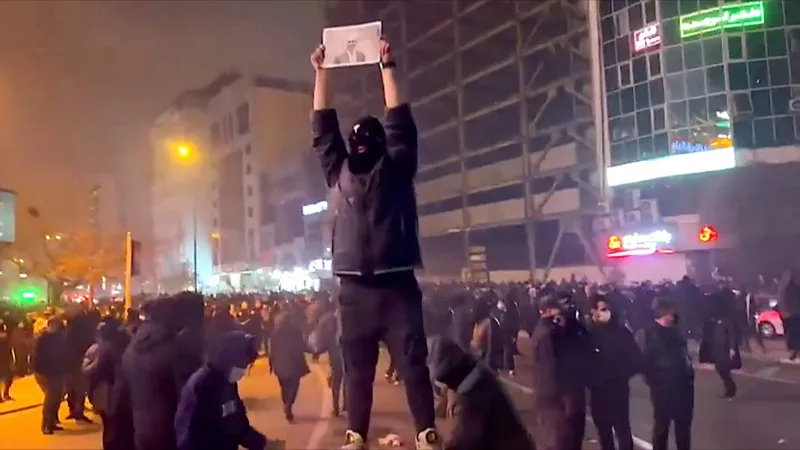
“I saw it with my own eyes—they fired straight into the crowds, and people fell where they stood.”
Omid, a protester in his early 40s whose name has been changed for safety, spoke to the BBC with a voice trembling from fear. He has been on the streets of a small southern Iranian city in recent days, protesting against the country’s deepening economic hardships. According to him, security forces opened fire on unarmed demonstrators using Kalashnikov-style rifles.
“We are fighting a brutal regime with nothing but our hands,” he said.
Similar accounts of lethal crackdowns have been reported across Iran in the wake of widespread protests last week. Access to the internet has been heavily restricted, making independent reporting almost impossible, and BBC Persian remains banned from operating inside the country.
The protests reached one of their largest peaks on Thursday, following calls from Reza Pahlavi, the exiled son of Iran’s last shah, who was overthrown in the 1979 Islamic Revolution. In response, Supreme Leader Ali Khamenei issued a stark warning: “The Islamic Republic will not back down.” Eyewitnesses say the heaviest bloodshed occurred after this statement, as security forces and the Islamic Revolutionary Guard Corps (IRGC) executed orders directly from the Supreme Leader.
Iranian authorities have accused the United States and Israel of stirring unrest and labeled the demonstrations as “terrorist actions,” according to state media.
A young woman in Tehran described Thursday as feeling like “the day of judgement.” She said even remote neighborhoods were filled with protesters. By Friday, however, the atmosphere had turned deadly: “Security forces just kept killing. Witnessing it myself was so distressing that I completely lost morale.”
She described Tehran as a battlefield, with security forces and protesters taking positions across the streets. “In war, both sides have weapons. Here, people only chant and get shot. It is a one-sided conflict,” she said.
Eyewitnesses in Fardis, west of Tehran, reported that paramilitary Basij forces, operating under the IRGC, attacked demonstrators after hours of no police presence. They used live ammunition while riding motorcycles, and unmarked cars drove into alleys, shooting at residents uninvolved in protests. One witness claimed, “Two or three people were killed in every alley.”
Accounts collected by BBC Persian suggest the true scale of the killings may far exceed what has been reported internationally. Norway-based Iran Human Rights (IHRNGO) reported at least 648 deaths, including nine minors, though local witnesses indicate the toll could be much higher.
Iranian media, by contrast, has claimed that 100 security personnel were killed and blamed protesters—whom they call “rioters”—for setting fire to dozens of mosques and banks.
Videos verified by BBC Persian show police vehicles and government buildings set ablaze in Tehran, Khorramabad, and other cities. Most testimonies come from larger cities with better internet access via Starlink satellite connections, such as Tehran, Karaj, Rasht, Mashhad, and Shiraz. Reports from smaller towns, where many initial casualties occurred, are scarce due to limited connectivity.
Despite challenges, the consistency and volume of accounts from multiple cities underline the intensity of the crackdown and the widespread use of lethal force. Nurses and medics report seeing numerous dead and injured protesters, with hospitals overwhelmed and unable to treat those with severe injuries, particularly to the head and eyes. In some locations, bodies were stacked and not returned to families.
Graphic videos shared on activist-run channels, including Vahid Online, show mass casualties at the Kahrizak Forensic Medical Centre in Tehran. Some clips depict families identifying corpses via photographs displayed on screens, while large numbers of bodies in black bags are visible both inside and outside the facility.
A mortuary worker in Mashhad reported that between 180 and 200 severely injured bodies were brought in before sunrise on Friday and buried immediately. In Rasht, approximately 70 bodies arrived at a hospital mortuary on Thursday, with security forces reportedly demanding “payment for bullets” before releasing them to families. A medic in eastern Tehran confirmed that around 40 bodies were brought in the same day.
UN Secretary-General António Guterres expressed shock at reports of violence, while UN Special Rapporteur Mai Sato warned that lethal force by Iranian security forces is deeply concerning regardless of the death toll.

