

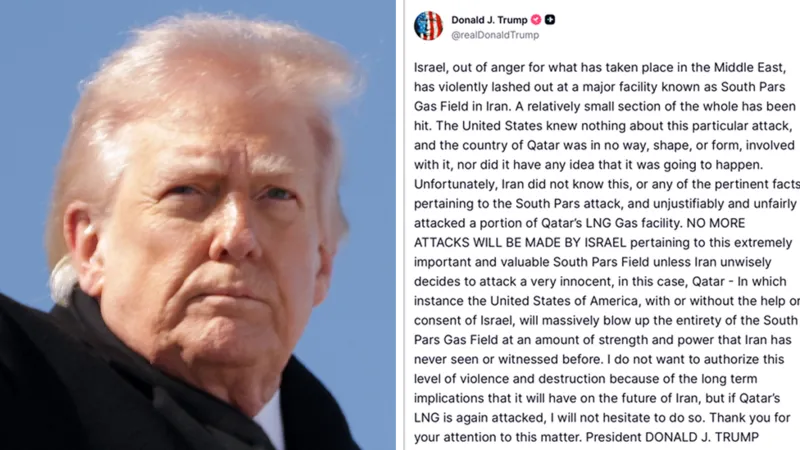
After Israel struck Iran’s South Pars gas field on Wednesday and Iran retaliated by hitting Qatar’s LNG facility, Donald Trump took to Truth Social with a lengthy, capitalised, and characteristically revealing post. Reading it carefully tells you quite a lot — not just about Trump’s mood, but about the state of the US-Israel alliance and how this war is actually being run.
The US ‘knew nothing’ about the attack
Trump’s claim that the US had no prior knowledge of Israel’s strike on South Pars is the most immediately striking part of the post — and also the most contested. Israeli newspapers reported the opposite within hours. Centrist paper Yedioth Ahronoth said the attack had been coordinated in advance with the United States and agreed between Netanyahu and Trump directly. Right-wing paper Israel Hayom went further, reporting that Trump had discussed the upcoming Israeli strike with leaders of three Gulf states over the weekend.
As is so often the case with Trump’s assertions, the truth is difficult to pin down. But his choice of language is telling regardless. He describes Israel as acting “out of anger,” having “violently lashed out” at the gas field — the kind of language usually reserved for reckless or impulsive actions, not a coordinated military strike by a close ally. It raises an obvious question: is Trump suggesting Israel acted unwisely?
Israel will make ‘no more attacks’ on gas field
Trump is not known for using capital letters sparingly, but in this lengthy post he deploys them in full just once. “NO MORE ATTACKS WILL BE MADE BY ISRAEL,” he writes, before conditioning that on Iran staying away from Qatar’s LNG facilities.
Whether this reflects a commitment already extracted from Netanyahu or a warning fired across his bow is impossible to say. But it echoes earlier reports that Trump was privately angered by Israel’s attacks on Iranian oil depots earlier in the war. The pattern is becoming familiar — public alliance, private friction.
Israeli officials were quick to push back on any suggestion of a rift. “We are very much aligned on most or all of our goals regarding the Islamic regime in Iran,” the Israeli embassy spokesman in London told the BBC. But the fine print matters here. Israel has been openly and consistently focused on regime change in Iran — a goal Netanyahu has pursued for decades. Officials quoted in Israeli media described the South Pars attack as part of a deliberate effort to turn Iranians against their government by cutting off gas supplies and accelerating domestic unrest. The US, meanwhile, has concentrated its military effort more narrowly on degrading Iran’s missile and drone capabilities and naval strength. The allies may want the same outcome, but they are not always choosing the same methods to get there.
Iran ‘did not know’ the facts
Trump’s post takes an unusual turn when he addresses Iran’s retaliation against Qatar. He insists Qatar had no involvement in and no advance knowledge of the Israeli strike — and then says Iran unfortunately didn’t know this before hitting back. It’s a careful formulation. He doesn’t excuse Iran, but he does imply that Tehran may have been operating on false assumptions. Whether this is a diplomatic off-ramp or simply Trump covering Qatar, a key regional partner, is unclear.
The threat to ‘massively blow up’ the gas field
The most dramatic passage is vintage Trump — a sweeping threat to unleash unprecedented destruction on South Pars if Iran touches Qatar’s LNG infrastructure again. “With or without the help or consent of Israel,” he writes, the US would act.
That phrase — “with or without the consent of Israel” — is the one that will attract the most scrutiny. Is it a reminder to Netanyahu that America doesn’t need Israeli permission to act? Or, as some of Trump’s critics in the MAGA movement would see it, an inadvertent admission that the question of Israeli consent has been relevant at all? Either way, it is a jarring thing for a US president to write about his closest military partner in the middle of a shared war.
The bigger picture
Three weeks into this conflict, Trump sounds impatient and the war keeps throwing up complications his administration didn’t appear to anticipate. Oil and gas prices are climbing again. The Strait of Hormuz remains blocked. Support for the war in the US has slipped below 50%, even as it remains sky-high in Israel. The conflict could extend Netanyahu’s political career while damaging Republican prospects in November’s midterms.
The US and Israel have fought alongside each other in many ways over the decades, but this is the first time they’ve gone to war together. Between them, they’ve achieved a great deal in less than three weeks. But with every passing day, the gap between what Trump thought this war would look like and what it has actually become appears to be widening.

