

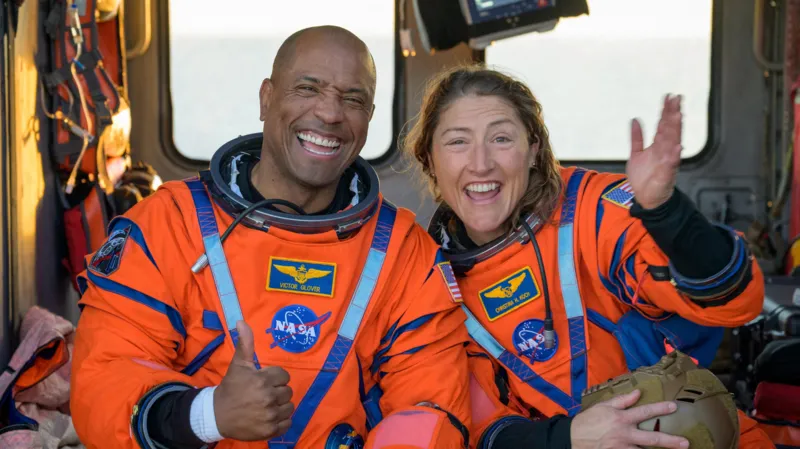
The four astronauts who flew NASA’s Artemis II mission around the Moon have returned to Earth, splashing down safely in the Pacific Ocean after a nine-day voyage that took them further from our planet than any humans in history.
Commander Reid Wiseman, pilot Victor Glover, mission specialist Christina Koch and Canadian astronaut Jeremy Hansen are now aboard the USS John P Murtha, recovering and undergoing medical evaluations before being flown to Houston on Saturday to reunite with their families. As they waited on the ship’s deck, they were seen smiling, chatting and posing for photographs.
The return was not without tension. The Orion capsule — named Integrity by the crew — was travelling at more than 24,000mph when it hit the upper atmosphere, subjecting its heatshield to temperatures half as hot as the surface of the Sun. The capsule lost contact with mission control in Houston for six minutes during the descent. When communication was restored, Commander Wiseman’s voice came through: “Houston, Integrity here. We hear you loud and clear.” Cheers erupted at mission control.
Shortly after, the capsule’s red-and-white parachutes deployed and carried it to what NASA commentator Rob Navias called “a perfect bull’s eye splashdown” — landing within a mile of its target southeast of Hawaii, near the Californian coast.
The precision of the re-entry was a particular point of pride for the mission team. “The team hit it — that is not luck, it is 1,000 people doing their jobs,” said NASA associate administrator Anit Kshatriya. The angle of the capsule’s approach had to be exact: too shallow and Orion would have skipped off the atmosphere; too steep and the heat could have caused serious damage. Engineers had redesigned the return path following unexpected heatshield damage on the uncrewed Artemis I test flight in 2022, and this mission was the first time that new trajectory was tested with a crew on board. It worked.
Flight Director Rick Henfling said there had been significant anxiety throughout the process. “We all breathed a sigh of relief once the side hatch opened up,” he said. “The flight crew is happy and healthy and ready to come home to Houston.” NASA acting associate administrator Lori Glaze praised the crew’s teamwork and camaraderie. “It was a mission for all of humanity,” she said.
President Trump welcomed them home and called the trip “spectacular,” repeating an earlier invitation to visit the White House.
The successful return clears the way for the next phase of the Artemis programme. Artemis III, redesigned under new NASA administrator Jared Isaacman, is now planned as an Earth-orbital mission to test rendezvous and docking with SpaceX and Blue Origin lunar landers, pencilled in for mid-2027. The first actual Moon landing — Artemis IV — is targeted for 2028, though doubts remain about whether that timeline is achievable.
Today’s splashdown doesn’t put boots on the Moon. But it confirms the hardware works, the trajectory holds and the people can endure the journey. The foundation, as NASA put it, has been laid. The hardest part is still ahead.

