

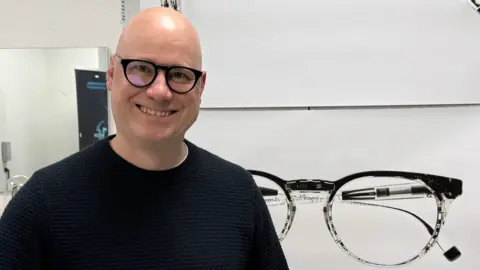
Finnish eyewear company IXI is preparing to launch smart glasses that look like ordinary spectacles but are capable of “autofocusing” based on what the wearer is looking at.
The glasses use eye-tracking sensors combined with liquid-crystal lenses that adjust the prescription instantly. According to the company, this improves on traditional bifocal and varifocal lenses, which are designed to help people see both near and far but come with notable limitations.
Bifocal lenses — commonly credited to Benjamin Franklin in the late 18th century — divide the lens into two distinct zones, typically with distance vision at the top and a smaller section for reading. Varifocals, introduced in the 1960s, refined that idea by creating a gradual transition between magnification zones to make vision feel more seamless.
Both designs still require wearers to look through specific parts of the lens depending on what they want to focus on. While varifocals offer a smoother experience, they can distort peripheral vision, require time to adapt to, and cost significantly more than standard lenses.
IXI’s approach removes fixed zones entirely. “Modern varifocals have this narrow viewing channel because they’re mixing basically three different lenses,” said IXI CEO Niko Eiden. “You have far sight, intermediate and short distance, and you can’t seamlessly blend these lenses. That creates distortion, and the sides of the lenses are almost useless.”
With IXI’s dynamic lenses, the glasses create a larger reading area positioned based on the wearer’s eye exam. Most of the time, that area disappears altogether, leaving the entire lens dedicated to distance vision.
“For seeing far, the difference is really striking,” Eiden said. “With varifocals, you have to look through the top part of the lens. With ours, you get the full lens area for distance — like when you were younger.”
The glasses’ internal components are housed in frames that look largely indistinguishable from standard eyewear. IXI employs around 75 people and has raised more than $40m in funding. The company says the glasses will launch within the next year and will be priced at the high end of the eyewear market.
They do, however, require charging. A hidden magnetic port in the temple allows overnight charging, and the electronics add little weight — one recent prototype weighs just 22 grams. Some distortion is still present near the edges of the liquid-crystal area, but Eiden said this is rarely noticeable during normal use.
More testing is needed before the glasses can be approved for driving. If the electronics fail, a built-in failsafe switches the lenses back to a standard fixed prescription, typically for distance vision, without disrupting sight.
The eye-tracking system relies on photodiodes and LEDs that emit invisible infrared light, measuring reflections from the eyes to determine where the wearer is focusing.
IXI says the glasses are being designed for everyday conditions, including changes in temperature, moisture and movement, though exact operating limits have not yet been disclosed.
Ian Murray, a professor of visual neuroscience at University of Manchester, who is not involved with IXI, said the concept is sound from a physics perspective. However, he noted that early versions would likely be niche and viewed as a novelty, with open questions around field of vision and performance in low light.
Other companies are also developing liquid-crystal autofocus lenses, including Japan’s Elcyo. Another Japanese firm, ViXion, already sells autofocus glasses, though they use small apertures and do not resemble standard eyewear.
IXI’s glasses will be manufactured in Finland and launched in Europe first, pending regulatory approval, before seeking FDA approval in the US. Initially, only a few frame shapes will be available, offered in multiple widths.
Eiden compared the technology to the arrival of autofocus in cameras. “After varifocals, there’s basically been nothing,” he said. “That’s what we want to change. Maybe in 10 or 15 years, people will wonder how we ever wore fixed-focus glasses.”

