

British YouTuber James Bruton set out to build a giant walking robot inspired by Star Wars’ iconic At-At and then ride it around his friend’s tennis court. “My goal is to have something people would click on,” he says.
To make that happen, Bruton needed to create four powerful legs for the towering machine, which first appeared in The Empire Strikes Back. Crucially, those legs had to be controllable with real precision. “I don’t want something that’s massive and wobbly,” he explains.
The solution was an intricate system of motors and gears acting like servos moving components whose position can be carefully monitored and controlled. Once the build was complete, Bruton filmed himself dressed as a Stormtrooper, riding the At-At as it lumbered along. “It’s pretty slow,” he admits.
He’s now working on a two-legged version, which presents an even tougher challenge. Balancing on just two legs while carrying a human requires far more responsive movement. Some of the parts he designs behave like “variable springs” components that can reverse motion and absorb impact from the ground. “It can dynamically absorb load as you need it to,” he says.
At the heart of all robotic movement are actuators the motors that drive machines. Actuators typically either rotate or move in and out, and combining them with artificial limbs makes everything from robot arms to humanoids possible.
As robots become more advanced, they’ll need actuators that are more efficient, more precise and far smarter than today’s versions. Only a small number of companies can currently manufacture high-precision actuators at scale, and even the best of them fall far short of the complex muscle systems that allow animals to move with such ease and grace.
A new generation of actuators could mark the shift from clumsy, stumbling machines to robots capable of fluid, almost balletic movement.
“For a long time, roboticists have used DC motors to make robots move,” says Mike Tolley of the University of California, San Diego. These motors work well for spinning fans, where high speed and low torque are ideal.
Human movement is very different. “We want to be able to lift things, and push things, and do things that require a lot of force and torque,” Tolley explains. Torque refers to the twisting force that makes something rotate around an axis.
Safety is another major concern. If a robotic arm swings toward a person, it must be able to stop instantly and reverse direction without causing harm. That requires what’s known as a back-driveable actuator — one that can be pushed back easily. Without that, robots behave a bit like manual cars that need to be shifted before they can reverse.
Power is another limitation. “Another problem with today’s robots is they rapidly run out of batteries,” says Jenny Read, programme director for robot dexterity at Aria, a technology funding agency. “Electric motors are terrible at that.” On top of this, very small motors tend to overheat, creating further challenges.
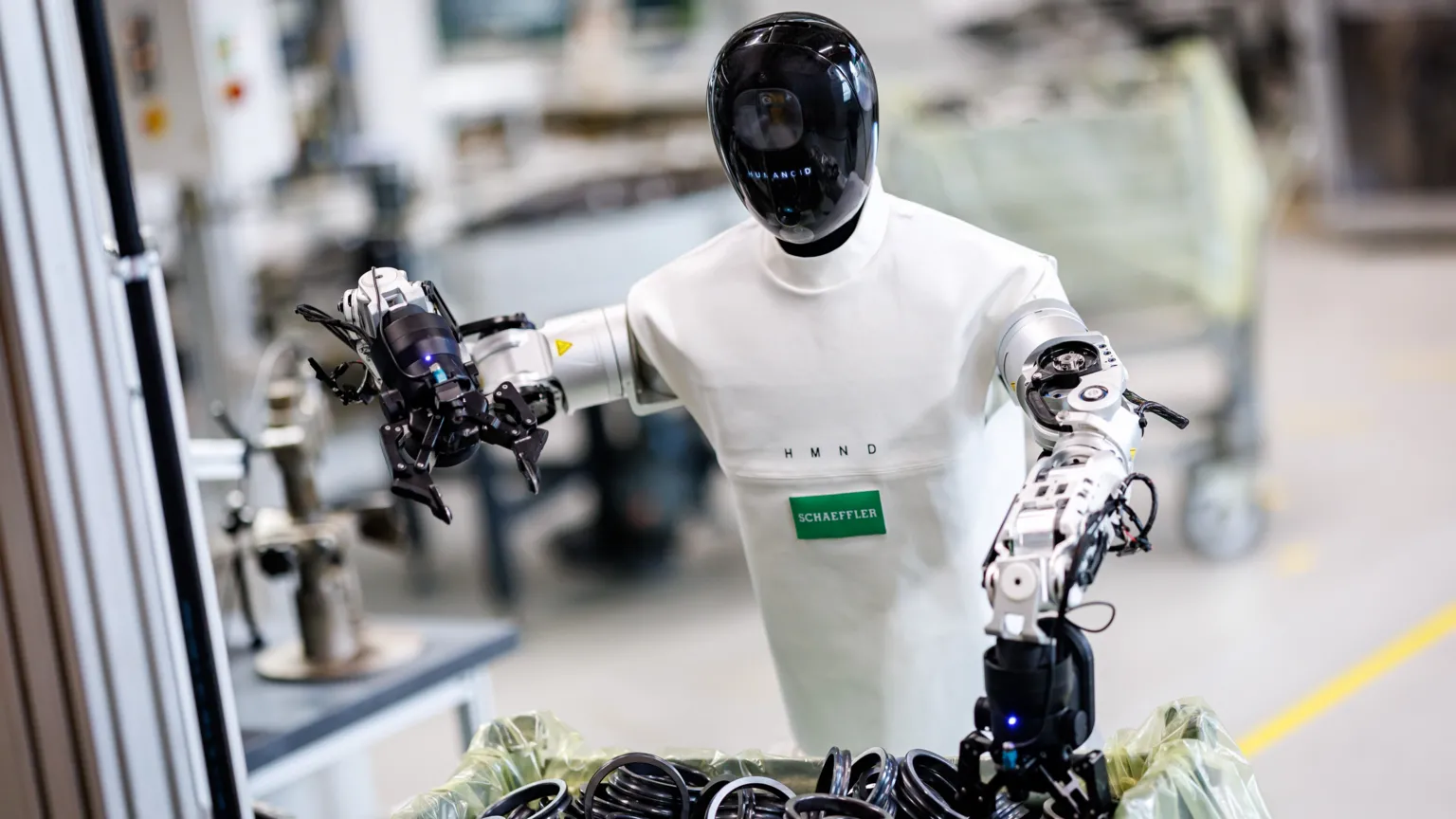
Germany-based engineering firm Schaeffler is developing actuators for British robotics company Humanoid, aiming to deliver highly efficient and well-controlled movement a must for bipedal robots working safely alongside people.
The approach combines hardware and software. Actuators are designed to output large amounts of data about their position and performance, allowing computers to make real-time adjustments. But refining the physical components remains a complex task. “We have to try and test to find this optimisation of friction, of back-driveability,” says David Kehr, president of humanoid robotics. “It’s really a big puzzle.”
Schaeffler plans to deploy robots in its own factories, handling tasks like transferring newly made parts from conveyor belts into washing machines before packaging. Labour shortages are already being felt, Kehr says, adding that workers currently doing these jobs would be retrained for other roles.
In the US, robotics company Boston Dynamics has partnered with South Korean automotive supplier Hyundai Mobis to develop a new generation of actuators. These systems resemble electric power steering units, combining motors, controllers and reduction gears.
“This will be the first time we supply actuators for humanoid robots,” says Se Uk Oh, vice president of robotics at Hyundai Mobis. With robots increasingly sharing space with humans, he adds, quality and reliability are critical. “We have a lot of technology for that and a lot of experience.”

