

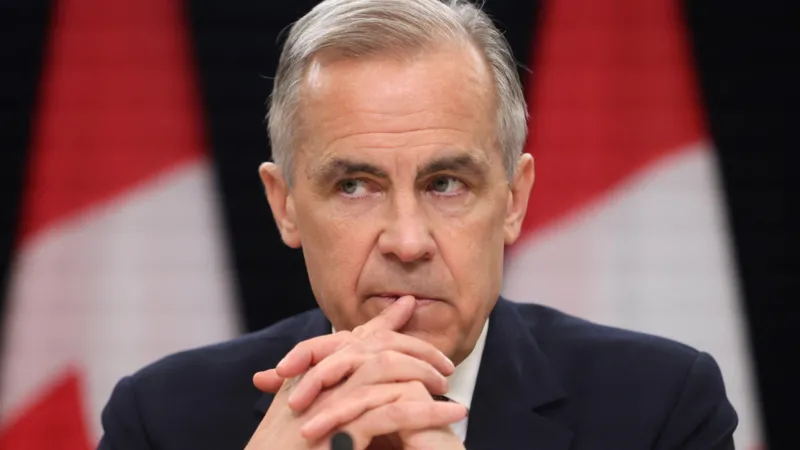
Canada’s Prime Minister, Mark Carney, is travelling to China on a high-stakes trip intended to stabilise relations with Beijing and open up new economic opportunities beyond the United States.
The visit comes with significant challenges. Canada is attempting to expand trade ties without jeopardising its critical relationship with the US, while also maintaining firm positions on national security and human rights.
However, with uncertainty continuing to cloud Canada’s trade outlook with its largest partner, the United States, Ottawa is now seeking to mend strained relations with China to safeguard its economic future.
Senior officials have characterised the visit — the first by a Canadian prime minister since 2017 — as both “historic” and “highly consequential”. They describe it as part of an ambitious strategy to double Canada’s exports outside the US market over the next ten years.
According to the prime minister’s office, discussions will focus on trade, agriculture, and international security. China’s foreign ministry said both nations share common interests and should deepen cooperation through expanded cultural exchanges and people-to-people engagement.
On Thursday, Carney is scheduled to meet China’s Premier Li Qiang and Zhao Leji, Chairman of the Standing Committee of the National People’s Congress. On Friday, he will hold a one-on-one meeting with President Xi Jinping. The two leaders last met in 2025 on the margins of the Asia-Pacific Economic Cooperation summit in South Korea.
This visit marks a major step toward rebuilding ties after relations between Ottawa and Beijing deteriorated sharply in 2018, when Huawei executive Meng Wanzhou was arrested in Vancouver on a US extradition request over alleged fraud linked to violations of Iran sanctions.
China reacted angrily to the arrest and later detained two Canadian citizens on espionage charges. All three individuals were released in 2021 after Meng reached an agreement with US prosecutors.
Tensions have persisted in recent years, with allegations that China interfered in Canada’s political processes. While a public inquiry concluded that foreign interference had minimal impact on recent federal elections, Beijing has repeatedly rejected the accusations.
Canada has historically struggled to maintain stable relations with China. Ottawa has described Beijing as an “increasingly disruptive global power” that frequently disregards international norms, while still acknowledging that China’s global influence makes limited cooperation unavoidable.
Officials in Carney’s government insist that the visit does not signal a shift in this position. However, they acknowledge that reducing Canada’s dependence on the US economy will be impossible without expanding trade with China.
Carney is expected to pursue cooperation in shared priority areas such as energy and climate policy, while establishing clear boundaries in areas of disagreement including defence and critical minerals.
“I think we are approaching the relationship now with a level of realism that has been absent for decades,” said Colin Robertson, a former Canadian diplomat, speaking to the BBC.
Robertson added that clearer expectations on both sides could lead to a more balanced relationship, provided each country understands the other’s limits.
The sensitivity of the visit has already been evident. Ahead of Carney’s departure, two Liberal MPs ended a sponsored visit to Taiwan earlier than planned. They told the Globe and Mail that although Canada’s position on Taiwan remains unchanged, the decision was made to avoid confusion given the prime minister’s engagement in Beijing.
A major priority for Canada during the trip is persuading China to lift tariffs on Canadian canola, which have significantly impacted farmers in the prairie provinces.
China imposed the agricultural tariffs last year, widely viewed as retaliation for Canadian tariffs on Chinese electric vehicles introduced in 2024, which mirrored similar measures taken by the United States.
In a recent editorial, China’s state-run Global Times highlighted Canadian farmers’ frustrations and suggested Canada was paying a “heavy price” for aligning too closely with Washington. Beijing has made clear that it wants Ottawa to remove the EV tariffs.
From China’s perspective, Canada is a valuable trading partner, with bilateral trade valued at approximately $118bn in 2024. Any agreement reached with Carney would also give Beijing greater influence in a country geographically and politically close to the US.
The Global Times editorial urged Canada to pursue a foreign policy independent of Washington and to demonstrate greater “strategic autonomy”.
One of the biggest uncertainties surrounding the visit is how the US might respond to any agreements between Canada and China. Canada has already been affected by American tariffs on steel, aluminium, and automotive exports, and negotiations to ease those measures remain stalled.
Later this year, Canada will also take part in critical talks to renew the North American free trade agreement with the US and Mexico — a deal that has shielded Canada from many of former President Donald Trump’s broad tariffs.
Robertson said it is likely that US officials are closely monitoring Canada’s engagement with China, noting that Ottawa has kept Washington informed of its intentions.
Still, he emphasised: “Ultimately, Canada is pursuing its own national interests.”

