

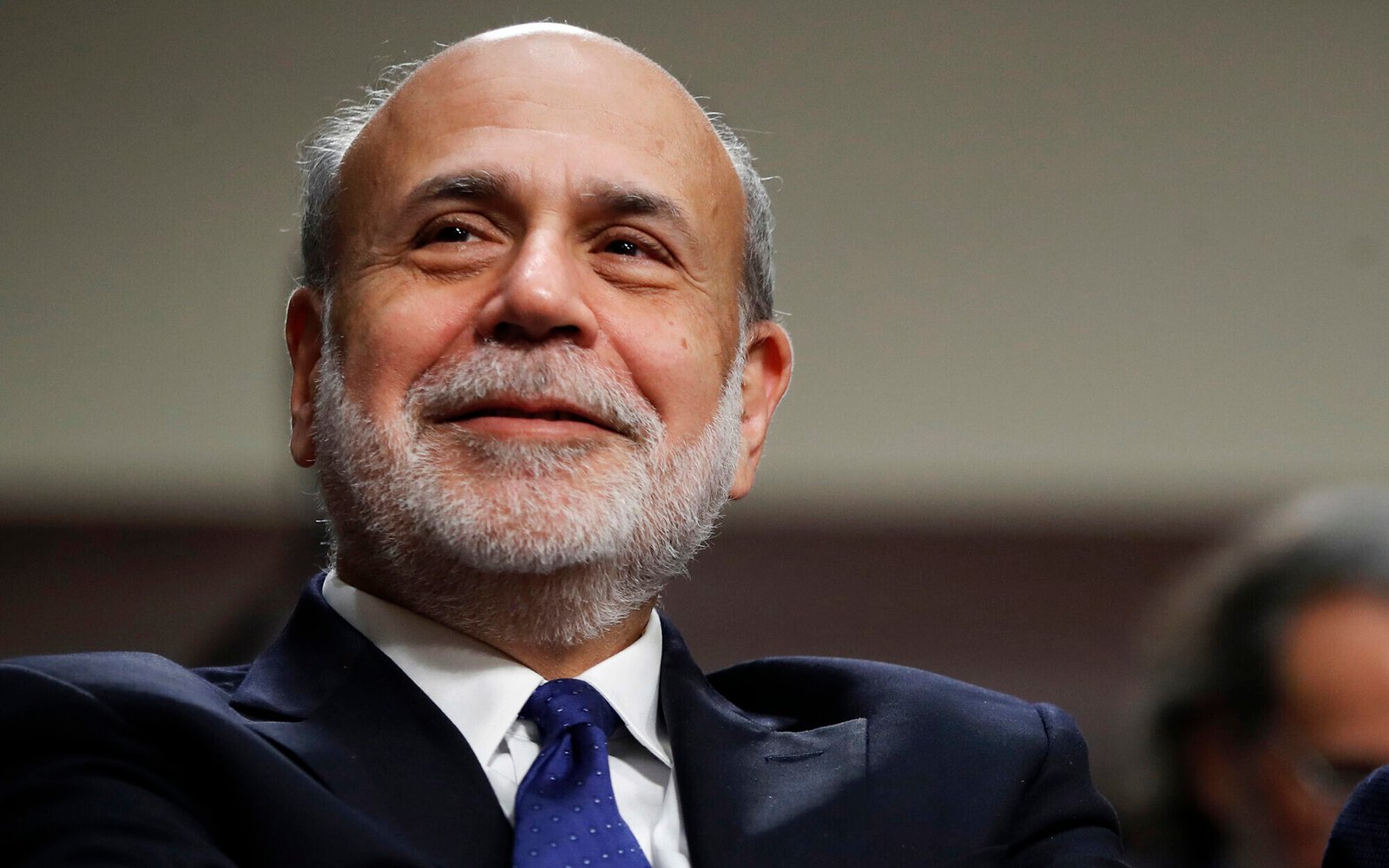
Ben Bernanke? Why is he important?
Ben Bernanke was the chair of the board of governors of the U.S. Federal Reserve from 2006 to 2014. Bernanke took over the helm from Alan Greenspan on Feb. 1, 2006, ending Greenspan’s 18-year leadership at the Fed.
A former Fed governor, Bernanke was chair of the U.S. President’s Council of Economic Advisors before being nominated as Greenspan’s successor in late 2005.
Early Life and Education
Born Benjamin Shalom Bernanke on December 13, 1953, he is the son of a pharmacist and a schoolteacher and was raised in South Carolina.2 A high-achieving student, Bernanke completed his undergraduate degree summa cum laude at Harvard University and then completed his Ph.D. at MIT in 1979.3
He taught economics at Stanford and then at Princeton University, where he chaired the department until 2002, when he left his academic work for public service.3 He officially left his post at Princeton in 2005.
Notable Accomplishments
Bernanke was first nominated as chair of the Fed by President George W. Bush in 2005.
U.S. Congress. “PN1025—Ben S. Bernanke—Federal Reserve System.”
He had been appointed to President Bush’s Council of Economic Advisors earlier the same year, widely seen as a test run for succeeding Greenspan as chair.6
In 2009, President Obama nominated him for a second term as chair. He was succeeded by Janet Yellen as chair in 2014. Before serving his two terms as chair of the Federal Reserve, Bernanke was a member of the Federal Reserve’s Board of Governors from 2002 to 2005.1
Economic Contributions
Ben Bernanke stimulated the U.S. economy after the 2008 banking crisis, which led to a downward spiral. He took an aggressive and experimental approach to restore confidence in the financial system.
One of the Fed’s multiple strategies to curb the global crisis was enacting a low-rate policy to stabilize the economy. Under Bernanke’s tutelage, the Fed slashed the benchmark interest rates to near zero. By reducing the federal funds rate, banks lend each other money at a lower cost and, in turn, can offer low-interest rates on loans to consumers and businesses.
$16.2 trillion
The total net worth of American households was lost between 2007 and 2009 during the Great Recession. As conditions worsened, Bernanke proposed a quantitative easing program. The quantitative easing scheme involved the unconventional purchase of Treasury bond securities and mortgage-backed securities (MBS) to increase the money supply in the economy.8 By purchasing these securities on a large scale, the Fed increased demand for them, which led to an increase in prices. Since bond prices and interest rates are inversely related, interest rates fell in response to the higher prices. The lower interest rates reduced the financing costs for business investments, improving a business’s financial position. By bolstering operations and activities, businesses could create more jobs, which would reduce the unemployment rate.
Bernake’s bailouts
Ben Bernanke also helped to curb the effects of the rapidly deteriorating economic conditions by bailing out several troubled big financial institutions. While the Fed underwrote the decision to let Lehman Brothers fail, they bailed out companies, such as AIG Insurance, due to the higher risk that the bailed-out companies posed if they went bankrupt.
In the case of AIG, Bernanke believed that the company’s colossal liability was solely isolated in its financial products, which involved hundreds of billions of dollars in derivatives speculation. If the company lost its speculative position on these derivatives, it would not have sufficient funds to pay for or cover its losses.11 For companies like Merrill Lynch and Bear Stearns, the Federal Reserve incentivized Bank of America and JPMorgan to purchase and take over both companies by guaranteeing the bad loans of the troubled banks.
Published Works
In 2013, Bernake released The Federal Reserve and the Financial Crisis, a compilation of his lectures about the history of the Federal Reserve and the financial crisis of 2008. It features his insights on the Fed’s activities, decisions, and responses to events.
Two years later, he published The Courage to Act: A Memoir of a Crisis and Its Aftermath, chronicling his experiences as the chairman of the Federal Reserve Board and exposing how close the global economy came to collapsing in 2008, stating that it would have done so had the Federal Reserve and other agencies not taken extreme measures. President Barack Obama has also stated that Bernanke’s actions prevented the financial crisis from becoming as bad as possible. However, Bernanke has also been the subject of critics who claim he didn’t do enough to foresee the financial crisis.
Legacy
Although Bernanke’s actions were memorable for the recovery of the global economy, he faced criticism for his approaches to achieving this recovery. Economists criticized his pumping hundreds of billions of dollars into the economy through the bond-purchase program, potentially increasing individual and corporate debt and leading to inflation. In addition to these economists, legislators also criticized his extreme measures. They opposed his re-appointment as Federal Reserve Chair in 2010.President Barack Obama, however, reappointed him for a second term.
As of August 2022, Ben Bernanke is an economist at the Brookings Institution, a nonprofit public organization based in Washington, DC, where he advises on fiscal and monetary policies. He also serves as a senior advisor to Citadel.
What Boards Did Ben Bernake Serve on?
After stepping down as the chair of the board of governors of the U.S. Federal Reserve, Ben Bernake served as a member of the Montgomery Township Board of Education in New Jersey for two years and is now an economist for the Brookings Institution and an advisor for financial services firm Citadel.
What Did Ben Bernake Do During the Financial Crisis?
To counter the effects of the financial crisis 2008, Bernake employed a low-rate policy—rates were reduced to practically nothing—and a quantitative easing plan to increase the money supply. Bernake also bailed out many large, failing financial institutions.
To What Economic School of Thought Does Ben Bernake Belong?
Ben Bernake belongs to the Milton Friedman and Anna Schwartz schools of thought.18 Bernake subscribed to the principle that the Federal Reserve Board could reduce inflation and revitalize the economy by increasing the money supply at the same rate as the gross national product (GNP).
Ben Bernake, the former two-term chair of the Federal Reserve, is primarily regarded for implementing strategies that saved the U.S. economy. His methods, albeit somewhat controversial, led to increased U.S. jobs, the bailout of well-known, established financial institutions, and a robust economy. However, his actions were not exempt from scrutiny, as a host of critics believed his actions were more detrimental than good. Despite varying opinions, Bernake remains in high demand as an economist and advisor and is one of history’s most influential Fed chairs.
Conclusion
- Ben Bernanke is a former Federal Reserve chair, serving from 2006 to 2014.
- As Fed chair, Bernanke oversaw the central bank’s response to the 2008 financial crisis and the Great Recession.
- Janet Yellen succeeded Bernanke, who had previously been Alan Greenspan.
- Bernake introduced several strategies, including quantitative easing, to boost the U.S. economy during the 2008 recession.
- Critics argue that Bernake flooded the economy with too much money, contributing to inflation and increasing debt.

