

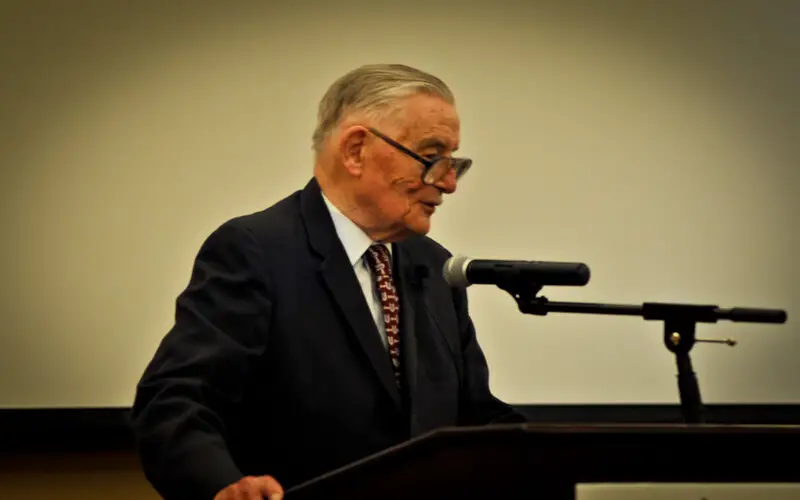
James M. Buchanan Jr. was an American economist who won the Nobel Prize in 1986 for his work on public choice theory. This theory uses economics to look at how people and public leaders act.
He has written many books, such as What Should Economists Do?, The Limits of Liberty, and, with Gordon Tullock, The Calculus of Consent. On January 9, 2013, James M. Buchanan Jr. passed away.
Early Years and School
He was born in Murfreesboro, Tennessee, on October 3, 1919. James M. Buchanan Jr. attended Middle Tennessee State College and got his bachelor’s degree in 1940. He then attended the University of Chicago and got his Ph.D. in 1948.
It was from 1956 to 1968 that Buchanan taught at the University of Virginia. There, he created the Thomas Jefferson Center for Studies in Political Economy. From 1968 to 1983, he taught at UCLA and Virginia Tech. After that, he moved to George Mason University and left as a senior professor.
The Theory of Public Choice
When economists James M. Buchanan Jr. and Gordon Tullock wrote The Calculus of Consent together in 1962, they laid out the main ideas of public choice theory. People in political science and economics use the book as a resource for the field of public choice.
Most people think lawmakers make decisions that are best for their clients, but the public choice theory says this is not always the case. It looks at how rewards and personal gain affect the decisions lawmakers make. With Buchanan’s insights into human nature and political results, we can better understand what drives politicians and make more accurate guesses about their decisions. His work on “the contractual and constitutional bases for the theory of economic and political decision-making” earned him the Nobel Prize in economics in 1986.
As a result of Buchanan’s Nobel Prize-winning economic and political science theories, the Center for Public Choice at George Mason University builds on those ideas. Public Choice is a study program that uses economic tools to examine how voters, candidates, lawmakers, bureaucrats, and courts act. The University of Virginia started the Center in 1957. It was first known as the Thomas Jefferson Center for Studies in Political Economy. The Center first moved to Virginia Tech in 1969. In 1983, it moved to George Mason University, where it still is today.
What parts of economics did James M. Buchanan Jr. think about?
Some of the economic schools of thought that Buchanan looked into were liberalism and free-market thinking.
What’s the difference between social choice theory and public choice theory?
Social choice theory and public choice theory are very similar. They are both types of schools of thought in public economics. While the public choice theory looks at how people’s interests affect their voting behavior, the social choice theory uses math to examine how those interests affect voting behavior.
What kinds of leadership roles did James M. Buchanan Jr. play?
The Independent Institute had Buchanan on its Board of Advisors. He was also a member of the Mont Pelerin Society and its past president. Finally, he was a Distinguished Senior Fellow at the Cato Institute.
In Short
The economist James M. Buchanan Jr. came up with the idea of the “economic theory of public choice.” He questioned the idea that politicians only work for the people they represent and concluded that self-interest and rewards often drive civil workers and elected officials.
Conclusion
- In 1986, James M. Buchanan Jr. won the Nobel Prize in economics.
- He and another economist, Gordon Tullock, developed the theory of public choice.
- Buchanan’s work in economics enabled George Mason University to create the Center for the Study of Public Choice.

