

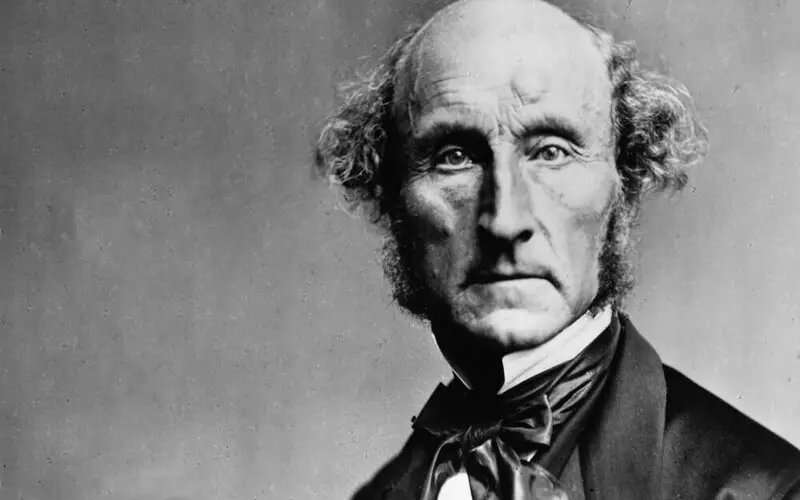
John Stuart Mill was an influential philosopher, economist, politician, and high-level employee of the East India Company. He lived from 1806 to 1873. In Britain in the 1800s, he was a controversial figure who pushed for using classical economic theory, intellectual thought, and social understanding in making political decisions and laws. Many of his ideas, like those about women’s rights and slavery, were pretty liberal for the time.
He mixed business and philosophy. He believed in utilitarianism, which says that actions that make people happy are right and actions that make people suffer are wrong. Within the field of economics, his most famous work, Principles of Political Economy (1848), was a top guide for many years after it came out. On Liberty, A System of Logic, The Subjection of Women, and Utilitarianism are some of his other important works.
Early Years and School
The British historian, economist, and philosopher James Mill had a son named John Stuart Mill in 1806. John was born in London. Born into a strict family with a strict father, he had to learn history, Greek, Latin, math, and economic theory from a very young age.
John Stuart Mill’s childhood and the ideas that James Mill taught him greatly impacted his beliefs, thoughts, and essential works. He met the famous political philosopher Jeremy Bentham through his father in 1808. The two then started a political movement that supported radical philosophy and utilitarianism, which says, “the greatest amount of good for the greatest number of people.” The young Mill learned the economic ideas, political ideas, and social views that would shape his later work during this time.
He got his start in life from this upbringing, which also caused him to have a mental breakdown and then a mental success. Mill thought that his overbearing father and the extreme system he was raised in caused him to feel sad, depressed, and even commit suicide for long periods. Because of the mental slip-up, he had to rethink ideas he had previously thought were true. By thinking about himself, he changed Bentham’s practical ideas to make them more positive. He then adopted these changes as his own set of beliefs.
The East India Company hired Mill when he was 16 and kept him there for 38 years, most of his working life. He was a Member of Parliament (MP) for the City of Westminster from 1865 to 1868.
Important Achievements
Mill’s Thoughts
People in Britain think that John Stuart Mill was one of the most important political thinkers. He greatly impacted political philosophy, economics, ethics, mathematics, social and political philosophy, and other fields.
Many of his articles, essays, and books compared the legal status of women at the time to that of enslaved people. He also pushed radical empiricism as a function of mathematics. He came up with the idea of the harm principle, which says that political power should only be used over a member of an organization when it is used to protect that member from harm.
Even though Mill strongly supported freedom and individual rights, he wasn’t always in favor of a “let it go” system. As an economist, he did support taxes and government control, such as rules for the workplace and limits on workers’ hours. In his later works, he seems to have moved away from the free market and capitalism, central to classical economics, and toward socialism or a mixed economy.
Mills built on the ideas of early economists David Ricardo and Adam Smith to develop economic terms like opportunity cost, economies of scale, and comparative advantage in trade.
Written Works On Sale
In order of when they came out, Mill’s most well-known works are:
The 1843 book A System of Logic describes how science works and how it can be used in social physics.
Principles of Political Economy (1848), a work that mixes theory and economics, says that limiting population and slowing economic growth would benefit the environment and make more public goods available.
On Liberty (1859), which talks about the kind of power society can legally have over an individual and its boundaries, introduces the harm principle and defends free speech.
Utilitarianism (1863), which builds on Bentham’s original ideas and uses them as the basis for morality, rejects the idea that one only looks out for one’s interests and says one wants to make society better.
The Subjection of Women (1869) argues for women’s right to vote and equal rights for men and women.
Some of his most famous works are Three Essays on Religion (1874), which criticizes traditional religious beliefs and supports a more open-minded “religion of humanity” (released after his death).
Autobiography (1874), which he wrote the year he died and released after his death.
The utilitarian creed says that actions are morally right if they make people happy and wrong if they tend to make people unhappy. By happiness, we mean pleasure and no pain; by sadness, we mean pain and the inability to enjoy pleasure.
—Utilitarianism by John Stuart Mill
Life in general
Harriet Hardy Taylor was Mill’s true love. They became close friends for twenty years, while she married someone else. In 1851, they got married. Taylor was a brilliant, liberal thinker and writer in her own right. She greatly influenced Mill’s work, and he even says so in The Subjection of Women. She may have also edited or co-written some of his pieces. Indeed, she helped Mill focus on the progressive ideas she cared deeply about, such as socialism, women’s rights, individual freedom, and a “utopian” view of how people can get better.
Which of John Stuart Mill’s books is the most important?
The Principles of Political Economy (1848), On Liberty (1859), Utilitarianism (1861), and The Subjection of Women (1869) are some of John Stuart Mill’s most important books.
What does John Stuart Mill’s utilitarianism mean?
John Stuart Mill’s utilitarianism builds on the ideas of philosopher Jeremy Bentham and has three main points:
- Happiness, or pleasure, is the only thing that has value on its own.
- When actions make people happy, they are correct, and when they make people unhappy, they are wrong.
- Everyone’s happiness is essential.
In his 1861 article “Utilitarianism,” Mill wrote about these ideas.
What did John Stuart Mill think about money?
John Stuart Mill wrote about his economic ideas in Principles of Political Economy, a term from the 1800s that means the same thing as “macroeconomics” today. It was first released in 1848 and underwent several versions as Mill added to and improved his ideas. Mill saw a close connection between economics, social theory, and politics. He believed that work naturally leads to wealth, but the division of wealth depends on the choices and will of real people, albeit a small group of educated elites. So, human rules and institutions can and should decide how wealth is shared.
In Mill’s mind, socialism was better because worker-owned companies would run the economy and make things. But he also believed in competition, accessible business, and taking the initiative himself. The government was in charge of keeping these things in good shape, stopping companies, helping people experiencing poverty, and ensuring kids got an education.
In Short
John Stuart Mill was a politician, philosopher, economist, and business leader. He is still exciting today as a liberal thinker who fought for people’s rights, the quest for happiness and as an ethical theorist. Mill thought that political leaders needed to know about economics, philosophy, and society to make better choices for the people. He was one of the most critical and controversial people in British politics and economics in the 1800s because of his books, such as Principles of Political Economy, Utilitarianism, and A System of Logic.
Conclusion
- John Stuart Mill was a famous British philosopher and economist who lived from 1806 to 1973. He was also a Member of Parliament (MP) and worked for the East India Company.
- As a liberal classical economist, Mill supported individual rights, progressive social policies, and the idea of utilitarianism, which says that people should do what does “the most good for the most people.”
- Mill thought that economics, philosophy, and social understanding should all be a part of politics and help make decisions about public policy.
- Mill’s most well-known books are principles of Political Economy, Utilitarianism, On Liberty, and The Subjection of Women.

