

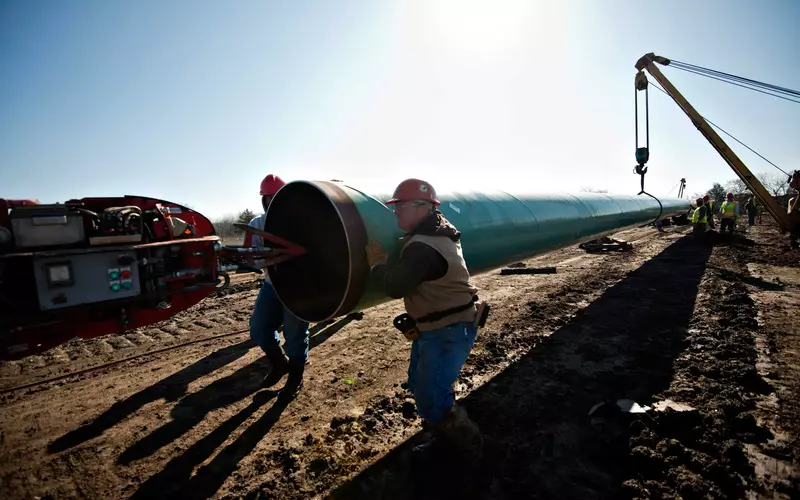
What Is the Pipeline Keystone XL?
The purpose of the Keystone XL pipeline was to deliver crude oil from Alberta, Canada, to American refineries. T.C. Energy, formerly TransCanada Corporation, was tasked with developing the last segment of the Keystone XL pipeline. Since 2010, the company has built multiple pipelines between Canada and the United States.
The oil pipeline was to be built through the international border between the United States and Canada. In March 2019, then-President Donald Trump issued presidential approval for its construction. However, President Biden revoked permission for the Keystone XL pipeline on January 20, 2021, through an executive order.
Knowing About the Keystone XL Pipeline
In a news release dated February 9, 2005, TransCanada Corp. announced their proposal for the Keystone Pipeline. The statement read, “TransCanada is in the business of connecting energy supplies to markets, and we view this opportunity as another way of providing a valuable service to our customers.” An inventive and economically viable solution to the pipeline expansion requirements resulting from the projected ten-year surge in Canadian crude oil output is to convert one of our natural gas pipeline assets for oil transportation.”
The pipeline’s initial section runs from Hardisty, Alberta, to the intersection at Steele City, Nebraska, and then continues to the Patoka Oil Terminal Hub, located north of Patoka, Illinois, and the Wood River Refinery in Roxana, Illinois. Section two extends southward from Steele City, Nebraska, across Kansas to Cushing, Oklahoma, where it serves refineries in Port Arthur. From there, it continues south to Nederland, Texas. The Houston Lateral Pipeline, which will link refineries and terminals in the Houston region with the crude oil pipeline in Liberty County, Texas, is the project’s third phase.
To strengthen their position against climate change, President Barack Obama declared in November 2015 that his administration would not approve permits for the pipeline’s construction.
President Trump issued an executive order in his first week in office, paving the way for the pipeline project.
The Republican Party thought the pipeline’s development would strengthen the economy and increase employment. President Joe Biden revoked the Keystone XL pipeline’s construction permit on January 20, 2021. Earlier that day, TC T.C. Energy said that construction was ceasing.
The Keystone Pipeline’s Operation
Through Montana, South Dakota, Nebraska, Kansas, and Oklahoma, diluted bitumen and synthetic crude oil are transported from Alberta to Texas, Illinois, and Oklahoma refineries via the Keystone system. Encased in oil sands, Canada possesses substantial oil reserves. Since it’s heavier than other types of oil, this oil needs to be refined differently. Particulate materials like soot and compounds like sulfur, hydrogen cyanide, and sulfides are released during heavy oil production. Over 800,000 barrels of oil per day are predicted to be carried by the completed Keystone XL pipeline.
Residents of the states where the Keystone pipeline travels, environmental organizations, and politicians have opposed the pipeline. These groups have expressed concerns regarding the proposed route’s closeness to the Ogallala aquifer, which supplies a substantial amount of the water utilized for agriculture irrigation in the United States, and the Sandhill region of Nebraska.
The bitumen that the pipeline transports to the United States will probably emit more greenhouse gases.
For instance, in an attempt to halt pipeline development, the National Resource Defense Council (NRDC) filed lawsuits in 2017, 2019, and July 2020.
The NRDC claims that tar sands oil is more acidic and heavier than regular crude oil, making pipeline leaks and spills more likely. According to the group, North Dakota experienced an oil spill in October 2019 that involved 378,000 gallons of oil.
Advocates of the pipeline assert that it will augment the United States’ oil supplies and that oil originating from a friendly bordering nation enhances security.
Conclusion
- In 2005, TC Energy (formerly TransCanada Corp.) suggested the Keystone Pipeline to get new heavy oil finds from oil sands in Canada to refineries in the U.S. The pipe network is 4,324 km (2,687 mi) long.
- Keystone has been divisive for a long time because of worries about how it will affect the environment locally and globally.
- President Joe Biden took away the building permit for the Keystone XL pipeline on January 20, 2021.

