

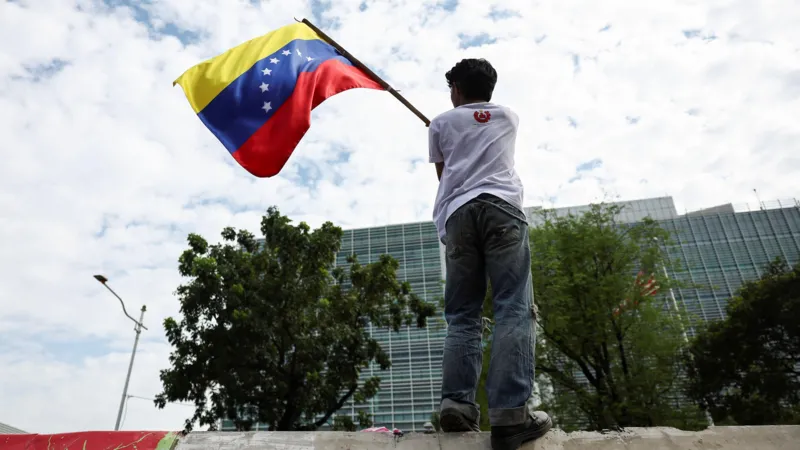
Across Venezuela, people are trying to process what the sudden removal of President Nicolás Maduro means for their country, as fear, caution and hope collide in the aftermath of the US-led operation.
In Caracas, Marcelo, a university student, says many Venezuelans quietly welcome Maduro’s capture but only behind closed doors.
“There are still people loyal to Maduro who hold power,” he told the BBC World Service. “That’s why we don’t celebrate publicly. But I can tell you most Venezuelans are relieved about what happened.”
His caution reflects a broader mood. Many people critical of the former government agreed to speak anonymously, worried about reprisals. Others, however, remain fiercely loyal to Maduro and angry at the US intervention.
Rosa Contreras, a 57-year-old supporter, said she felt humiliated by how easily US forces removed the president.
“It was shocking how they took him away,” she said.
Deadly operation, unclear future
Dozens of people were reportedly killed during the raid that saw Maduro and his wife, Cilia Flores, seized from their residence in Caracas and flown to the US to face drug trafficking and weapons charges. Cuba says at least 32 of its security personnel were among the dead.
Soon after the operation, President Donald Trump said the US would now “run” Venezuela — though what that entails remains uncertain.
Maduro’s vice-president and closest ally, Delcy Rodríguez, has since been sworn in as interim president. Her appointment has been followed by heightened security measures, including police patrols and the detention of journalists.
At a rally calling for Maduro’s release, Contreras said footage of him waving on arrival in the US strengthened her resolve.
“He sent us a message: stand tall and keep going,” she said.
Relief mixed with resentment
For others, Maduro’s survival carries a different meaning.
“We want him alive — but spending every remaining day behind bars,” Marcelo said.
Years of economic collapse and political repression have driven millions of Venezuelans to leave the country. Marcelo believes some of his friends abroad would return if the seizure led to genuine political change and an end to Chavismo, the socialist movement founded by Hugo Chávez.
“If the US oversees a stable transition — economically and socially — many people would accept it, even if it’s imperfect,” he said.
An opposition activist in his 60s from Maracaibo echoed that view, saying that while the loss of life troubled him, he felt relief that Maduro was finally detained.
“He did enormous harm to this country,” he said. “We’re glad he’s facing justice.”
A 33-year-old masseuse described years of deprivation under the former government.
“They left people with crumbs while they kept everything for themselves,” she said, adding that although she does not support interim president Rodríguez, she accepts the situation if it leads to a transition.
Anxiety over what comes next
Despite the sense of relief among some, fear remains widespread. President Trump has not ruled out further military action, raising concerns about renewed violence.
Gelén Correa, who works in government social programmes, rejected the idea of foreign intervention.
“Venezuelans deserve respect,” she said. “If there’s another attack, we will resist.”
Others worry the power structure has barely changed.
“They removed the figurehead, but the system is still there,” said José, 60.
Economic anxiety is already growing. Several people reported sharp price increases in basic food items. One man said the cost of cornflour had nearly tripled, while another reported bread prices rising by around 30%.
In eastern Guyana City, a woman said streets were largely empty, with military personnel guarding supermarkets amid fears of looting.
“People are afraid to leave their homes,” she said.
Several respondents described feeling intimidated by armed pro-government groups patrolling neighbourhoods.
Memories of past repression
A 34-year-old entrepreneur said she feared retaliation similar to what followed the disputed 2024 election, when Maduro was declared the winner by an electoral council loyal to his government — a result rejected by the US, EU and several Latin American countries.
Her fears are rooted in experience. Previous protests were often crushed by security forces and armed civilian groups aligned with the government.
“There are soldiers on every corner, and armed civilians creating fear,” she said. “No one knows if peace will come next.”
That sense of unease was summed up by the masseuse in Maracaibo.
“There is fear everywhere — in the streets and inside our homes,” she said.

