

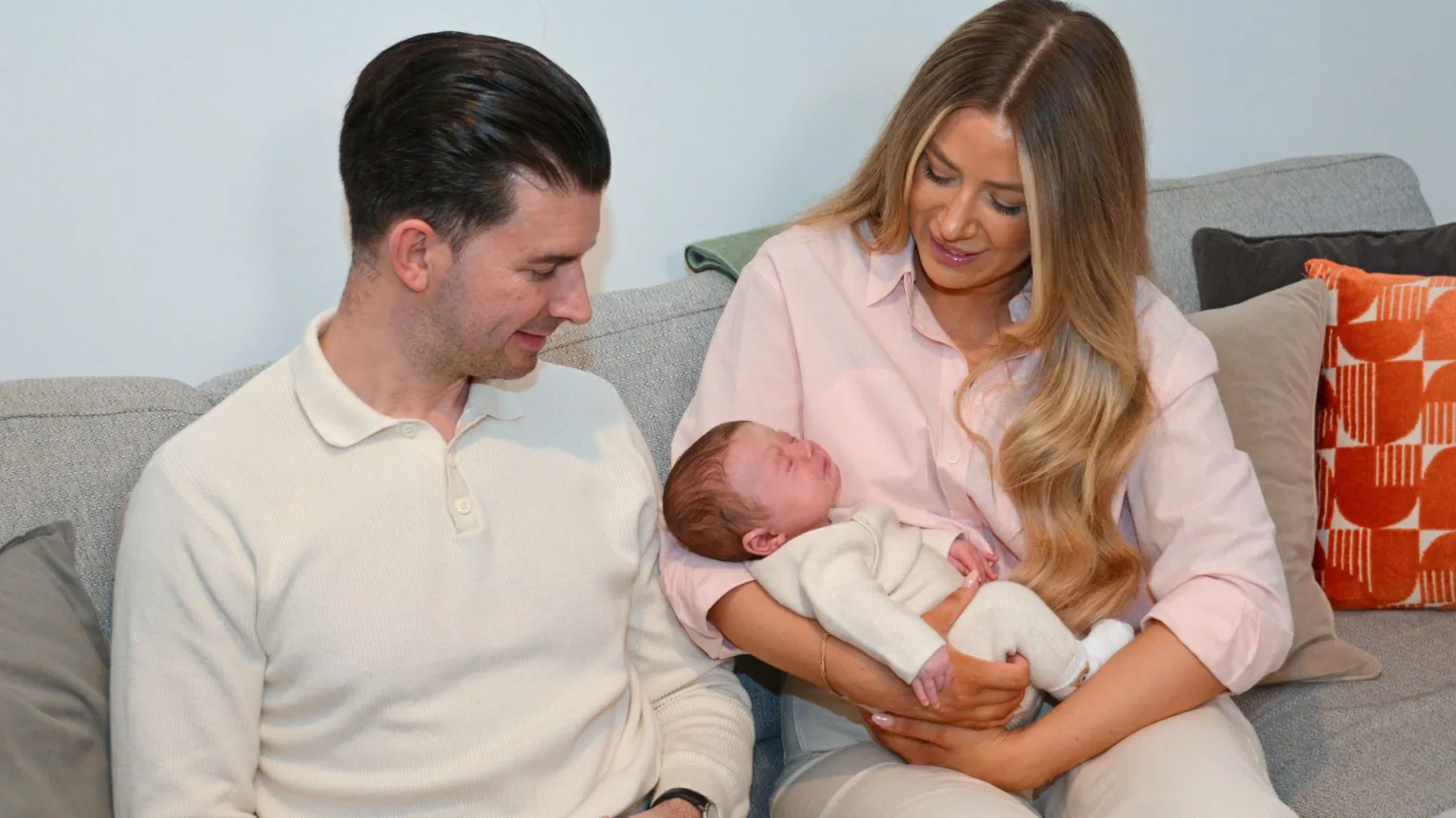
A baby boy has made medical history as the first child in the UK to be born after his mother received a womb transplant from a deceased donor, marking a major breakthrough in reproductive medicine.
Grace Bell, a woman in her 30s from Kent who was born without a functioning womb, gave birth to her son Hugo late last year. Now 10 weeks old, Hugo’s arrival followed years of medical research, surgery, and fertility treatment — and a gift from a donor family Bell describes as life-changing.
Speaking to the BBC, Bell said the experience of becoming a mother was beyond words. “He is simply a miracle,” she said, reflecting on the moment she first saw her baby’s face.
Hugo was delivered just before Christmas 2025 at Queen Charlotte’s and Chelsea Hospital, weighing just under 7lb. His birth followed a womb transplant operation carried out in June 2024 at The Churchill Hospital, where surgeons spent 10 hours implanting the donated organ.
Bell was born with MRKH syndrome, a condition that means she does not have a viable womb and never experienced menstrual periods, despite having normally functioning ovaries. She was diagnosed at 16 and told she would never be able to carry a child herself.
For years, her only potential paths to parenthood were surrogacy or the possibility — still experimental at the time — of a womb transplant.
That possibility became real when Bell received a call informing her that a womb from a deceased donor had been offered and a transplant could go ahead. She recalled being stunned by the news, torn between excitement and the emotional weight of knowing that another family had suffered a loss.
She said she thinks of the donor and her family every day. “I pray they find peace in knowing their daughter gave me the biggest gift — the gift of life,” Bell said. “A part of her will live on forever.”
Following the transplant, Bell and her partner, Steve Powell, underwent IVF treatment and embryo transfer at The Lister Fertility Clinic. Months later, Bell became pregnant.
Describing the moment Hugo was born, she said it felt unreal. “I remember waking up and seeing his little face, with his dummy in, and it felt like I needed to wake up from a dream,” she said. “It was just incredible.”
Hugo’s birth is part of a UK clinical research trial examining whether womb transplants from deceased donors can become a viable treatment for women without a functioning uterus. Ten such transplants are planned. Three have already taken place, but Hugo is the first baby born from one.
Earlier in 2025, another child — baby Amy — was born after a womb transplant from a living donor. In that case, the mother received her sister’s womb in a transplant operation carried out in January 2023. Her sister had already completed her own family. Five more transplants from close relatives are planned in the UK.
Both births took place at the same London hospital and involved the same specialist medical team, which has spent decades working towards this milestone.
Consultant gynaecologist Professor Richard Smith, who was present at Hugo’s birth, has been researching womb transplantation for more than 25 years. He works at Imperial College Healthcare NHS Trust and founded the charity Womb Transplant UK.
Bell and Powell honoured Smith’s role by giving their son the middle name Richard.
The couple may choose to have a second child. After that, surgeons plan to remove the transplanted womb so Bell does not need to remain on powerful immune-suppressing drugs for the rest of her life.
Transplant surgeon and joint team leader Isabel Quiroga described Hugo’s birth as a landmark moment for UK medicine. She said very few babies in Europe have been born following womb transplants from deceased donors and that the trial aims to establish whether the procedure can become a routine treatment option.
The baby has no genetic link to the donor, as genetic material comes from the parents, not the transplanted womb.
Globally, more than 100 womb transplants have been performed, resulting in over 70 healthy births. However, womb donation differs from other organ donations. It can only occur following a specific request to families who have already agreed to donate their relative’s organs.
In the UK, organ donation operates under an opt-out system, meaning consent is presumed unless someone has chosen otherwise.
The parents of Hugo’s donor, who remain anonymous, said they felt “tremendous pride” in the legacy their daughter left behind. She donated five organs in total, helping four other people.
“Through organ donation,” her family said, “she has given other families the precious gift of time, hope, healing — and now life.”

