

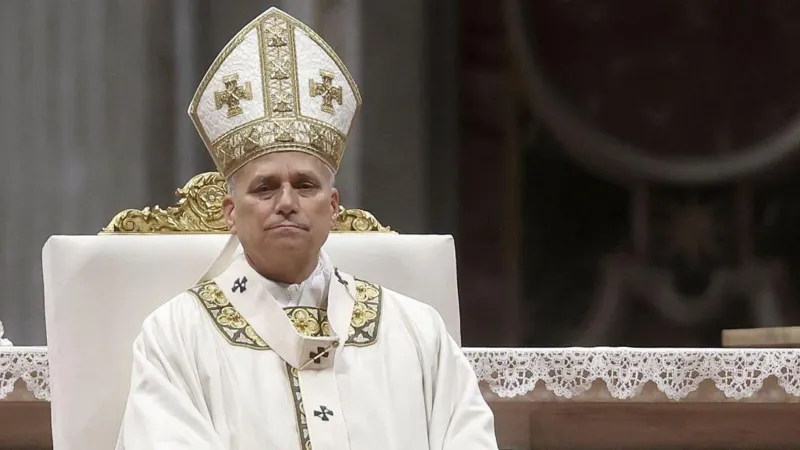
Tensions are growing between Pope Leo XIV and the Trump administration, exposing deep divisions over immigration policy within the American Catholic Church and raising questions about the relationship between faith and politics in the United States.
Jesse Romero, a conservative Catholic podcaster and outspoken supporter of Donald Trump, does not mince his words when it comes to the American-born pontiff. “The Pope should tell us how to get to heaven,” Romero says. “He has no authority over the government. He has to stay in his lane.”
Romero’s criticism reflects mounting anger among conservative Catholics following comments by Pope Leo and senior US bishops opposing the administration’s mass deportation policies. With one in five Americans identifying as Catholic, the Church remains a powerful force in US public life — and a significant political constituency.
Catholic voters and leaders played a crucial role in Donald Trump’s electoral success. Vice President JD Vance, along with influential conservative figures such as legal activist Leonard Leo, were central to mobilising Catholic support. Catholics also occupy key positions within the administration, including Secretary of State Marco Rubio and Education Secretary Linda McMahon.
Yet immigration has emerged as a major fault line — not only between Church leadership and the government, but also among Catholic parishioners themselves.
When cardinals gathered in Rome for the papal conclave in May, some conservatives had hoped for a “Trump-like Pope.” Instead, Pope Leo XIV has repeatedly voiced concern about the treatment of migrants in the United States. In November, he called for “deep reflection” on immigration policy, invoking the Gospel of Matthew: “At the end of the world, we’re going to be asked, ‘How did you receive the foreigner?’”
A week later, the United States Conference of Catholic Bishops (USCCB) issued a rare “Special Message” expressing alarm over what it described as a “climate of fear and anxiety” affecting immigrant communities. The bishops said they opposed “the indiscriminate mass deportation of people” and prayed for an end to “dehumanising rhetoric and violence.”
It was the first time in more than a decade that the USCCB had released such a communiqué. Pope Leo publicly endorsed the statement, calling it “very important” and urging Catholics and “people of goodwill” to listen carefully.
Chicago has become a focal point of the administration’s immigration enforcement efforts, symbolising the growing divide.
“I think the relationship is quite tense,” says David Gibson, director of Fordham University’s Center on Religion and Culture. He notes that many conservatives had expected Pope Leo to move away from the social justice emphasis of his predecessor, Pope Francis. “Instead, many are angry. They want to tell the Church to shut up and focus only on issues like abortion,” he says.
Senior administration figures have pushed back strongly. White House border czar Tom Homan, himself a Catholic, said the Church “is wrong” and should focus on fixing its own internal issues. In October, Press Secretary Karoline Leavitt rejected Pope Leo’s suggestion that US immigration practices were “inhuman” and inconsistent with “pro-life” values.
According to Gibson, the administration appears willing to risk confrontation. “There are enough American Catholics — particularly white Catholics — who support Donald Trump that it’s politically advantageous to pick a fight with the Pope,” he says. “That’s an unprecedented calculation.”
Polling supports that view. A recent study by the Public Religion Research Institute found that nearly 60% of white Catholics approve of Trump’s handling of immigration, compared with around 30% of Hispanic Catholics, who make up 37% of the US Catholic population.
Vice President JD Vance, a Catholic convert, has frequently spoken about how his faith shapes his politics. While he has argued that current immigration policy does not contradict Church teaching, he has also acknowledged a moral responsibility to recognise the humanity of those living in the US without legal status.
Many Catholics say that principle is being violated. Jeanne Rattenbury, a parishioner at St Gertrude Catholic Church in Chicago, participated in a Mass attended by around 2,000 people outside an ICE detention centre in November. Organised by the Coalition for Spiritual and Public Leadership (CSPL), the service aimed to provide Communion and pastoral care to detainees.
“That ministry used to be allowed,” Rattenbury says. “Now it isn’t.” The CSPL has since filed a federal lawsuit alleging it was unlawfully blocked from providing religious services.
“I’m proud to be a Catholic when the Church — from the Pope to the bishops — insists that immigrants deserve respect and that their inherent human dignity must be upheld,” she adds.
The strength of feeling has also surfaced symbolically. A church near Boston used its Christmas nativity scene to highlight the issue, replacing the baby Jesus with a sign reading “ICE was here,” a reference to Jesus’s status as a refugee. Following complaints, the Catholic Archdiocese of Boston ordered the display removed, saying it was divisive and violated rules governing sacred objects. The church has so far refused.
While US Catholics often align with the Church’s conservative stance on issues such as abortion, they are generally more politically diverse than white evangelical Christians, who have overwhelmingly backed Republicans in recent elections. Around a third of white Catholics consistently vote Democratic.
Nearly one-third of Catholics in the United States were born outside the country — a reality that shapes the Church’s identity. “This is a church built on immigration,” Gibson says. “The Catholic brand in the United States is an immigrant church.”

