

Hyundai Motor Group has announced plans to begin deploying humanoid robots across its manufacturing facilities from 2028, joining a growing list of global companies investing in advanced robotics.
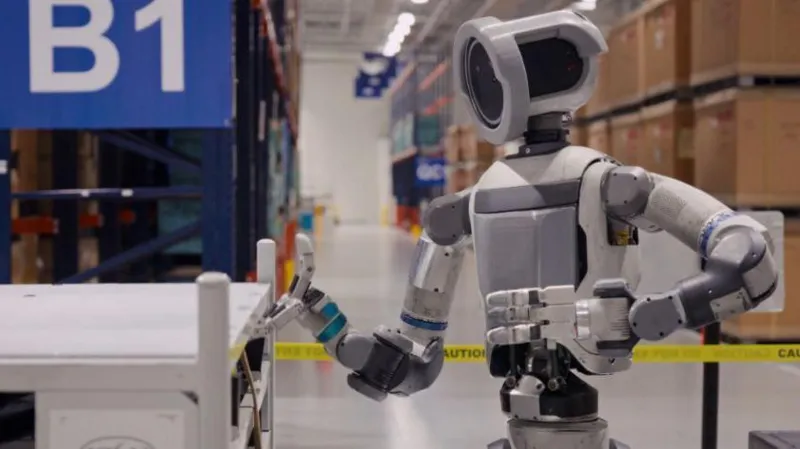
The South Korean carmaker showcased Atlas, a human-shaped robot developed by Boston Dynamics, at the Consumer Electronics Show (CES) in Las Vegas. Hyundai, which holds a majority stake in Boston Dynamics, said the robots will eventually be integrated throughout its worldwide production network.
Atlas is designed for general industrial use and can operate both independently and alongside human workers. Hyundai says the robots will initially handle basic tasks before gradually taking on more complex responsibilities.
According to the company, the technology is intended to reduce physical strain on employees, perform hazardous jobs, and support the long-term expansion of robotics in manufacturing. Hyundai has not disclosed how many robots it plans to deploy in the early stages or the overall cost of the project.
Part of a wider robotics race
Hyundai’s announcement comes as major firms including Amazon, Tesla and China’s BYD accelerate efforts to introduce humanoid robots into their operations. Tesla, led by Elon Musk, has heavily promoted its own robot project, Optimus, as a future workforce assistant.
Speaking at CES, Hyundai vice-chair Jaehoon Chang acknowledged concerns that robots could replace human jobs. However, he said people would still play a vital role, particularly in training, supervising and managing robotic systems.
The move follows Hyundai’s 2025 pledge to invest more than $20bn in the United States, backing President Donald Trump’s push to strengthen domestic manufacturing. The investment includes expanding vehicle production and advancing autonomous driving and artificial intelligence technologies.
Georgia plant remains under scrutiny
Hyundai’s US battery plant in Georgia, operated with electronics firm LG, has drawn attention in recent years. In September 2025, the site was the focus of a large-scale immigration raid in which hundreds of workers—many of them South Korean nationals—were detained, sparking outrage in South Korea.
Images showing detained workers in leg restraints prompted criticism from political leaders and business executives. South Korean President Lee Jae Myung and Hyundai CEO José Muñoz warned the incident could discourage foreign investment in the US.
Following diplomatic discussions, the workers were released later that month. President Trump later said he opposed the raid and stressed the importance of allowing skilled foreign workers to help establish specialised industrial facilities.
Muñoz later revealed that the White House had contacted him directly to apologise for the incident.
Automation and the future of factory work
Hyundai says the introduction of Atlas robots is part of a broader strategy to modernise manufacturing while balancing automation with human expertise. As companies race to adopt humanoid robotics, the challenge remains how to integrate the technology without undermining job security or worker trust.

