

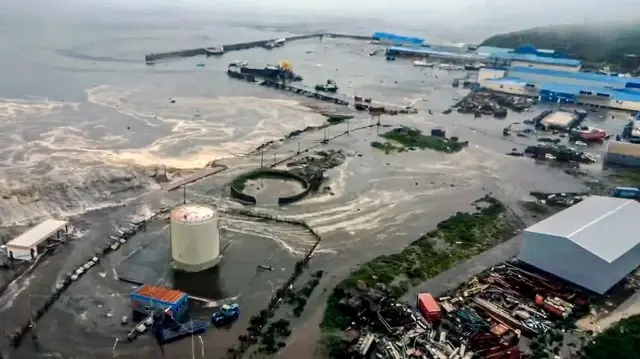
A powerful magnitude 7.6 earthquake struck north-eastern Japan late Saturday, prompting widespread evacuation orders and raising concerns about potential aftershocks. The quake occurred at 23:15 local time (14:15 GMT) at a depth of 50 kilometers (31 miles), approximately 80 kilometers off the coast of the Aomori region, according to the Japan Meteorological Agency.
Authorities issued tsunami warnings immediately after the tremor, which were later lifted, though waves reaching 70 centimeters (27 inches) were observed along the affected coastline. Japanese Prime Minister Sanae Takaichi confirmed that at least seven people sustained injuries and urged residents to remain vigilant, warning that aftershocks could continue for up to a week. She emphasized the importance of ongoing preparedness, advising citizens to secure furniture, review emergency evacuation plans, and be ready to move quickly if further tremors occur.
Roughly 90,000 residents received evacuation orders as officials worked to ensure safety across the region, Reuters reported. The government has activated a response office within the prime minister’s crisis management center and convened an emergency team to coordinate relief efforts. Chief Cabinet Secretary Minoru Kihara stated that authorities are actively assessing damage and deploying emergency measures, including rescue operations and aid distribution.
Transportation services were disrupted, with some bullet train lines along the north-eastern coast temporarily suspended. Despite the earthquake’s strength, no abnormalities were reported at the Higashidori and Onagawa nuclear power plants, according to Tohoku Electric Power. Japanese authorities also confirmed to the International Atomic Energy Agency that the disabled Fukushima nuclear facility, heavily damaged by the 2011 earthquake and tsunami, sustained no new issues.
The March 2011 magnitude 9.0 earthquake remains Japan’s deadliest recorded in modern history, generating a devastating tsunami that claimed over 18,000 lives and destroyed entire towns on Honshu, the country’s main island. Japan continues to face frequent seismic activity, with tremors occurring on average every five minutes, underscoring the ongoing need for vigilance and disaster preparedness throughout the nation.

