

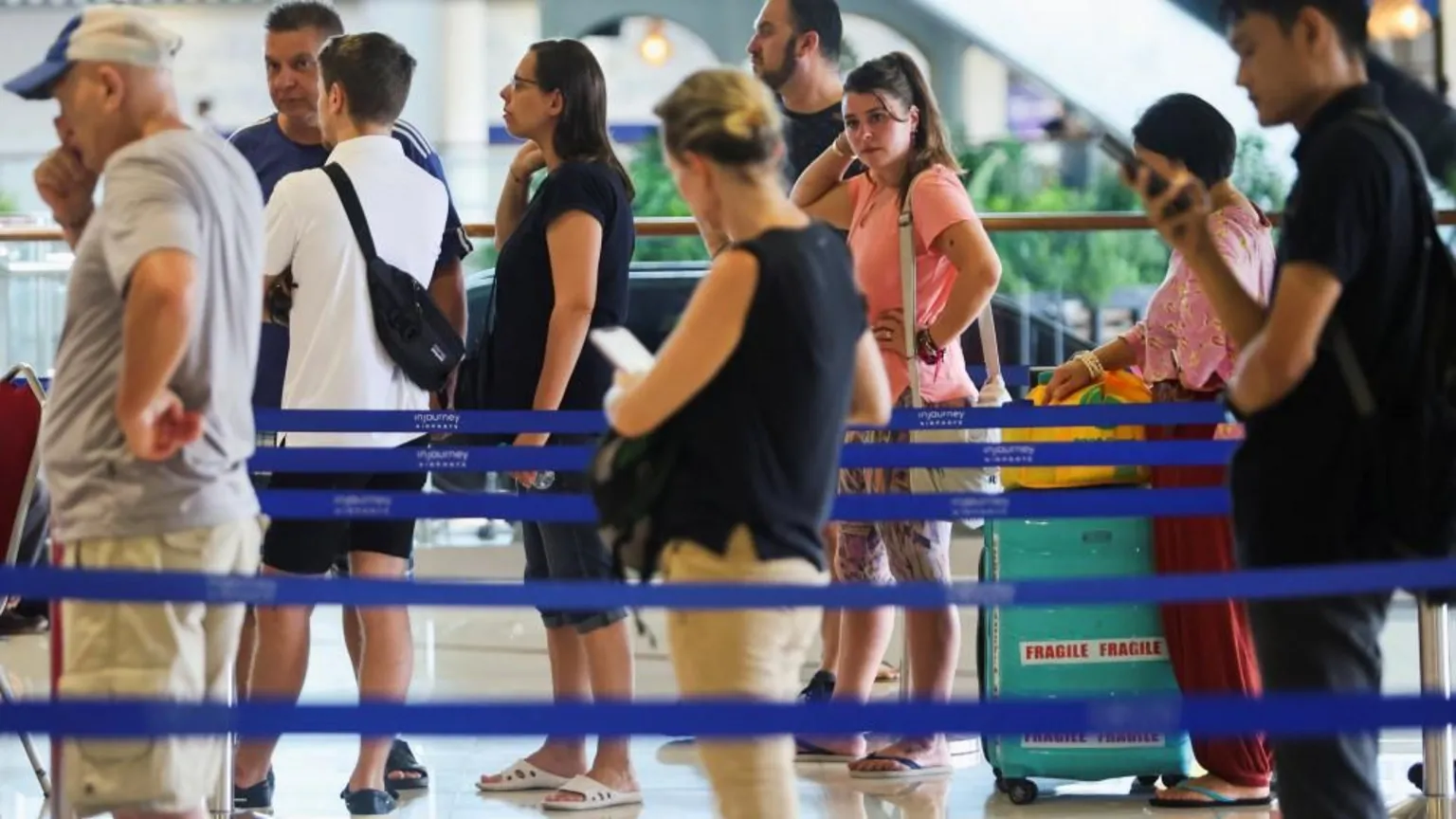
A small number of flights have managed to depart from the United Arab Emirates, but air travel across the Middle East remains heavily disrupted due to the ongoing military escalation involving Israel and United States targeting Iran.
According to flight tracking service Flightradar24, over 4,000 daily flights across the region have been cancelled, affecting hundreds of thousands of passengers. Ian Petchenik, director of communications at the service, warned that disruption “will only increase the longer the crisis continues” and that the situation “will have enormous repercussions for the industry.”
The airline disruption comes amid the UK government reporting that more than 100,000 British nationals have registered their presence in the Middle East to receive support and updates.
Flight Cancellations Across the Region
On Monday morning, aviation analytics firm Cirium reported that 79% of flights to Qatar and 71% to the UAE had been cancelled. In addition, 81% of flights to Israel and 92% to Bahrain were grounded.
Etihad Airways suspended services until 14:00 local time (10:00 GMT) on Wednesday, though some ad-hoc flights operated on Monday. Among these, an Etihad flight to London Heathrow (EY67) was scheduled to land in the UK in the early evening. Other ad-hoc departures included flights to Moscow, Paris, Cairo, Delhi, and Karachi. The airline clarified that these flights were limited to cargo, repatriation, or repositioning operations coordinated with UAE authorities, and that regular scheduled services remain cancelled.
Dubai Airports announced on social media that a “limited resumption of operations” would start on Monday evening, allowing a small number of flights to operate from Dubai’s two main hubs – Dubai International and Dubai World Central. Emirates has indicated that passengers with earlier bookings will be prioritized on these flights and will be contacted directly.
Meanwhile, no flights are departing or landing from Doha, as Qatar has kept its airspace closed. Qatar Airways confirmed operations remain suspended, stating it will resume flights only when the Qatar Civil Aviation Authority declares the airspace safe. Updates are being shared via the airline’s website and app.
From the UK, flights to many Middle Eastern destinations have been cancelled. This includes all flights to Israel and Bahrain, three-quarters of scheduled flights to the UAE, and 69% of flights to Qatar.
Stranded Passengers and Airline Guidance
Although a limited number of flights have departed the UAE today, many passengers remain stranded. Emirates said it would operate a small number of flights Monday evening, prioritizing those whose earlier bookings were cancelled. Passengers will be contacted directly and are advised not to travel to the airport unless notified.
Etihad reiterated that its regular scheduled services will remain suspended until Wednesday, warning customers not to visit airports unless contacted directly. Passengers are also urged to ensure their contact information is up to date and to check flight status online.
Qatar Airways confirmed all operations remain suspended, with updates expected on Tuesday.
FCDO Advisory
The UK Foreign, Commonwealth and Development Office advises travellers planning trips to the Middle East to check the latest travel guidance for their destination. The FCDO notes that travelling against official advice could invalidate travel insurance. Countries currently affected include Egypt, Israel, Bahrain, Lebanon, and Kuwait.
Travelling from Melbourne to Venice, his flight out of Doha on Saturday morning had to turn back mid-air due to the conflict.
“We were in the airport for 15 hours before being evacuated to a hotel,” Scott said. “That was full, and we had to shelter underground due to close explosions. Since then, I can hear blasts in the area and I am still waiting for an opportunity to leave.”

