


Normalizing China-Australia commerce requires more than political fixes. After three years of political conflict, China is lifting restrictions on Australian imports, but restarting trade is harder than blocking it.
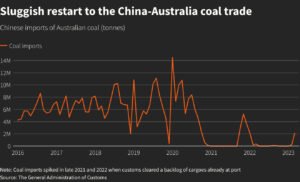
China lifted coal curbs in January after a late-year leaders summit. However, three months later, coal imports were still a third of the 2016-2019 average in March.
According to dealers, Chinese customs agents had to visit eight government offices to arrange permits after weeks of bureaucratic stagnation. In addition, buyers said Australia was not in the import licensing computer system in February.
The economy has deteriorated. Australian miners no longer give concessional coking coal pricing due to new consumers. China now imports cheaper goods from Russia and Mongolia.
“These things take time, there is no magic wand to bring everything back to normal, it will be a slow process over several months,” said Australia China Business Council head David Olsson.
In 2017, Canberra expressed concern over China’s militarization of South China Sea islands and adopted legislation criminalizing foreign meddling that targeted Beijing.
China imposed trade restrictions on A$17 billion of Australian coal and timber imports in 2020 after Australia requested a probe into COVID-19.
The slow coal trade return implies that restoring the markets, logistics, and expectations that facilitated trading in limited materials may take months or years.
Despite the curbs, Australian exports to China rose to A$175 billion last year from A$149 billion in 2019, largely due to a booming iron ore trade that China’s steel mills cannot risk disrupting.
The center-left Labor government prioritized open commerce and lifted coal restrictions early. The trade minister will follow Foreign Minister Penny Wong to Beijing in weeks.
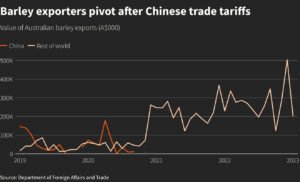
Last month, the nations agreed to resolve a WTO dispute over Chinese barley tariffs in three months. Australia’s trade minister expects wine tariffs.
Australian customs employees who verify export containers may be scarce. Frank Rudkiewicz, an Agriculture Department-certified “authorised officer” (AO) who inspects export shipments, claimed many fled overnight when the wood log trade was limited.
“There was so much work guaranteed and then overnight it all fell through,” he claimed.
He was transported to Townsville, 1,800 km north, to confirm a grain cargo.
Reuters interviewed three customs workers in three states. All noted shortfalls. One Tasmanian blamed “across-the-board” difficulties on government permissions that took 15 months, up from six months.
The Department of Agriculture stated that AO numbers had not changed much. In addition, the department stated that the usual application-to-appointment duration is 3-6 months.
Officials and exporters believe that competition, a desire to preserve new markets, and skepticism about the diplomatic thaw will prevent a speedy restoration to pre-restriction trade levels.
“Chinese coal traders see little incentive now to sign long-term contracts,” a Chinese trader said, noting huge inventories and “the potential risk of the relationship turning sour again.”
Reuters reported that Australian wine, lumber, and meat producers would not prioritize China over emerging markets.
“It would be short-sighted to lose the hard-fought new businesses we’ve built,” said Cattle Australia chair David Foote.
Producers returning to China will confront competitors who have had over two years to gain ground.
Lee Mclean, head of Australian Grape & Wine, said entrenched French and Chilean competition would keep Australian wine exports from recovering to pre-dispute levels.
Even as it pursues economic reconciliation, Australia has clarified that direct trade does not mean returning to China at the cost of other markets.
Tensions continue. Australian national security concerns prevented a Chinese rare earth investment in February.
While announcing the barley tariff deal, Foreign Minister Wong advised exporters to diversify.
“We never want to find ourselves in a situation where we’re so totally reliant on one market,” Trade Minister Don Farrell said Monday.

