


THE RISE OF E-COMMERCE IN THE ECONOMY IN 2023
If you thought e-commerce was already a major force in the economy, brace yourself: experts predict even more rapid growth and disruption in the years to come.
KEY TAKEAWAYS
- E-commerce is expanding quickly due to technological progress and customer preference shifts. As a result, Internet sales are anticipated to continue to rise and surpass traditional retail in 2023.
- E-commerce has a multifaceted impact on the economy, having both good and negative aspects. Although e-commerce can increase competitiveness and generate employment, it may also displace employees and hurt the environment.
- The way consumers purchase and connect with companies is changing due to new e-commerce trends, including mobile commerce, voice commerce, and social commerce.
- E-commerce rules, such as data privacy and consumer protection, vary greatly across nations and may substantially impact businesses and consumers.
- The future of e-commerce is thrilling and ominous, with new possibilities for businesses emerging alongside threats to their security and logistical bottlenecks.
- E-commerce is upsetting traditional retail and altering how businesses function, and businesses need to adapt to stay caught upheld.
- Businesses and politicians must carefully analyze the digital revolution’s impact and adjust appropriately as e-commerce continues to prominence in the global economy.
INTRODUCTION
E-commerce has become a crucial component of the global economy, transforming how consumers purchase, and businesses function. Moreover, the digital revolution is expected to considerably impact the economy by 2023, when e-commerce will continue upward.
The Internet exchange of products and services is known as e-commerce or electronic commerce. Due to technological developments and shifts in consumer behavior, this digital sector has expanded quickly in recent years. Businesses have reacted by spending extensively on e-commerce infrastructure due to the ease and accessibility of online purchasing, making it a desirable alternative for consumers.
As the first online sales transactions were made in the mid-1990s, e-commerce was only getting started. Yet, it was only with the introduction of online marketplaces like eBay and Amazon in the early 2000s that e-commerce took off.
Since then, e-commerce has continued to develop, with new technology and innovations fueling growth and transforming the industry. Mobile commerce, for instance, has grown significantly, with consumers utilizing their cell phones to do online shopping and make transactions. In addition, businesses use social media sites like Instagram and Facebook for marketing their wares and interacting with their target audience.
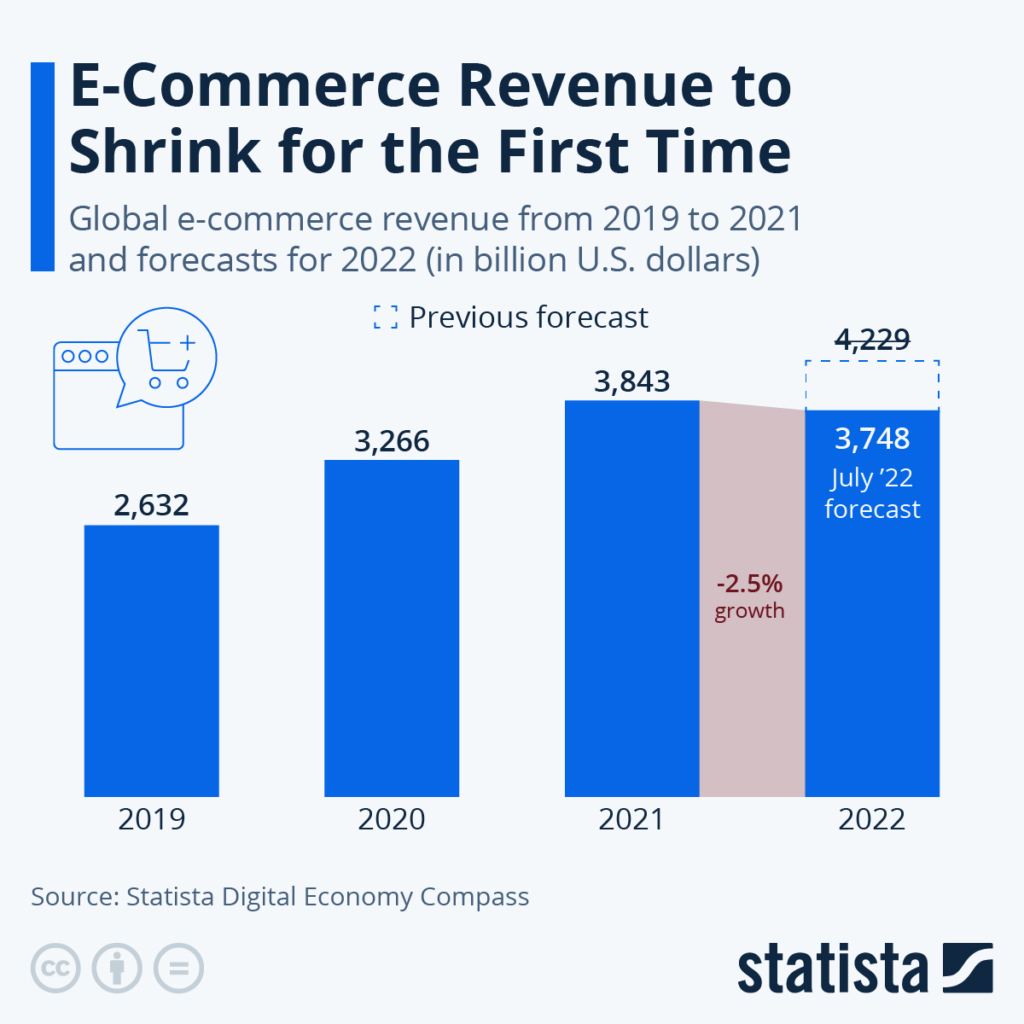
The global economy will be significantly impacted by e-commerce by 2023. Global e-commerce sales are expected to increase to $5.4 trillion in 2022 from $3.5 trillion in 2019. In the United States, e-commerce sales made up 14% of all retail sales in 2020, up from 5% in 2009.
With e-commerce becoming a larger and larger component of the economy, this growth is expected to continue in the years to come. However, it’s important to remember that there are still obstacles to e-commerce. To succeed, businesses must adapt to shifting customer behavior as the industry develops and negotiate new rules and regulations.
E-commerce has emerged as a significant force in the global economy and a crucial driver of economic growth. With evolving technology and shifting customer behavior fueling growth and change in the industry, e-commerce is expected to continue its upward trend as of 2023. To succeed in today’s competitive, ever-evolving market, businesses must keep one step ahead of the curve and adapt to these shifts.
TRENDS IN E-COMMERCE
With online sales making up a significant fraction of all retail sales worldwide, e-commerce has grown tremendously in recent years. Many key elements, such as technical improvements and shifting consumer behavior, propel this growth. Some emerging themes shape the future of e-commerce as we look forward to 2023 and beyond.
In recent years, e-commerce has seen remarkable growth. Global e-commerce sales increased to $4.28 trillion in 2020 from $2.93 trillion in 2018. With eMarketer predicting that worldwide e-commerce sales will reach $6.38 trillion by 2024, this growth is expected to continue.
The proliferation of smartphones and other mobile devices has been a key factor in this growth. As a result, it is now more convenient than ever for consumers to shop online since they may do it from any location at any time.
Technological improvements have significantly influenced the growth of e-commerce. These developments have made it easier and safer for consumers to shop online, from better internet connections to more secure payment methods. Moreover, developments in logistics and delivery have made it feasible for online retailers to deliver products more quickly and effectively than ever before.
Another key factor in the growth of e-commerce is changing customer behavior. Today’s consumers are more used to buying online and are more inclined to do so than in traditional shops. Moreover, since younger generations, who are more acclimated to buying online, make up a bigger share of the consumer market, this tendency is expected to continue.
One of the most important emerging trends in online commerce is mobile commerce or m-commerce. Retailers are investing in mobile-friendly websites and applications to create a smooth online shopping experience as more consumers shop online using smartphones. Moreover, voice commerce, or v-commerce, is gaining popularity as consumers use voice assistants like Amazon’s Alexa to purchase.
Another emerging trend that is changing the face of online commerce is social commerce. Retailers may now offer products to consumers directly via their social media profiles thanks to sites like Instagram and Facebook. This makes it easier for consumers to find new products and purchase without leaving their preferred social networking site.
IMPACT OF E-COMMERCE ON THE ECONOMY
The global economy has been significantly impacted by e-commerce, positively and negatively. This section will discuss how e-commerce has impacted the economy and the sectors that have been most impacted.
The development of new jobs is one of e-most commerce’s major benefits. Website designers, software engineers, and customer service representatives are just a few of the talented personnel online retailers need. Moreover, e-commerce has created new possibilities for startups and solopreneurs, allowing them to compete with established enterprises and reach a worldwide audience.
E-commerce has also boosted competition, which has led to higher productivity and cheaper pricing for consumers. With online retailers, consumers can readily compare prices and items from different retailers, placing pressure on companies to provide low costs and a positive shopping experience.
Although e-commerce has created new employment and economic prospects, it has also led to losing jobs in the logistics and retail sectors. Retailers and logistics industries are being compelled to adjust as consumers shift more and more to online shopping, which might lead to employment losses in these sectors.
E-commerce has also had a negative influence on the environment. For example, the rise of online shopping has increased vehicle emissions and packaging waste. As a result, online retailers are looking for new ways to lower their environmental effects to offset these negative impacts, such as switching to more eco-friendly packing materials and refining their distribution networks.
The rise of e-commerce has impacted several industries, including the retail industry. Consumers increasingly resort to online retailers for anything from household goods to apparel and technology due to the ease of doing business with them. As a result, traditional brick-and-mortar retailers have been pressured to change, and many have invested in online platforms or gone out of business completely.
E-commerce has also significantly impacted the logistics industry. Online shopping has increased the pressure on logistics providers to provide lightning-fast service. This has led to substantial expenditures in logistics facilities like warehouses and distribution centers and development in delivery methods like drones and autonomous vehicles.
E-COMMERCE REGULATIONS
As much as e-commerce has simplified our daily lives, it has also brought along many new rules and regulations that businesses and consumers must learn to negotiate. In this part, we will present an overview of e-commerce regulations in various countries, effective regulations governing e-commerce, and the impact of e-commerce regulations on businesses and consumers.
When it comes to e-commerce, many countries have different rules and regulations. For example, the United States has the Federal Trade Commission Act (FTC) to protect consumers from unfair and misleading business practices. In contrast, the European Union has implemented the General Data Protection Regulation (GDPR) to protect consumers’ data privacy.
To encourage the expansion of e-commerce, the Chinese government has implemented several regulations, including tax breaks and subsidies for online retailers and other businesses. In addition, to control e-commerce transactions and protect consumers’ interests, India has implemented the Consumer Protection Act (CPA).
Data privacy, consumer protection, and taxes are a few of the most important regulations that govern e-commerce. Data privacy regulations protect consumers’ data while doing transactions online. These regulations differ from country to country, with some countries having more rigorous regulations than others.
Consumer protection regulations guarantee that consumers are shielded from fraudulent acts and that their rights are protected while doing transactions online. This category falls under regulations on product quality, shipping, returns, and refunds.
E-commerce businesses are subject to the same tax requirements as conventional brick-and-mortar businesses according to taxation regulations. This comprises import/export fees, value-added tax (VAT), and sales tax regulations.
E-commerce regulations have both beneficial and bad effects on businesses and consumers. Additionally, regulations may assist in leveling the playing field for businesses, encourage fair competition, and protect consumers’ interests.
Regulations, on the other hand, might impose unnecessary overhead for businesses. For example, businesses may need to invest in new technologies and systems to protect customers’ data from complying with data privacy regulations. Similarly to this, tax regulations may increase expenses for international businesses.
E-commerce regulations may provide consumers peace of mind and guarantee that their interests are protected while doing transactions online. But conversely, regulations may restrict customer choice, drive up costs, and make it harder to purchase products and services from other countries.
FUTURE OF E-COMMERCE
Businesses must be prepared to adapt to industry changes to remain competitive since the world of e-commerce is rapidly changing. In this part, we will look at some of the predictions for the future of the e-commerce industry, possible challenges, and business opportunities.
E-commerce is expected to grow, with global e-commerce sales predicted to reach $6.5 trillion by 2023. The rise in the use of mobile devices and the popularity of social media platforms for shopping are key factors in this expansion.
The ability to tailor one’s online shopping experience to one’s tastes is necessary for success in today’s competitive e-commerce market. Businesses can customize their offerings and improve their customers’ shopping experience thanks to technological advances like machine learning and artificial intelligence.
The rise of omnichannel commerce, which entails the seamless integration of online and physical shopping experiences, is expected to continue. As a result, a more streamlined and adaptable shopping experience will be offered to customers by businesses that can reach them via many channels.
Cybersecurity: As more private and financial data is exchanged online, cyberattacks are becoming increasingly common. To safeguard their consumers’ data and prevent data breaches, e-commerce businesses must have stringent security protocols.
Logistical Challenges: As e-commerce grows, businesses must deal with logistical challenges such as shipping, fulfillment, and inventory control. To maintain a smooth and effective supply chain, these challenges need a large investment in infrastructure and technology.
Businesses can now increase their reach and focus on new areas worldwide thanks to the rise of global e-commerce. Understanding many linguistic, cultural, and legal systems is necessary for this.
Improved Consumer Insights: E-commerce businesses have access to various customer data that can be utilized to improve their goods, services, and marketing efforts. Businesses may improve their understanding of the requirements and preferences of their customers by studying this data and customizing their offerings appropriately.
The future of e-commerce is bright, but businesses must be prepared to adapt to changes in the industry to remain competitive. Nevertheless, businesses may succeed in the e-commerce by adopting new technology, overcoming logistical challenges, and concentrating on individualized client experiences.
CONCLUSION
In sum, the emergence of e-commerce in the economy has been a game-changer and will continue to do so. Significant advantages of e-commerce include greater job creation, enhanced efficiency, and access to worldwide markets; nevertheless, it also presents risks, including cyberattacks and logistical difficulties.
As technology and consumer behavior grow, the e-commerce sector will continue to develop with new trends like mobile commerce, voice commerce, and social commerce. But, laws will also be important in shaping the future of e-commerce.
To stay competitive, businesses must constantly learn about new trends and difficulties. Success in the digital economy will require embracing e-commerce possibilities and investing in technology.
E-commerce is here to stay, and companies that adopt it early will gain a competitive edge. Businesses must be prepared to adapt to stay relevant and competitive as the world becomes more digitally linked. E-commerce will continue to transform the way we do business.

