

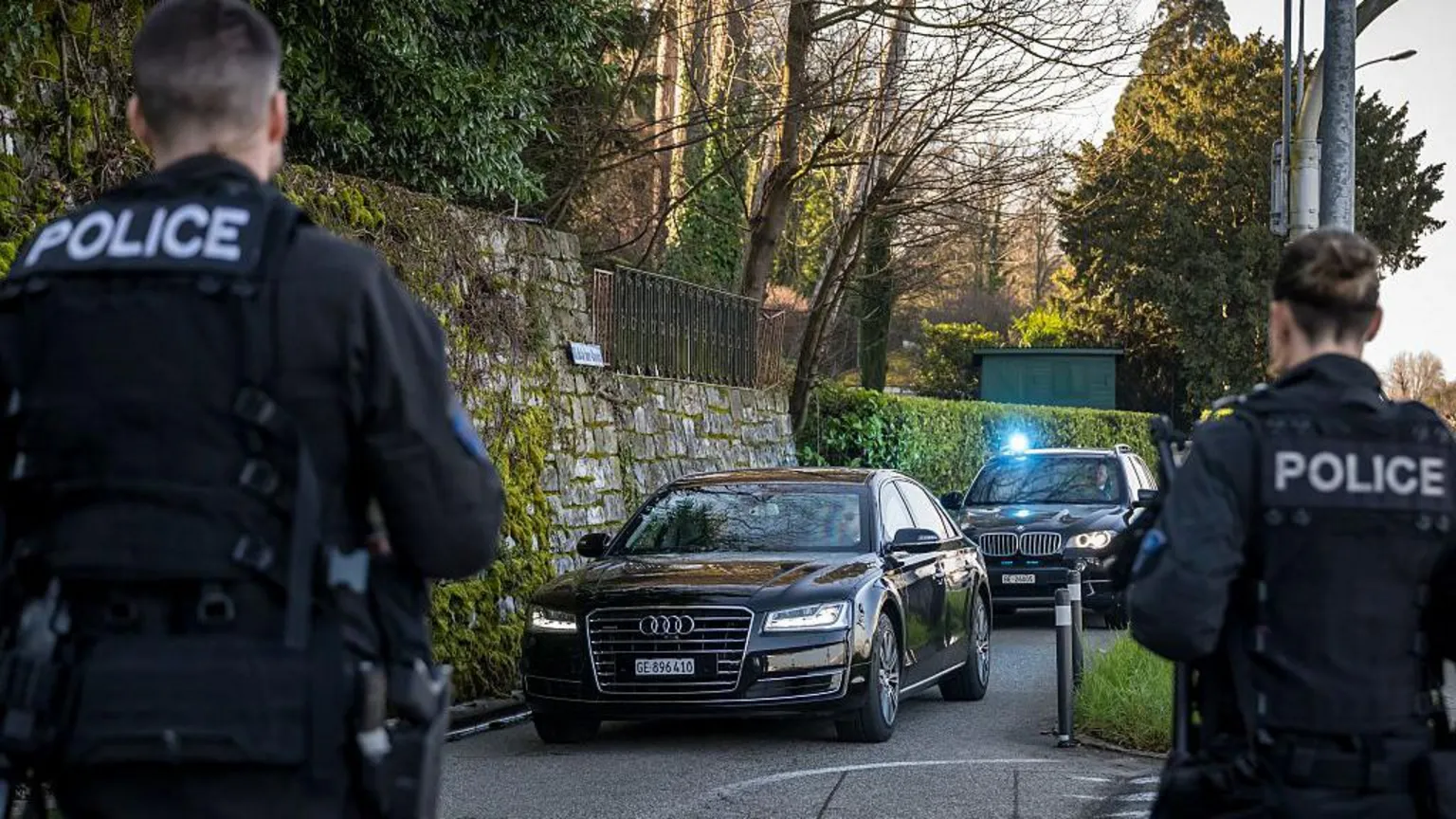
US and Iranian officials have begun a third round of indirect talks in Geneva, negotiations widely viewed as pivotal to averting a broader conflict, as President Donald Trump has renewed threats of military action if a nuclear agreement cannot be reached.
The talks are taking place against the backdrop of the largest US military build-up in the Middle East since the US-led invasion of Iraq in 2003, with Iran warning that it would respond forcefully to any attack on its territory.
Once again, the discussions are being mediated by Badr Albusaidi, Oman’s foreign minister. He said negotiators from both sides had shown what he described as “unprecedented openness to new and creative ideas and solutions,” though the prospects for a deal remain uncertain.
Despite repeated assertions from Trump that he prefers diplomacy, the US president has also said he is considering a limited military strike on Iran to pressure its leadership into accepting an agreement. He has offered little public detail about his specific demands or why military action could be necessary now, eight months after US forces bombed Iranian nuclear facilities during a war between Israel and Iran.
Iran has firmly rejected Washington’s demand that it halt uranium enrichment entirely on its own territory. However, there are indications that Tehran may be willing to make certain concessions related to the scope and oversight of its nuclear programme.
As with the previous two rounds of talks earlier this month, Iran’s delegation is being led by Foreign Minister Abbas Araghchi. The US side is represented by special envoy Steve Witkoff and Trump’s son-in-law, Jared Kushner.
In recent weeks, the US has deployed thousands of additional troops to the region, along with what Trump has described as an “armada” of military assets. These include two aircraft carriers, accompanying warships, fighter jets, and refuelling aircraft.
Trump first publicly threatened to bomb Iran last month, during a period when Iranian security forces were violently suppressing anti-government protests that left thousands dead. Since then, however, the administration’s focus has shifted back to Iran’s nuclear programme — a source of tension between Tehran and the West for decades.
The US and Israel have long accused Iran of secretly seeking to develop nuclear weapons. Iran maintains that its nuclear activities are strictly for peaceful purposes, although it remains the only non-nuclear-armed country to have enriched uranium to near weapons-grade levels.
In his State of the Union address to Congress on Tuesday, Trump briefly addressed the standoff with Iran but did not clearly outline the rationale for possible strikes. He claimed Iran was developing missiles that would “soon” be capable of reaching the United States, without providing supporting details. He also accused Tehran of attempting to revive its nuclear weapons ambitions after last year’s strikes and said he could not allow what he called “the world’s number one sponsor of terror” to possess a nuclear weapon.
The US struck three Iranian nuclear sites last June as part of a coordinated bombing campaign with Israel. At the time, Trump said the facilities had been “obliterated.” Iran, however, says its enrichment activities ceased after the attacks and has refused to allow inspectors from the International Atomic Energy Agency to access the damaged sites.
“They want to make a deal,” Trump said, “but we haven’t heard those secret words: ‘We will never have a nuclear weapon.’”
Just hours before the speech, Araghchi posted on social media that Iran would “under no circumstances ever develop a nuclear weapon.” He added that there was an “historic opportunity to strike an unprecedented agreement that addresses mutual concerns and achieves mutual interests.”
Iranian officials reacted angrily to Trump’s address. A foreign ministry spokesman accused the US of repeating what he called “big lies” about Iran’s nuclear programme, its ballistic missile capabilities, and the number of protesters killed during the crackdown.
While Iran’s specific proposals in Geneva have not been made public, the discussions are expected to include ideas such as forming a regional consortium for uranium enrichment — a concept raised in earlier negotiations — as well as possible arrangements for dealing with Iran’s estimated 400kg (880lb) stockpile of highly enriched uranium.
In exchange, Iran is seeking relief from international sanctions that have severely damaged its economy. Critics of the Iranian government argue that lifting sanctions would provide the clerical leadership with an economic lifeline.
It remains unclear what conditions Trump would accept in a final agreement. Iran has already ruled out negotiations on limiting its ballistic missile programme or ending its support for allied armed groups across the region — a network Tehran refers to as the “Axis of Resistance,” which includes Hamas in Gaza, Hezbollah in Lebanon, militias in Iraq, and the Houthis in Yemen.
US media reports, citing unnamed administration officials, have suggested that Trump may be considering an initial strike on Iran’s Revolutionary Guards or nuclear facilities in the coming days to increase pressure on Tehran. Some reports indicate that if talks collapse, the president could even authorise a broader campaign aimed at toppling Iran’s Supreme Leader, Ali Khamenei.
The Chairman of the Joint Chiefs of Staff is also reported to have warned that military action could draw the US into a prolonged and dangerous conflict. Trump, however, has insisted that the chairman, Dan Caine, believes any such operation would be “easily won.”
Iran has warned that it would retaliate against any attack by targeting US military assets across the Middle East as well as Israel.
US allies in the region have expressed concern that an attack on Iran could spiral into a wider war and have cautioned that air power alone would be unlikely to bring about regime change.
Israeli Prime Minister Benjamin Netanyahu has warned against any agreement that fails to address Iran’s ballistic missiles and its support for regional proxies. Analysts believe Netanyahu, who visited the White House earlier this month, may be advocating for a campaign aimed at dismantling Iran’s ruling system entirely.
The US possesses the world’s second-largest nuclear arsenal, while Israel is widely believed to have nuclear weapons, though it neither confirms nor denies their existence.
Ahead of the State of the Union, Secretary of State Marco Rubio delivered a classified briefing to the so-called “gang of eight” — senior congressional leaders from both parties and the heads of the intelligence committees.
After the briefing, Senate Minority Leader Chuck Schumer issued a brief statement, saying: “This is serious, and the administration has to make its case to the American people.”

