

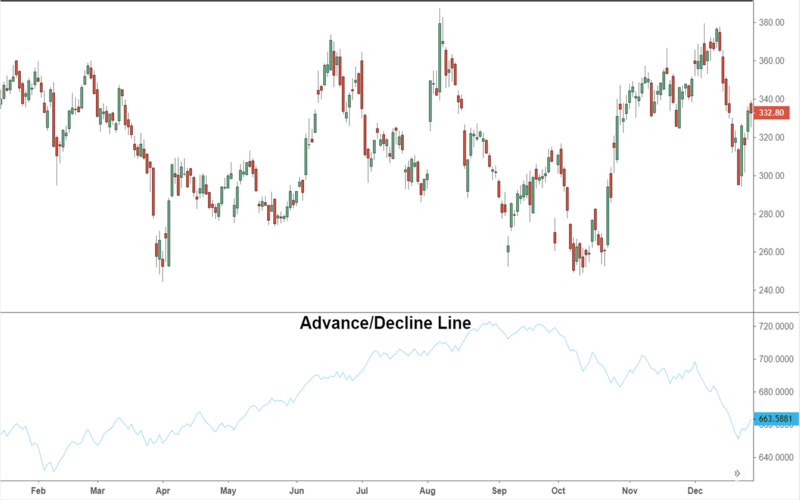
The Advance/Decline (A/D) Line: What Is It?
The difference between the number of advancing and sinking stocks daily is plotted on the advance/decline line (also known as the A/D line), a technical indicator. The indicator is cumulative, meaning that a positive value is added to the previous value, and a negative value is deducted from the previous value.
The A/D line, which informs traders whether more stocks are rising or dropping, displays market sentiment. It is used to validate price patterns in significant indices and can signal reversals when divergence is in place.
The Formula for Advance/Decline (A/D) Line Is:
A/D=Net Advances+{PA, if PA value exists0, if no PA value where:
Net Advances=Difference between the number of daily ascending and declining stocks
PA=Previous Advances Previous Advances=Prior indicator reading
How to Calculate the A/D Line
- Subtract the number of stocks that finished lower on the day from those that finished higher on the day. This will give you the Net Advances.
- If this is the first time calculating the average, the Net Advances will be the first value used for the indicator.
- On the next day, calculate the Net Advances for that day. Add the total from the prior day if positive or subtract if negative.
- Repeat steps one and three daily.
What Can You Infer from the A/D Line?
The strength of a current trend and the chance that it will reverse are both confirmed by the A/D line. The indicator demonstrates if most equities are moving in the same direction as the market.
A bearish divergence occurs when an index rises while the A/D line is trending downward, indicating that the market is losing breadth and might be poised to turn around. The market is considered healthy if the A/D line’s slope is up and heading upward.
On the other hand, if the indexes are still falling and there is a positive divergence (A/D line turning up), it can mean that the sellers are becoming less confident. The likelihood that prices will continue to decline increases if the A/D line and the markets are heading lower simultaneously.
Difference Between the Arms Index (TRIN) and the A/D Line
Usually employed as a longer-term indicator, the A/D line displays the number of stocks increasing and dropping over time. On the other hand, the Arms Index (TRIN), a shorter-term indicator, gauges the proportion of advancing stocks to increasing volume. Both indicators provide traders with various information because of the varied calculations and time frames they concentrate on.
Issues with Using the A/D Line
For NASDAQ equities, the A/D line won’t always give reliable readings. This is because the NASDAQ routinely lists small, speculative businesses, many of which fail or are delisted. The equities remain on the A/D line’s earlier estimated values even when delisted from the exchange. The cumulative prior value is added to future calculations after this. As a result, the A/D line will occasionally decline for prolonged periods, even if NASDAQ-related indexes increase.
You should also know that some indexes are weighted according to market capitalization. This indicates that a company’s influence on the movement of the index increases with its size. The A/D line provides each stock the same weight. As a result, rather than the more scarce huge or mega-cap stocks, it is a better indicator of the ordinary small to mid-cap stock.
Investopedia does not offer tax, investment, and financial services. The material is provided without considering any specific investor’s investing goals, risk tolerance, or financial situation, so it might not be appropriate for all investors. Risks associated with investing include the potential loss of investment.
Conclusion
- An indicator of breadth used to demonstrate how many stocks are taking part in a market rally or drop is the advance/decline (A/D) line.
- A rising A/D line indicates the upswing when major indices rally and display significant involvement.
- When major indices are advancing and the A/D line is descending, fewer stocks are joining the advance, which suggests that the index may be concluding its advance.
- A decreasing advance/decline line indicates that key indices are downtrend.
- Since fewer companies are declining over time when major indexes are declining and the A/D line is rising, the index may be nearing the conclusion of its decline.

