

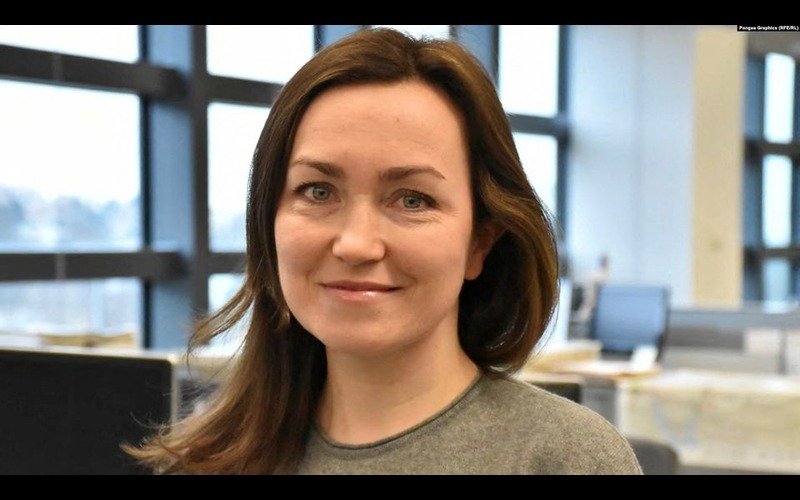
According to the station, a Radio Free Europe/Radio Liberty (RFE/RL) editor was held in Russia for failing to register as a foreign agent while traveling there for a family emergency.
Since the commencement of the war in Ukraine, Russia has increased its control over the media, forcing the closure of renowned independent news organizations and branding several journalists and publications as “foreign agents.”
Nearly all American journalists have fled Russia due to the conflict and the March arrest of Wall Street Journal writer Evan Gershkovich on suspicion of espionage. To escape Russia, the State Department has frequently advised American citizens.
A family issue necessitated Alsu Kurmasheva, a journalist for Radio Free Europe/Radio Liberty’s Tatar-Bashkir Service, to go to Russia on May 20.
Kurmasheva was held, and her passports were taken while she awaited her return aircraft at the end of that trip as she attempted to depart Russia. She was fined for not registering her American passport with the Russian authorities.
RFE/RL reported that Russian officials accused Kurmasheva, who is based in Prague, of not registering as a “foreign agent” on October 18.
The phrase, which has Cold War espionage associations, is used in Russia to describe organizations, journalists, activists, and even pop singers and authors who are thought to be involved in political activism with outside assistance.
Interim RFE/RL president Jeffrey Gedmin said, “Alsu is a highly respected colleague, devoted wife, and dedicated mother to two children.”
“She needs to be released so she can return to her family immediately.”
According to the Russian news service Tatar-Inform, Kurmasheva failed to register as a “foreign agent” while gathering intelligence on Russia’s military action. RFE/RL demanded her release and stated that she might spend up to five years in prison.
Regarding her arrest, the Russian government is still silent.
THE PRESS IN RUSSIA
Some journalists, thinkers, and opposition activists in Russia claim that the liberties gained with the fall of the Soviet Union have been squandered and that nationalistic propaganda dominates public discourse there.
Russian authorities reject these allegations, claiming that Western media has for years failed to portray Russia adequately and has actively slanted its coverage of Russia and the Ukraine conflict to serve the interests of the West.
It aims to “promote democratic values by providing accurate, uncensored news and open debate in countries where a free press is threatened, and disinformation is pervasive,” according to Radio Free Europe/Radio Liberty, which has offices in Prague and Washington.
Through the US Agency for Global Media, a grant from the US Congress provides the funding. RFE/RL provided news to audiences behind the Iron Curtain during the Cold War. According to RFE/RL’s history, the American Central Intelligence Agency’s engagement with the organization ended in 1972.
The arrest of Kurmasheva caused the Committee to Protect Journalists to express its grave concern.
According to Gulnoza Said, the coordinator of CPJ’s Europe and Central Asia program, “CPJ is deeply concerned by the detention of U.S.-Russian journalist Alsu Kurmasheva on baseless criminal charges and calls on Russian authorities to release her immediately and drop all charges against her.” “Journalism is not a crime, and Kurmasheva’s detention proves that Russia is determined to stifle independent reporting.

