

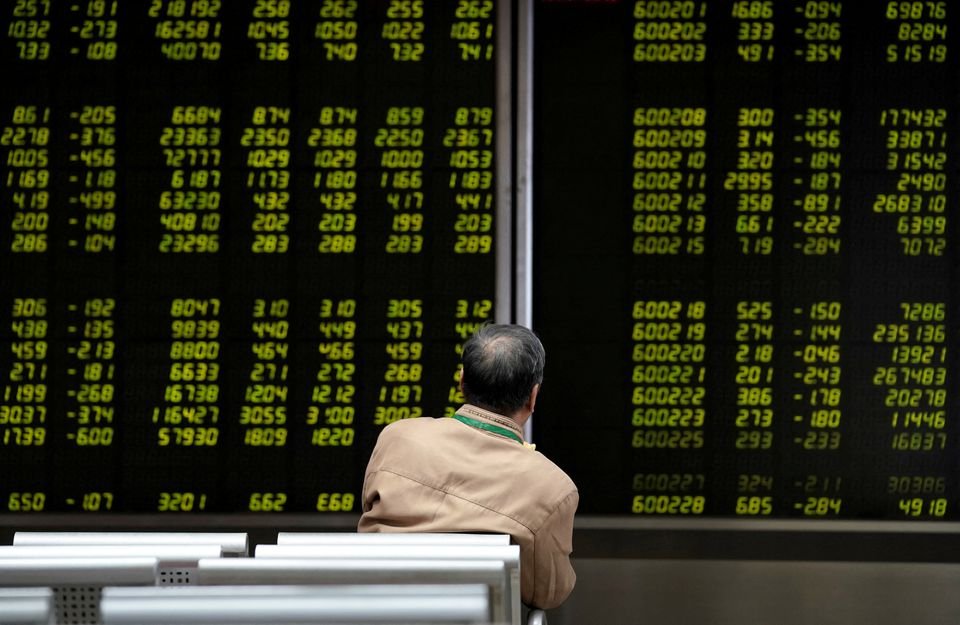
Wayne Cole previews the day’s events in the European and international markets. Asian markets have had a cautious start as Israeli forces, supported by tanks, launched a ground assault into northern Gaza, prompting further global concerns for the safety of civilians.
However, oil prices have decreased, and U.S. equities futures have firmed, indicating that investors are betting that the violence won’t worsen or disrupt the oil supply, at least not for now.
The Bank of Japan’s two-day policy meeting closes on Tuesday, and rumors exist that it may change or scrap its yield curve management strategy. This has caused the Nikkei (.N225) to suffer the most.
Analysts disagree on whether the central bank would take action to enable 10-year bond rates to go further, even though it is peculiar to raise its inflation estimates given that it just spent billions to keep them below 1%.
After rising 11 basis points this month, rates were up 0.88% on Monday, marking a significant shift for the market. The BOJ is pressured to increase the limit or expand the yield trading range.
Most of the talk is that it will remain on hold for the time being, but it will speak about setting the stage for a potential change.
Significant financial organizations, such as Japan’s Dai-Ichi Life Insurance, anticipate a change in BOJ policy early in 2019. Approximately 66% of economists surveyed by Reuters predict the BOJ will stop using negative rates by 2024.
Any change would cause Japanese yields to climb and exacerbate the suffering in the Treasury market, where 10-year rates hardly moved on Monday, reaching 4.87%, with little evidence of a rush for haven assets.
Rather than this, dealers are worried about the amount of fresh issuance that the Treasury will reveal at its refunding this week; an increase is nearly guaranteed given the government’s borrowing requirements.
NatWest Markets analysts predict marketable borrowing of $885 billion in Q4 and $700 billion in Q1. They see rises of $1 billion in 7s, 20s, and 5y and 10y TIPS, $3 billion for 2s, 5s, and 10s, and $2 billion for FRNs, 3s, and 30s.
The bond market was severely rattled when $1.007 trillion in financing requirements for the third quarter were revealed on July 31. This resulted in a substantial rise in auction volumes.
It’s also noteworthy that, despite the economy’s surprising resilience, borrowing continued to increase. The third quarter saw a scorching 8.5% annualized increase in nominal GDP, a rate that China used to brag about and that would typically represent a tax revenue windfall.
Analysts are confident that the Federal Reserve will remain unchanged at its policy meeting this week due to the steep increase in market borrowing costs; futures indicate a 97% likelihood of rates remaining at 5.25–5.5%.
Additionally, the market has factored in 165 basis points of relaxation beginning in the middle of 2024.
This week marks the continuation of the earnings season, with several companies reporting, including Apple (AAPL.O), Airbnb (ABNB.O), McDonald’s (MCD.N), Moderna (MRNA.O), and Eli Lilly (LLY.N). Thus far, the lackluster outcomes have led to the S&P 500’s (.SPX) decline into the correction zone.
Significant events that might affect Monday’s markets include:
- The Bank of Japan starts a two-day policy conference.
- German CPI and GDP statistics, EU business environment
- Appearances by Governor Erik Thedéen of Riksbank and Vice President Luis de Guindos of the ECB
- Treasury releases its projections for borrowing in 2024’s first and fourth quarters.

