

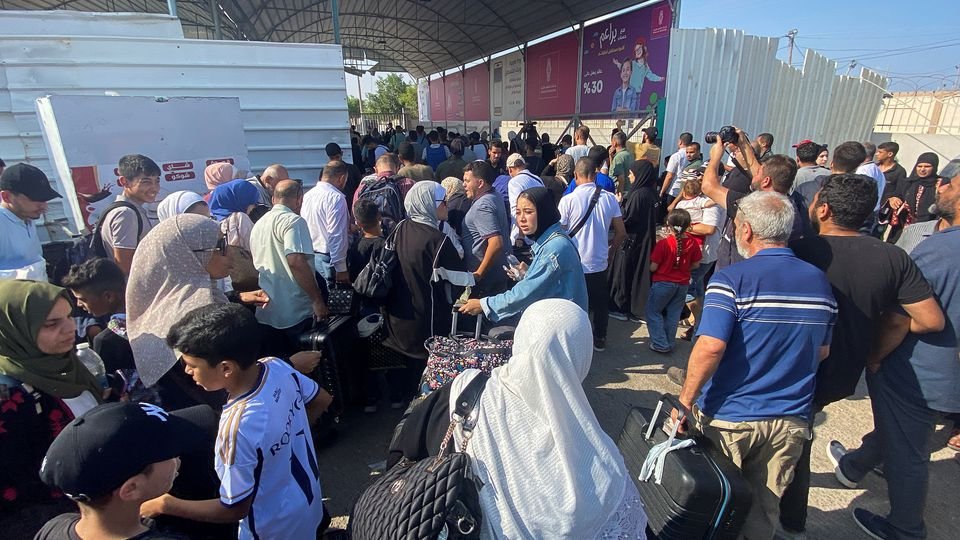
According to Egyptian media and a source at the border, Qatar-negotiated terms allowed the first group of injured Gaza refugees to enter Egypt on Wednesday. At the same time, Israeli forces continued their fight against Hamas terrorists in the Palestinian enclave.
Ambulances carrying the evacuees were driven through the border crossing at Rafah. The agreement that Egypt, Israel, and Hamas have struck will let a handful of foreign nationals and seriously injured individuals evacuate the besieged area. According to Palestinian health sources, an Israeli airstrike on Tuesday killed over fifty individuals at a refugee camp, sparking yet another day of carnage in Gaza. Israel claimed that many more fighters and a top Hamas commander were killed in the strike. After weeks of airstrikes and artillery barrages, Israel sent its soldiers into the Gaza area under Hamas control as punishment for the Islamist organization’s October 7 fatal attack on southern Israel.
Israel is determined to destroy Hamas. However, as food, fuel, drinking water, and medication run out, and hospitals struggle to treat the wounded, the number of civilian deaths in Gaza and the dire humanitarian conditions have raised serious concerns across the world.
Earlier, a security source in Egypt stated that up to 500 foreign passport holders will enter the border at Rafah on Wednesday. According to the source, about 200 individuals were waiting on the Palestinian side of the wall on Wednesday morning. Not everyone was anticipated to show up on Wednesday, according to a second source. They said there was no timeframe for when the crossing would be accessible for evacuation.
According to a Western official, Israel and Egypt have agreed on a list of foreign passport holders who are allowed to exit Gaza, and the appropriate embassies have been notified. Israel was coordinating the evacuation with Egypt, according to an Israeli official who asked to remain anonymous.
According to medical authorities, Egypt has set up a field hospital in Sheikh Zuwayed, Sinai. There were ambulances parked at the Rafah border. However, according to the first source, this agreement had nothing to do with other issues, such as the release of more than 240 captives held by Hamas or a “humanitarian pause” in hostilities, both of which Israeli Prime Minister Benjamin Netanyahu had rejected. Approximately 300 troops and 1,100 civilians were killed in the Hamas offensive on southern Israel on October 7, according to Israeli officials.
According to the Gaza health ministry, since October 7, at least 8,525 Palestinians—including 3,542 children—have died as a result of Israeli reprisal bombings in Gaza.
HIT REFUGEE CAMP
The Israeli military said that Tuesday’s attacks on Jabalia, the biggest camp for refugees in Gaza, had killed scores of Hamas members in addition to Ibrahim Biari, a Hamas leader who was crucial to planning the October 7 attack.
A Hamas statement claimed that 400 Palestinians were killed and injured in Jabalia, which is home to families of refugees from 1948 battles with Israel. Palestinian health officials reported that at least 50 Palestinians had died and 150 had been wounded.
Three international passport holders were among the seven civilian captives who perished in the Jabalia raid, according to the military branch of Hamas, the al-Qassam Brigades. Israel remained silent over the allegation.
The Israeli military said that eleven more Israeli troops had died in battle on Tuesday, marking the most losses in a single day since the original attack. Although he lamented the growing military casualties, Netanyahu predicted a protracted but successful conflict.
“The fight we are in is hard. The fight will be protracted,” he declared in a statement. “I swear to all Israeli citizens: we will complete the task at hand. We’re going to keep going till we win.”
The Israeli military activated sirens in southern villages and the port cities of Ashkelon and Ashdod following an interval of several hours without rocket fire.
POWER DROP
Throughout the night, Israel’s warplanes, tanks, and navy vessels were constantly bombarding Gaza City and its surroundings. In the north, south, and east of Gaza, Israeli ground troops engaged in combat with Hamas and other militant organizations. These incursions appeared to be intended as progressive advances rather than a full-scale invasion.
According to telecoms company Paltel, communications and internet services were shut down in Gaza on Wednesday once more.
Ahmed Muhey, a resident of Gaza, stated, “They don’t want the world to see their crimes against civilians.”
In anticipation of receiving their relatives’ remains for burial, dozens of Palestinians gathered outside the mortuary at Nasser Hospital. Inside, bodies were lying on the ground, ready to be washed of blood and dust and then covered in white shrouds.
Health authorities said that they had received 15 bodies—four of them children—of Palestinians killed in Israeli attacks in Khan Younis during the previous night. “Every day there are dead, and every day there are children or women among them or both,” a physician stated.
Al Shifa Medical and the Indonesian Hospital, two of Gaza’s primary hospitals, lost power due to their generators running out of fuel quickly.
CIRCUMSTANCES
The Palestinians’ ambitions for an independent state and an end to Israel’s occupation remain as far as ever from reality, and the present bloodshed is the worst in years of intermittent fighting. The right-wing administration of Netanyahu has increased Jewish settlements in the occupied West Bank, and peace negotiations are now a thing of the past.
With its pledge to topple the Jewish state, Hamas poses an existential threat to Israel. Ahead of his Friday visit to Israel, U.S. Secretary of State Antony Blinken stated that should Hamas terrorists be driven from power, the United States and other nations were considering “a variety of possible permutations” for Gaza’s future.
Iran backs several other extremist organizations in the area, including Hamas, and the situation in Gaza has raised concerns about a potential wider escalation. In response to the long-range drone and missile assaults that the Houthis in Yemen have claimed, the Israeli military said on Wednesday that it had stationed missile boats in the Red Sea.

