

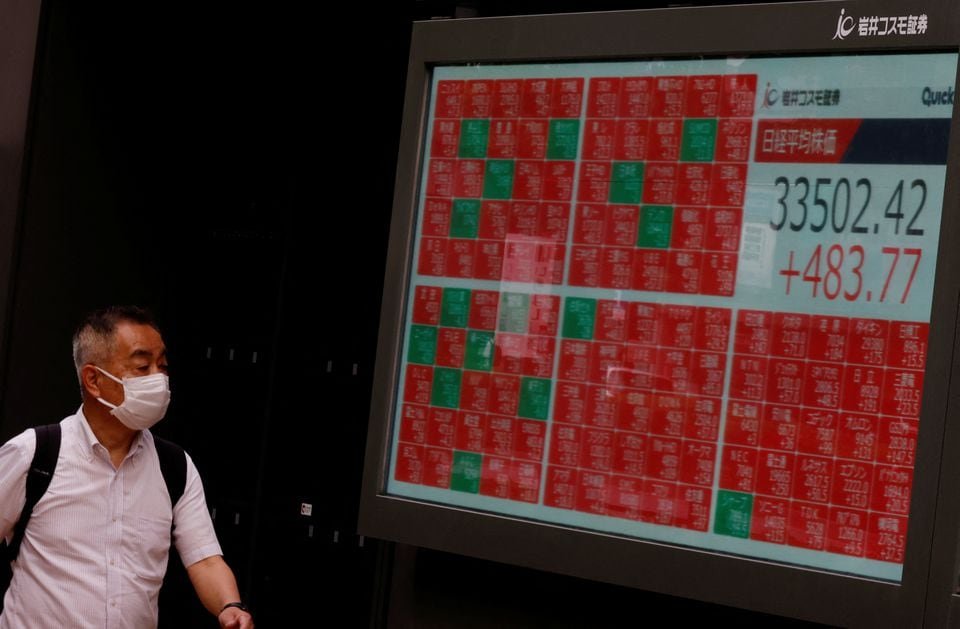
Asian shares rise despite Chinese property slump. Thursday saw a surge in Asian stock markets and a strengthening of the dollar even though foreign investors once again dumped the problematic mainland Chinese real estate market. With a 0.1% increase, MSCI’s broadest index of Asia-Pacific equities outside of Japan (.MIAPJ0000PUS) is now up 4.3% for the month.
Benchmark 10-year Treasury note yields have risen to 4.4902% from their Wednesday closing U.S. price of 4.508%. In contrast to the U.S. closing of 4.936%, the two-year yield, which grows in tandem with traders’ forecasts of increasing Fed fund rates, hit 4.9277%.
The Nikkei stock index in Japan (.N225) increased by 1.53%, while Australian shares (.AXJO) gained 0.26%. China’s blue chip CSI300 Index (.CSI300) was up 0.1% in the afternoon, but Hong Kong’s Hang Seng Index (.HSI) gave up an early gain and was down 0.25%.
Following a day of gains in the majority of significant equities due to a Reuters story stating that the Chinese government had urged Ping An Insurance Group to acquire a controlling share in Country Garden Holdings (2007. H.K.), the problematic property industry in China is being keenly monitored on Thursday.
A representative for Ping An (601318. S.S.) refuted the Reuters article that named four people with knowledge of the proposal and stated that the business had not received any approaches from the government.
The Hong Kong developers-focused Hang Seng Properties Index (.HSNP) was down 0.7% on Thursday, while the Hang Seng Mainland Properties Index (.HSMPI) was down 3.73%.
Jason Lui, Head of APAC Equity & Derivative Strategy at BNP Paribas, stated, “I think there are so many unknowns that for equities investors, they are still shying away from Chinese property.”
“It is challenging to expect investors to return to the days before the real estate bubble burst; property will essentially have a completely different position in the future development of the Chinese economy.
“Property needs to stop being a drag on GDP and sentiment so investors can move on to the real growth drivers.” The German DAX futures were down 0.05%, the FTSE futures were down 0.16% at 7,401.5, and the pan-region Euro Stoxx 50 futures were up 0.1% in early European trades.
S&P 500 e-mini futures for U.S. stocks were down 0.06% at 4,396.8. According to official data, China’s October inflation rates, released on Thursday, decreased 0.1% from September and 0.2% from a year earlier. At 150.93, the dollar fell 0.03% vs the yen. It is heading back toward October 31’s high of 151.74, which was reached this year.
The dollar index, which measures the value of the U.S. dollar relative to a basket of the currencies of other significant trade partners, increased to 105.51 today. In contrast, the European single currency gained 0.0% at $1.0708, marking a gain of 1.25% in a month.
Due to growing confidence that the Fed has stopped hiking rates, the dollar has recovered from last week’s severe sell-off. There is less consensus on the possibility of a rate reduction given that inflation is still higher than the 2% objective set by the U.S. Federal Reserve.
Wall Street saw gains of 0.10% for the S&P 500 (.SPX) and 0.08% for the Nasdaq Composite (.IXIC). 0.12% was lost by the Dow Jones Industrial Average (.DJI).
For the eighth day in a row, the S&P 500 increased, continuing its longest winning streak in two years. The Federal Reserve is scheduled to meet again in the middle of next month. Last week, the Fed maintained the benchmark overnight interest rate in the current range of 5.25% to 5.50%.
The weekly unemployment claims data from the United States, released on Thursday, will be keenly examined as a gauge of the health of the labor market in the nation. According to economists, claims are expected to reach 219,000 after hitting 217,000 the previous week.
Concerns over declining demand in China and the United States caused oil prices to drop by more than 2% on Wednesday to their lowest point in almost three months.
U.S. crude increased by 0.15% to $75.44 a barrel during Asian trading on Thursday. A barrel of Brent oil rose to $79.68. Gold dropped a little. The spot price of gold was $1948.9332 an ounce.

