

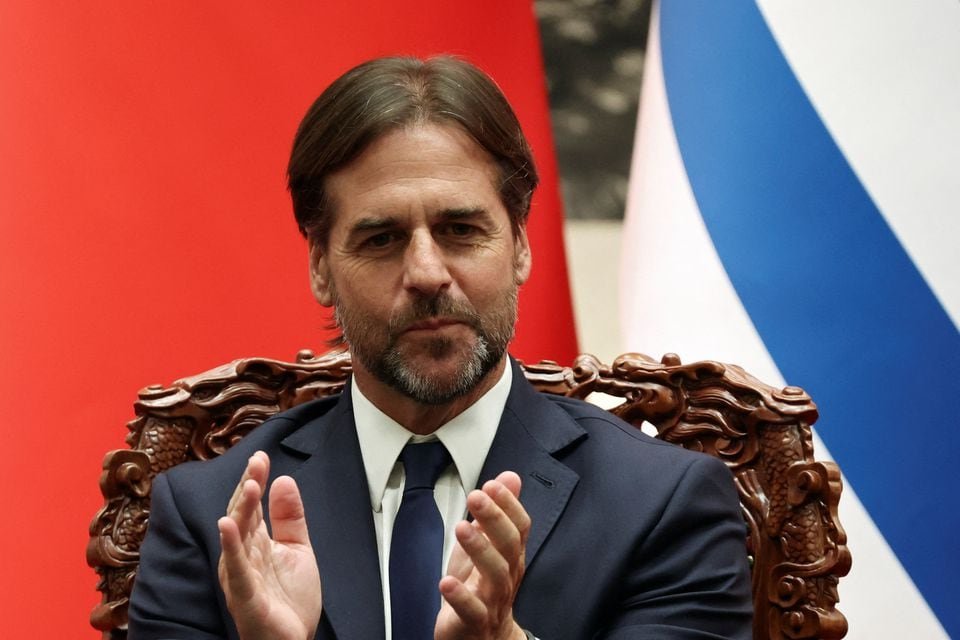
According to a joint statement, the President of Uruguay, Luis Lacalle Pou, and the Premier of China, Li Qiang, are eager to continue working on a bilateral free trade deal and explore one between China and the larger Mercosur trading group.
The declaration comes after the two leaders met on Thursday in Beijing and after China and Uruguay elevated their bilateral connection to a “comprehensive strategic partnership” this week, bringing Montevideo’s ties with Beijing to the same level as those of Argentina and Brazil. The meeting between the two leaders took place in Beijing.
It is believed that Beijing is particularly interested in a free trade agreement with Mercosur because such an agreement may put pressure on Paraguay, the only South American nation that still has relations with Taipei, to reconsider its ties with Taiwan, which China considers to be a part of its territory.
In the statement, it was said that China and Uruguay were dedicated to working toward establishing a bilateral free trade agreement (FTA), and it was mentioned that a feasibility study conducted by both countries had been finished.
“At the same time, the two sides are willing to promote China-Mercosur FTA talks,” the statement stated. In 2021, Lacalle Pou initially proposed a bilateral free trade agreement (FTA) with China to provide its exporters with prospects comparable to those enjoyed by exporters from Chile, Costa Rica, Ecuador, and Peru. These nations have successfully negotiated tariff-free access to the economy of the world’s second-largest nation.
According to a summary of the meeting published in Chinese official media, Lacalle Pou stated, “Uruguay is firmly committed to close relations with China and active participation in the Belt and Road Initiative (BRI).”
According to reports published in Chinese media, he also stated that Uruguay was “willing to… accelerate establishing an FTA between Uruguay, Mercosur, and China.”
However, Uruguay is up against tough competition from sister Mercosur members Argentina, Brazil, and Paraguay, all of whom favor having their bloc negotiate an FTA with Europe rather than Uruguay. In November 2016, they warned that they could resort to “measures” against Uruguay if the country continued with its ambitions to unilaterally negotiate an FTA with China.
Both Montevideo and Beijing will need to overcome considerable political obstacles before it will be feasible for either country to join a significant trans-Pacific free trade treaty that China is also interested in joining. Uruguay has applied to become a member of the pact.
According to what I reported, China and Uruguay should view the signing of cooperation papers related to the Belt and Road Initiative as a chance to support a steady expansion in bilateral commerce. According to figures provided by the United Nations Comtrade, China was responsible for 27% of Uruguay’s exports in 2022.
Currently, a 12% tax is placed on Uruguayan beef, which accounts for two-thirds of those shipments to China. Other significant beef exporters, such as Australia and New Zealand, which have free trade agreements with China, pay 3.3% and 0% tariffs, respectively.
In 2006, Uruguay’s government came very close to negotiating a free trade agreement (FTA) with the United States; however, it ultimately decided against doing so out of concern that it would be kicked out of Mercosur if it did so.
Research that was carried out in 2021 by the National Meat Institute of Uruguay found that if China agrees on a free trade agreement (FTA) with Uruguay, the meat sector would be able to impose a preferential tariff of 0%, which would result in a reduction of tariffs of $150 million.

