

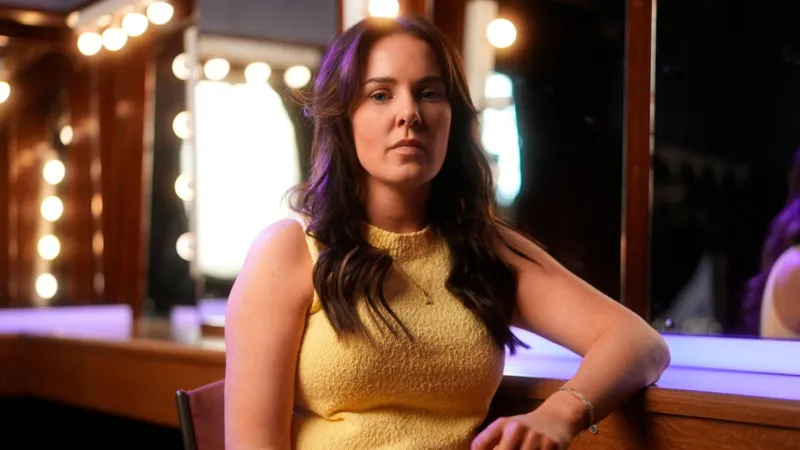
Abbie Draper’s life was moving quickly and in a positive direction.
She had just reached the finals of the Miss Scotland competition and had begun a new career as a flight attendant, travelling across the world. Everything felt like it was falling into place.
Then, toward the end of 2014, a single Facebook friend request arrived — and it would go on to dominate the next decade of her life.
At the time, Abbie was back in her hometown of Kilmarnock, visiting her grandfather after he had suffered a stroke. The friend request came from a man named David Graham, who claimed to be the doctor treating her grandfather.
Abbie remembers the profile photo clearly.
“He was a really good-looking guy,” she says.
The account appeared legitimate. David Graham had friends, posted photographs from inside the hospital, and shared videos featuring a niece he spoke about fondly. Everything about the profile seemed authentic.
But Abbie’s mother raised doubts. She told her daughter she had never seen this doctor on the ward.
Not long afterward, Abbie heard from David again. She had started a dance group and had been posting videos of rehearsals online. David told her he was organising a charity ball at a Glasgow hotel and was searching for dancers to perform.
Abbie agreed and shared the promotional material he sent her across social media.
Almost immediately, she received a warning message.
“Whatever you do, don’t trust David Graham.”
Alarmed, Abbie decided she needed proof. She contacted the hotel directly and was told there was no charity ball scheduled and no record of the event.
By now, suspicion had turned into certainty. Abbie began digging deeper into David Graham’s identity.
She searched the medical register — his name was not listed.
If he wasn’t a doctor, then who was he?
Determined to find out, Abbie examined his Facebook profile more closely, contacted women who were connected to him online, and created a private Facebook group chat she called “007”.
One woman mentioned that David had once called her while she was on holiday in Marbella. During that call, he handed the phone to someone named Adele.
Abbie didn’t recognise the name at first — until she realised Adele was a woman from Kilmarnock, the same age as her, who worked as a nurse.
Abbie searched Facebook and instantly recognised her face.
“She worked in my grandad’s hospital,” Abbie says.
“I had seen her standing beside him on the ward.”
The realisation was horrifying.
By the end of 2014, Abbie contacted the hospital and told them that one of their nurses was impersonating a doctor online. She says staff did not believe her.
So she went to the police.
“I was in the police station for four or five hours,” she recalls.
“They told me she hadn’t really done anything criminal.”
Officers explained that catfishing — creating a false online persona — was not illegal unless it involved fraud, threats, or intimidation.
Frustrated and determined, Abbie posted publicly on Facebook that David Graham was fake and that he was actually a woman named Adele Rennie.
What followed shocked her.
Her inbox filled with messages from women across the area, many describing experiences that were similar — and in some cases far worse.
“That’s when I realised this was much bigger than I thought,” Abbie says.
Adele Rennie, a nurse on the stroke ward where Abbie’s grandfather was being treated, would later be described as Scotland’s most prolific catfish.
Investigators believe up to 100 women were affected. Some were persuaded to send intimate photographs, which were then used to threaten them when they tried to end contact.
A new three-part BBC documentary, The Beauty Queen and the Catfish, features six victims whose experiences span more than 15 years.
One of them is Samantha — not her real name — who received a friend request from David Graham in 2015.
Messages followed quickly. David talked about his work caring for patients, sent photographs from inside the hospital, and came across as warm and attentive.
“He was friendly and chatty,” Samantha says.
Soon they were speaking on the phone regularly. Gifts began to arrive. Flowers were delivered every few weeks — always by the same woman, who introduced herself as Ashley.
Ashley reassured Samantha that David was “a really good guy” and told her she was lucky.
Samantha wanted to meet David in person, but there was always an excuse. Instead, he insisted on constant phone contact. He would call early in the morning and stay on the line for hours, then continue texting throughout the day.
As the relationship progressed, his behaviour became controlling. He grew angry when Samantha didn’t respond immediately and demanded to know her whereabouts.
Eventually, David agreed to meet after a concert.
When Samantha arrived, she saw Ashley the florist, who said David had gone to the toilet. He never returned.
They tried calling him repeatedly. He didn’t answer.
Samantha drove Ashley home and called David again. This time he answered, apologised, and claimed he had bumped into friends and left with them.
“That didn’t make sense,” Samantha says.
Desperate for answers, Samantha devised a plan.
David promised her a birthday present. She asked him to deliver it to her mother’s house. Her mother waited in the dark to see who arrived.
She couldn’t see the driver clearly, but she noted the registration number of a red Vauxhall Corsa.
Samantha then worked out where David usually parked near the hospital and waited.
As the car arrived, Samantha was on the phone to David.
When the driver stepped out, she was stunned.
“It was the florist,” she says.
“It sent shivers through me.”
David Graham had never existed. The voice Samantha had fallen for was created using a voice-changing app.
For Abbie, the obsession took a heavy personal toll.
Her grandfather, John Draper, died in 2015.
“I lost months with him,” she says.
“All that energy I spent chasing Adele should have been time with my grandad.”
After police visited Adele, David Graham’s profile disappeared and the messages stopped — briefly.
Then Abbie was alerted that the same account photos were being used on Tinder under a new name: Matthew Mancini.
“It wasn’t just happening again,” Abbie says.
“It was getting worse.”
Following an internal hospital investigation and mounting complaints, police arrested Adele Rennie in November 2015.
She later pleaded guilty to 18 offences involving 10 victims, including indecent communication, sexual coercion, and stalking.
In December 2017, Rennie was sentenced to 22 months in prison and placed on the sex offenders register for 10 years.
Victims felt the punishment did not reflect the harm done.
“What we all wanted to know was why,” Abbie says.
Rennie was released in October 2018, but within months she came to police attention again after a victim reported a suspicious dating profile.
This time she was posing as a wealthy lawyer and convincing women to send explicit images.
She was jailed again in 2019 for three years.
Rennie’s mother, Christine, appears in the documentary and says she was devastated.
“I was mortified and ashamed,” she says.
“You don’t want to believe your child is capable of this.”
After Rennie’s release in May 2021, Christine believed her daughter had changed.
“She said she felt different,” she recalls.
“She was hopeful about the future.”
For Abbie, life also moved on. She had two children and heard nothing about Rennie for four years.
Then, in October 2023, she received another message.
“Who do you think this sounds like?”
A Facebook group called Are We Dating the Same Guy? had flagged a suspicious Tinder profile. The photo matched David Graham’s old image.
Abbie posted a warning on Instagram.
The next day, Adele called her.
“She asked why I was bringing her name up again,” Abbie says.
“She told me I had it wrong.”
Abbie admits she questioned herself.
“Was I obsessed? Was I trying to ruin her life?”
But she couldn’t ignore the pattern.
The new profile — Callum Crolla — had uploaded a photo of a woman at a London concert to provoke jealousy in another victim.
Abbie tracked down the woman in the image. Her name was Eilish, and she had never heard of Callum Crolla.
When Eilish sent concert videos, Abbie spotted a familiar face dancing in the crowd.
It was Adele Rennie.
Within 24 hours, Rennie was arrested and charged with stalking, deception, and sexual coercion. In July 2024, she was jailed for a third time.
Cyber psychology expert Dr Nicola Fox Hamilton says such behaviour is difficult to explain.
“Early childhood experiences are often a significant factor in catfishing,” she says.
Rennie later told her mother about trauma she experienced growing up. Christine says her first marriage was abusive and that Adele’s father died by suicide when Adele was six — a truth she was not told at the time.
In January last year, Rennie was released again, having served half her sentence.
Ten days later, she was arrested for breaching release conditions by contacting a former victim.
She was sent back to prison and ordered to serve the remainder of her sentence plus an additional 100 days.
Rennie, who is due for release in March, provided a statement to the documentary.
She apologised and accepted responsibility, saying her actions had traumatised innocent women.
“I should never have projected my inner turmoil onto others,” she said.
Abbie says closure will only come when the behaviour finally stops.
“Prison doesn’t give closure,” she says.
“It just pauses things.”
“I’d really like to say — case closed.”

