

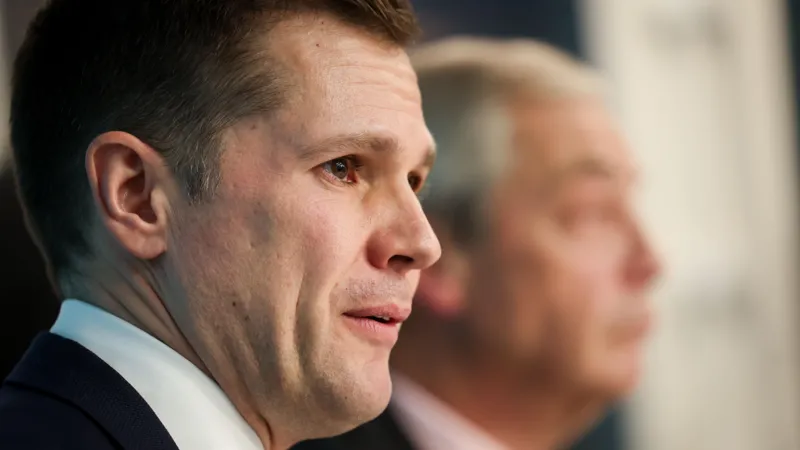
Only weeks ago, Robert Jenrick dismissed speculation about his political future, insisting he was not planning to leave the Conservative Party despite persistent rumours linking him to Reform UK.
That position has now dramatically changed. The former cabinet minister has formally joined Nigel Farage’s party, a move confirmed just hours after Conservative leader Kemi Badenoch removed him from her shadow cabinet amid accusations that he was preparing to defect.
Jenrick, who had been serving as shadow justice secretary, said he first contacted Farage four months ago after reaching what he described as a “painful realisation” that the party he joined at the age of 16 was no longer capable of repairing the country.
Farage, however, suggested the timing of events was not entirely deliberate, arguing that Badenoch had acted prematurely by dismissing Jenrick before a final decision had been made.
Nevertheless, the switch brings to a close months of intense speculation about the 44-year-old MP’s future, as the Conservatives continue to lag behind Reform UK in opinion polls since Badenoch took over the party leadership.
Jenrick’s removal follows a period of growing tension within the party. He narrowly lost the Conservative leadership contest to Badenoch in 2024, a defeat that former colleagues say he found difficult to accept.
Since then, he has been highly visible, remaining in near-constant campaign mode. Although he accepted the role of shadow justice secretary, he frequently spoke beyond the scope of the brief, particularly on immigration and the courts.
He steadily shifted further to the right on immigration policy, attempting to outpace Reform’s rhetoric and build momentum online. This marked a striking evolution for the Newark MP, who voted to remain in the European Union in 2016 and was once mockingly labelled “Robert Generic” by critics within his own party for his centrist instincts.
During the leadership race, Jenrick called for Britain to withdraw from Europe’s main human rights treaty as a way to tackle illegal migration. Badenoch initially rejected the idea, only to later adopt the position herself.
As shadow justice secretary, Jenrick became increasingly vocal in criticising court decisions in immigration cases, frequently accusing judges of political activism.
He also cultivated a strong social media presence, drawing attention through confrontational videos in which he challenged fare dodgers on London Underground trains and filmed illegally dumped rubbish in Labour-run Birmingham.
His remarks about Birmingham’s Handsworth area, which he described as “one of the worst-integrated places” he had encountered, sparked widespread controversy and further raised his profile.
Early life and background
Born in Wolverhampton in 1982, Jenrick was raised in Shropshire and Herefordshire and educated at a private school. His father worked as a gas fitter, while his mother was employed as a secretary.
He studied history at Cambridge University, graduating with first-class honours, and wrote for a student newspaper during his time there.
After university, he pursued a career as a corporate lawyer, working in both London and Moscow, before moving into the art world as an international managing director at auction house Christie’s.
His first attempt to enter politics came in 2010, when he unsuccessfully contested the Staffordshire seat of Newcastle-under-Lyme for the Conservatives.
Four years later, he entered Parliament following a by-election in Newark triggered by a cash-for-questions scandal. He defeated a challenge from Nigel Farage’s UK Independence Party, which was then enjoying strong polling numbers.
Jenrick has held the Nottinghamshire seat ever since, presenting himself as a Midlands-focused politician with what he has described as an “unashamedly provincial” outlook.
“I think normal people, like those in Newark, have been badly let down by the political class throughout my adult life,” he recently told the Financial Times.
He is married to Michal Berkner, an Israeli-born, US-educated corporate lawyer. The couple have three daughters, whom they are raising as Jewish.
At the Conservative Party conference in 2024, Jenrick revealed that one of his daughters has the middle name Thatcher, in honour of the former prime minister.
He has been an outspoken supporter of Israel’s military campaign against Hamas and Hezbollah and has urged the UK government to move its embassy from Tel Aviv to Jerusalem.
In 2022, following Russia’s invasion of Ukraine, Jenrick and his family hosted a Ukrainian refugee family in their home, becoming the first MP’s household to do so.
More recently, he disclosed that he had briefly used the weight-loss drug Ozempic for around six weeks but said he stopped because he disliked the experience. He later said he lost four stone over a year through diet and exercise.
“Frankly, I was overweight,” he told Politico, adding that his weight loss was achieved through lifestyle changes.
Ministerial career and controversies
Jenrick’s early Westminster roles included serving as a parliamentary aide to senior ministers such as Michael Gove, Liz Truss and Amber Rudd. He later spent 18 months as a junior Treasury minister under chancellor Philip Hammond.
Despite voting to remain in the EU in the 2016 referendum, he has since described Brexit as the most significant achievement of the last Conservative government.
In 2019, while serving as housing, communities and local government secretary, he became embroiled in controversy over a planning decision involving a £1bn development on the Isle of Dogs proposed by property developer and Conservative donor Richard Desmond.
Jenrick overruled a decision blocking the project shortly before Desmond made an additional party donation. It later emerged the two men had been seated together at a fundraising dinner weeks earlier. Although Jenrick denied wrongdoing, the decision was ultimately overturned.
During the Covid lockdown, he faced criticism after travelling 150 miles from London to his Herefordshire home and then a further 40 miles to deliver supplies to his parents. Downing Street defended him at the time, and he continued to be deployed as a key media spokesperson during difficult periods for the government.
However, Boris Johnson removed him from the cabinet during a reshuffle in September 2021.
He returned to government a year later as a health minister under Liz Truss, despite being a supporter of Rishi Sunak. When Sunak became prime minister, Jenrick was appointed immigration minister and attended cabinet meetings.
Some observers believed he had been placed in the Home Office to restrain then-home secretary Suella Braverman, known for her hardline stance. Instead, the two found common ground, having known each other from Cambridge and attended each other’s weddings.
Jenrick later acknowledged that his time in the Home Office hardened his views on immigration, influenced by what he said he learned about the system’s failures.
In December 2023, he resigned from Sunak’s cabinet, arguing that emergency legislation to deport asylum seekers to Rwanda was inadequate and would not succeed.
From that point onward, he became one of the most vocal critics of his party’s record on immigration.
Badenoch initially tolerated Jenrick’s increasingly independent stance, including his calls for the Conservatives to adopt a less confrontational approach toward Reform UK. She also defended him against accusations of racism following the Handsworth controversy.
But her patience appeared to run out this week, as evidenced by a video announcement confirming his expulsion from the party.
At the press conference announcing his defection, Jenrick said he still had “respect” for Badenoch, while sharply criticising former colleagues Sir Mel Stride and Dame Priti Patel for their time in government.
The former minister has said he does not intend to trigger a by-election following his switch and will now attempt to rebuild his political career within Reform UK after more than a decade as a Conservative MP.

